Political Ideology Atlas · All ideologies · Take the test
Patria Grande
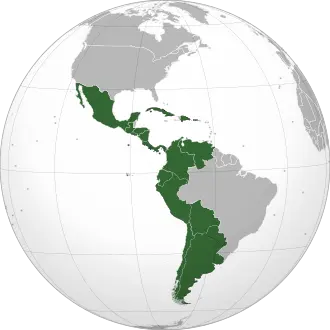
Patria Grande is the idea that the Spanish- and Portuguese-speaking nations of the Americas form one homeland, and that their fragmentation lets outside powers dominate them, so their independence depends on unity. Manuel Ugarte set it out in La Patria Grande (1922) and opposed outside domination, chiefly that of the United States (s7). Videla places Ugarte among the continental nationalists of 1924-1955 (s6). Ribeiro takes the term up for Latin America (s8). Rebelión (s4) quotes Perón's 'unidos o dominados' and names Fidel Castro and Hugo Chávez as taking up the flag of unity.
What it stands for
- Using a country's armed forces for wider policy goals is a misuse of military power.
- Trade unions may be subject to state direction of their affairs.
- Countries within one civilization should unite politically.
- Society should follow a third course beyond capitalism and communism.
- The government should steer investment into industries it sees as key to the country's future.
- A country can miss out on lasting gains when barriers to international commerce come down.
Key works
- La Patria Grande, Manuel Ugarte
Closest ideologies
- Person Dignity Theory (91% match)
- Zionism (90% match)
- Integral humanism (Hindu nationalism) (90% match)
- Putinism (90% match)
- Three Principles of the People (90% match)
People closest to it
- Abraham Lincoln (91% alike)
- Jean-Jacques Rousseau (91% alike)
- Mahmoud Ahmadinejad (90% alike)
- Joseph Smith (90% alike)
- Mahathir Mohamad (90% alike)
Key positions
- Strongly: Using a country's armed forces for wider policy goals is a misuse of military power.
- Strongly: Trade unions may be subject to state direction of their affairs.
- Strongly: Countries within one civilization should unite politically.
- Strongly: Society should follow a third course beyond capitalism and communism.
- Strongly: The government should steer investment into industries it sees as key to the country's future.
- Strongly: A country can miss out on lasting gains when barriers to international commerce come down.
- Strongly: Employers and workers should treat each other as partners whose cooperation comes before conflict, even where their interests differ.
- Strongly: My country should stay neutral and join neither of the opposing great-power alliances.
- Strongly: Countries should start from a policy of staying out of other countries' internal affairs.
- Strongly: Conflict between social classes ends once a society becomes socialist.
- Strongly: At least one other influence has shaped history as much as conflict between economic classes has.
- Strongly: The law should impose no restrictions on strikes.
- Strongly: Countries that feel dominated by Western powers should band together to resist them.
- Strongly: Genes are not the main cause of differences in average ability across racial groups.
- Strongly: People of different races should not be discouraged from forming a family together, including through marriage and children.
- Strongly: Groups have rights of their own.
- Strongly: Elected governments need not leave monetary policy to central banks acting on their own.
- Strongly: Central banks should keep a role in controlling the money supply.
- Strongly: No society has the right to rule another for its supposed improvement, however advanced it is.
- Strongly: Countries should keep their armed forces.
- Strongly: Each country should hold ultimate authority over its natural resources, without foreign interests controlling them.
- Strongly: Overseas territories need not be run mainly for the ruling country's economic benefit.
- Strongly: A weaker state need not formally treat a stronger power as its superior.
- Leans: Political leadership should belong to the country's original peoples.
- Leans: Long-term residents without citizenship have a say in the places where they live.
- Leans: The country's majority national group should have the leading role in controlling economic life.
- Leans: People should gain political representation through social bodies such as families, local communities and occupational associations instead of political parties.
- Leans: Newcomers should adopt the host nation's culture in place of their original culture.
- Leans: Capitalism did not build the productive power and wealth that a better society can rest on.
- Leans: Taxes on imports should shield domestic producers from foreign competition.
- Leans: Working-class political parties should campaign for reforms within capitalism.
- Leans: Defense should rest with armed ordinary citizens, not a standing force.
- Leans: New oil and gas wells and coal mines should be permitted.
- Leans: At its core, politics is a struggle between spiritual good and evil.
- Leans: A country should not tie itself to other countries through lasting military alliances.
- Leans: Peoples who share an ethnic heritage, such as the Slavic, Arab or Turkic peoples, should come together in one state, even across present borders.
- Leans: Democracy is best even when voters make poor choices.
- Leans: The government should be able to require citizens to serve in the military.
- Leans: Workers should form political alliances with business owners who oppose foreign domination.
- Leans: Immigration should favour people who already share the country's culture.
- Leans: Property should belong to many people in small holdings.
- Leans: The farmers who work large estates should take ownership from the landowners, with the transfer compulsory if owners refuse.
- Leans: State schools need not steer pupils away from belief in God.
- Leans: Industries such as energy, rail and utilities should be owned by the state or public bodies, not private companies.
- Leans: Government should have other tasks besides protecting people from physical violence.
- Leans: Politics should prioritise a single common good identified by reasoning over compromises among organised interests.
- Leans: Officials decide what gets made and who gets it at least as well as prices and competition do.
- Leans: Government should impose strict rules on how corporations operate.
- Leans: The state should stop foreign buyers from taking over key national businesses.
- Leans: Government should take sides on how people live, backing the ways of life it judges good.
- Leans: Owners' rights to their property need not be protected against being overridden for public goals.
- Leans: Countries should accept binding international arbitration of their disputes.
- Leans: Society should take active steps to make up for the harm done by past racial injustices.
- Leans: Women should be able to vote and stand for office on the same terms as men.
- Leans: Settlers from abroad who displace a land's people and found a state there are carrying out colonialism.
- Leans: Political independence means little unless the economic and property system is also transformed.
- Leans: A poor country should develop mainly with its own resources.
- Leans: The global economic system keeps poorer countries poor by directing their wealth toward richer countries.
- Leans: A person loses freedom from being at another person's mercy, even if that power is never exercised.
- Leans: Workers are better off for having labor unions.
- Leans: Politics should support people's spiritual well-being.
- Leans: School history should mostly tell the story of the student's own nation.
- Leans: Being allowed to make a choice only counts as freedom if you have the resources to act on it.
- Leans: A people's connection to its ancestral land is spiritual, beyond practical interests or ordinary affection.
- Leans: A people with a shared national identity is entitled to its own self-governing state.
- Leans: There should be a central bank.
- Leans: Political institutions developed in the West are not a suitable model for every civilization.
- Leans: A people split by an imposed border should be brought together in a single state.
- Leans: National policy should give priority to preventing outside powers from splitting the country territorially.