Political Ideology Atlas · All people · Take the test
Europe · born 1712, historical
Jean-Jacques Rousseau
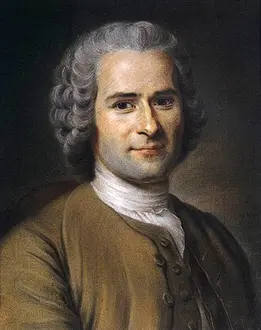
Genevan philosopher of popular sovereignty and the general will (1712-1778)
Rousseau held that legitimate authority rests only on the consent of citizens who make the laws themselves as a sovereign people, with government a subordinate agent and representation of sovereignty rejected. He favoured small republics of modest equality and civic virtue, a civil religion, public education and citizen militias, and condemned luxury, hereditary rule and the corrupting effects of the arts and sciences. He also held that women should be subordinate to men within the family and excluded from public life.
Closest ideologies
Based on the 88 statements where Jean-Jacques Rousseau has a known position.
- Integral humanism (88% match)
- Socialist Conservatism (87% match)
- Person Dignity Theory (87% match)
- Neue Rechte (87% match)
- Confucianism (87% match)
Similar people
- Joseph Smith (88% alike)
- Mahathir Mohamad (87% alike)
- Mahmoud Ahmadinejad (86% alike)
- Abraham Lincoln (86% alike)
- Wang Jingwei (86% alike)
Known positions
- Strongly: One spouse may have more authority than the other within a marriage.
- Strongly: Defense should rest with armed ordinary citizens, not a standing force.
- Strongly: Major laws should be decided by citizens voting on them themselves.
- Strongly: Living in the countryside does more for a person's moral wellbeing than living in a city.
- Strongly: Politics should prioritise a single common good identified by reasoning over compromises among organised interests.
- Strongly: High earners and the very rich should pay tax at a much higher rate than everyone else.
- Strongly: A woman who has sex outside marriage is doing something wrong.
- Strongly: Some institutional ties between government and religion are acceptable.
- Strongly: Technology will not solve most of humanity's problems.
- Strongly: The government should be able to require citizens to serve in the military.
- Strongly: What you owe your community matters more than your personal rights.
- Strongly: Ideas of what men and women are like do not come mostly from culture.
- Strongly: Society may hold back technological change that would overturn established institutions.
- Strongly: Some things are right or wrong for everyone, in every culture and era.
- Strongly: A person loses freedom from being at another person's mercy, even if that power is never exercised.
- Strongly: People are entitled to resist a ruler's unconstitutional exercise of power.
- Strongly: How someone turns out is shaped more by upbringing, society and experience than by the traits they are born with.
- Strongly: An electorate should choose the head of state, either directly or through elected representatives.
- Strongly: People should have a direct role in making decisions where they work, live and study, rather than having those decisions made entirely for them.
- Strongly: A healthy society depends on the traditional family, such as a married mother and father raising their children.
- Strongly: Schools should cultivate patriotic feeling: loyalty to and pride in the nation, expressed for example through respect for its flag and anthem.
- Strongly: Animals can suffer, and that suffering counts in how we treat them.
- Strongly: Constantly seeking additional possessions is harmful overall, despite any benefits it brings.
- Strongly: Public schooling money may go straight to schools instead of to parents as vouchers.
- Strongly: Rulers have a right to rule only because the people they rule have agreed to it.
- Strongly: In war, the enemy's civilians are not legitimate targets.
- Strongly: Very large concentrations of wealth threaten a free society.
- Strongly: Politics should support people's spiritual well-being.
- Strongly: The holy scripture of one's faith is not God's own error-free word.
- Strongly: Being powerful does not mean a country should bring more land within its borders.
- Strongly: Political authority does not ultimately come from God.
- Strongly: School history should mostly tell the story of the student's own nation.
- Strongly: Someone who actually governs a state should not hand that power on to their own child.
- Strongly: Religion does not offer illusory comfort for material suffering.
- Strongly: Laws should not be required to follow religious texts.
- Strongly: Keeping a nation's inherited culture alive, including its language, customs and traditions, matters.
- Strongly: Some decisions should bind people who have not consented to them.
- Strongly: Society needs government of some kind.
- Strongly: Countries should keep their armed forces.
- Strongly: The ruler should be subject to the country's laws.
- Strongly: Collecting taxes does not in itself amount to stealing people's money.
- Strongly: The holder of the highest state office need not be treated as holy.
- Strongly: Taking part in politics is at least as good a way to live as living privately away from public affairs.
- Strongly: State schools need not steer pupils away from belief in God.
- Strongly: Final authority over a state's laws need not belong to its most senior religious scholars.
- Leans: Women's political rights may differ from men's.
- Leans: The leader should bypass parties and organised interest groups in dealing with the people.
- Leans: Whoever first settles and works unowned land becomes its rightful owner.
- Leans: A person's sex should affect the public roles legally assigned to them.
- Leans: Some people are better suited by nature to govern.
- Leans: Young people should belong to uniformed, drilled organisations that prepare them to serve the nation.
- Leans: A national emergency sometimes justifies temporarily withdrawing normal legal safeguards against people the government regards as internal enemies, such as protections against detention without trial.
- Leans: Changes to society should be introduced a little at a time.
- Leans: A country should not tie itself to other countries through lasting military alliances.
- Leans: Force is for self-defence alone.
- Leans: Entertainment produced for mass audiences tends to weaken people's willingness to challenge the established social order.
- Leans: Property should belong to many people in small holdings.
- Leans: Government should not be bound by a written bill of rights protected against easy amendment by ordinary majorities.
- Leans: Prisons should mainly help offenders rejoin society.
- Leans: The worst crimes can be punished by death.
- Leans: The goods people consume should mainly come from nearby producers.
- Leans: People should want as few material things as possible.
- Leans: Political decisions should rest with the smallest local community able to handle them, with wider authorities handling matters that need a wider reach.
- Leans: Students should pay no tuition to attend public higher education institutions.
- Leans: Human rights come from the nature that all human beings share.
- Leans: Government should take sides on how people live, backing the ways of life it judges good.
- Leans: Free trade does not benefit everyone in the long run.
- Leans: Voters should be able to remove elected officials before their terms end.
- Leans: Purchases of basic necessities should carry no consumption tax.
- Leans: Where they conflict, religious faith should count for at least as much as evidence and reasoning.
- Leans: People who give their lives for the nation deserve to be remembered as martyrs, with reverence beyond ordinary thanks.
- Leans: Being free requires having the practical resources to act on one's choices, such as an adequate livelihood.
- Leans: Rulers must act under lasting, publicly known laws administered by recognised courts.
- Leans: Meeting poor people's needs should be the first consideration in public policy.
- Leans: The state may restrict what adults do for reasons other than preventing harm to others.
- Leans: Even a purely ceremonial head of state should not hold the position by birth.
- Leans: Income-tax percentages may differ between income levels.
- Leans: Private ownership is legitimate only insofar as it benefits society.
- Leans: At least some revolutions have been justified.
- Leans: A people with a shared national identity is entitled to its own self-governing state.