Political Ideology Atlas · All ideologies · Take the test
Athenian Democracy
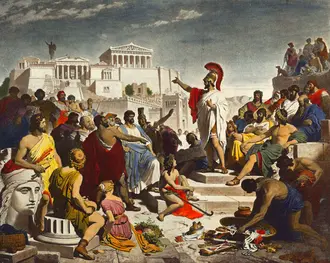
Athenian democracy was the system by which the adult male citizens of Athens governed themselves in the fifth and fourth centuries BCE: they voted directly in the Assembly, filled the Council, juries and most magistracies by lot, paid citizens for public service, and held officials to account by audits and removal. Its own statements stress equality before the law, open debate, advancement by ability and every citizen's duty to take part. It excluded women, slaves and resident foreigners, restricted citizenship to those of citizen descent, and ruled an empire of subject allies.
What it stands for
- Colonies should be run mainly to supply markets, materials and outlets for the ruling country.
- Citizens should be selected at random for public office in place of being elected.
- Women's political rights may differ from men's.
- Only people born in the country should hold public office.
- A powerful country should bring more land within its borders.
- A person's sex should affect the public roles legally assigned to them.
Key figures
- Cleisthenes: Reformer whose reorganisation of the tribes and demes after 508 BCE founded the democracy.
- Pericles: Statesman whose funeral oration, as Thucydides reports it, states the democracy's ideals.
Closest ideologies
- Right-Wing Populism (87% match)
- American nationalism (83% match)
- Russian imperialism (82% match)
- İttihadism (82% match)
- Megali Idea (82% match)
People closest to it
- Niccolò Machiavelli (85% alike)
- Theodore Roosevelt (85% alike)
- Viktor Orbán (84% alike)
- Asmongold (82% alike)
- William McKinley (82% alike)
Key positions
- Strongly: Colonies should be run mainly to supply markets, materials and outlets for the ruling country.
- Strongly: Citizens should be selected at random for public office in place of being elected.
- Strongly: Women's political rights may differ from men's.
- Strongly: Only people born in the country should hold public office.
- Strongly: A powerful country should bring more land within its borders.
- Strongly: A person's sex should affect the public roles legally assigned to them.
- Strongly: Groups of citizens chosen at random should meet to consider major public issues, with their conclusions contributing to policy decisions.
- Strongly: The representative legislature should have the final say on legislation.
- Strongly: Major laws should be decided by citizens voting on them themselves.
- Strongly: My country may join a military alliance led by one of the great powers.
- Strongly: My country's military strength should exceed that of its rivals.
- Strongly: Only children of citizens should be citizens at birth: being born in the country should not be enough.
- Strongly: A country has the right to stop a region becoming independent by using its military.
- Strongly: The worst crimes can be punished by death.
- Strongly: Some institutional ties between government and religion are acceptable.
- Strongly: Foreign powers sometimes have a right to intervene in a country's internal affairs.
- Strongly: Officeholders at higher levels may be chosen by means other than delegates picked by lower councils.
- Strongly: The government should be able to require citizens to serve in the military.
- Strongly: Large landed estates should not be compulsorily transferred to the people who farm them.
- Strongly: Armed forces may sometimes be used for purposes beyond defending the country against attack.
- Strongly: Democracy is best even when voters make poor choices.
- Strongly: Real command of the military may rest with someone other than the head of state.
- Strongly: A country may join permanent military alliances.
- Strongly: Voters should be able to remove elected officials before their terms end.
- Strongly: A country can get through deadlock among its institutions without a leader who overrides them.
- Strongly: People are entitled to resist a ruler's unconstitutional exercise of power.
- Strongly: An elected legislature must approve the government's budget before the government spends public money.
- Strongly: Recruitment to the civil service should not depend on competitive examinations.
- Strongly: The best constitution does not combine rule by the few with rule by the many.
- Strongly: People should have a direct role in making decisions where they work, live and study, rather than having those decisions made entirely for them.
- Strongly: Rules need not set equal numbers of women and men on public bodies.
- Strongly: A country may keep a region that wants to leave.
- Strongly: The general public should have at least as much say in policy as experts.
- Strongly: Voting in local elections should be reserved for citizens.
- Strongly: Being the law gives a rule a moral claim to be obeyed.
- Strongly: Political violence is sometimes justified.
- Strongly: Political authority does not ultimately come from God.
- Strongly: At least some revolutions have been justified.
- Strongly: No party's ideology should give it an exclusive right to lead the state.
- Strongly: Some areas of life should remain outside state direction.
- Strongly: Some decisions should bind people who have not consented to them.
- Strongly: Society needs government of some kind.
- Strongly: Countries should keep their armed forces.
- Strongly: The ruler should be subject to the country's laws.
- Strongly: Government should have other tasks besides protecting people from physical violence.
- Strongly: Political authority need not rest on oaths of loyalty sworn to a lord.
- Strongly: The holder of the highest state office need not be treated as holy.
- Strongly: People without property should also have the right to vote.
- Strongly: Final authority over a state's laws need not belong to its most senior religious scholars.
- Strongly: Farmers should have the legal freedom to leave the estates they work.
- Leans: The state should punish people who publicly insult what a religion holds sacred.
- Leans: The law may treat people differently according to such things as birth, sex, race and status.
- Leans: Having a shared national identity does not by itself entitle a people to its own self-governing state.
- Leans: Defense should rest with armed ordinary citizens, not a standing force.
- Leans: Universal social programmes should give way to programmes restricted to the poorest people, with eligibility based on financial need.
- Leans: Governments should actively help liberal democracy to spread in other countries.
- Leans: Governments should set legal price ceilings on essential foods when supplies are scarce.
- Leans: Those who hold public office should be paid no more than an average worker.
- Leans: Allies are bound to defend one another against armed attack.
- Leans: Every treaty and agreement between governments should be made public.
- Leans: Citizens should have a legal right to see government information.
- Leans: What you owe your community matters more than your personal rights.
- Leans: Courts need not be handed over to private businesses.
- Leans: An electorate should choose the head of state, either directly or through elected representatives.
- Leans: Nobody should hold a special rank by birth, such as a noble title, a hereditary crown or a caste position, or the special rights attached to one.
- Leans: Rulers must act under lasting, publicly known laws administered by recognised courts.
- Leans: No one is better suited by nature to govern than anyone else.
- Leans: Even a purely ceremonial head of state should not hold the position by birth.
- Leans: Grown children owe care to parents who need it.
- Leans: Whatever their circumstances, everyone should be able to count on the state for enough to live decently, through benefits, pensions or public services.
- Leans: A government needs more than fair elections to be democratic.