Political Ideology Atlas · All ideologies · Take the test
Anti-globalization movement
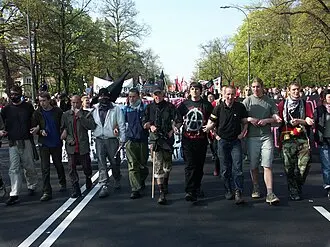
A loose network of movements opposing corporate-led globalization, as embodied in the WTO, IMF, World Bank and trade deals, which it says put profit above democracy, labor, the environment and local self-determination. Its mainstream wants democratic control of the economy, protection of commons and public services, debt cancellation and fair rules, and organizes through decentralized direct action and coalitions.
What it stands for
- Currency trades and similar international financial deals should carry a small tax of their own.
- People seeking political change should act directly—for example, with strikes, boycotts or occupations—instead of pursuing change through elections and parliaments.
- After members debate and adopt a party decision, those who opposed it should not have to help implement it.
- Tackling oppression requires a combined approach to its overlapping forms, such as racism, sexism and class oppression.
- Belonging to the nation does not tie a person's life to a sacred community that goes on after their death.
- Lack of full certainty is no reason to delay protective action.
Key figures
- Naomi Klein: Author of No Logo and widely named spokesperson for the movement.
- Vandana Shiva: Activist and author on biopiracy and corporate control of seeds.
- Noam Chomsky: Intellectual critic of corporate globalization and private power.
Closest ideologies
- Ecofeminism (94% match)
- Democratic Confederalism (93% match)
- Neozapatismo (93% match)
- Jineology (92% match)
- Alter-globalization (90% match)
People closest to it
- Noam Chomsky (88% alike)
- Catherine Connolly (88% alike)
- Albert Einstein (87% alike)
- John Dewey (87% alike)
- Theodor W. Adorno (87% alike)
Key positions
- Strongly: Currency trades and similar international financial deals should carry a small tax of their own.
- Strongly: People seeking political change should act directly—for example, with strikes, boycotts or occupations—instead of pursuing change through elections and parliaments.
- Strongly: After members debate and adopt a party decision, those who opposed it should not have to help implement it.
- Strongly: Tackling oppression requires a combined approach to its overlapping forms, such as racism, sexism and class oppression.
- Strongly: Belonging to the nation does not tie a person's life to a sacred community that goes on after their death.
- Strongly: Lack of full certainty is no reason to delay protective action.
- Strongly: Government borrowing should be free of binding legal limits.
- Strongly: Governments may refuse permission for new oil, gas and coal extraction.
- Strongly: The global economic system keeps poorer countries poor by directing their wealth toward richer countries.
- Strongly: Children of citizens are not the only ones who should be citizens at birth.
- Strongly: The goods people consume should mainly come from nearby producers.
- Strongly: My country may keep a military no stronger than its rivals'.
- Strongly: Political decisions should rest with the smallest local community able to handle them, with wider authorities handling matters that need a wider reach.
- Strongly: The foreign debts of poor countries should be written off, ending their obligation to repay them.
- Strongly: Democracy is best even when voters make poor choices.
- Strongly: Non-citizens should also be eligible for welfare benefits.
- Strongly: Genetically engineered crops need not be welcomed as a tool for sustainable farming.
- Strongly: Climate change calls for drastic action by governments.
- Strongly: Political freedom can last without economic freedom.
- Strongly: Workers' solidarity with workers in other countries should count at least as much as solidarity with their own nation.
- Strongly: Immigrants should not be expected to replace their original culture with the national culture.
- Strongly: Government should impose strict rules on how corporations operate.
- Strongly: Free trade does not benefit everyone in the long run.
- Strongly: A country can get through deadlock among its institutions without a leader who overrides them.
- Strongly: You can't reach a free, fair society by unfree or unfair means.
- Strongly: The state should not make one language the only common language of government, schooling and public life at the cost of limiting others.
- Strongly: Basic local services, such as water, hospitals and local transport, should be publicly owned and run.
- Strongly: The law should impose no restrictions on strikes.
- Strongly: A country should not be ready to use military force abroad without UN Security Council authorization.
- Strongly: Officials decide what gets made and who gets it at least as well as prices and competition do.
- Strongly: Workers are better off for having labor unions.
- Strongly: Ethnic diversity does not weaken a society's ability to hold together.
- Strongly: Economic accounts should exclude ecosystems from capital valuation.
- Strongly: People should have a direct role in making decisions where they work, live and study, rather than having those decisions made entirely for them.
- Strongly: A country should reject spending cuts demanded in return for loans and set its own course.
- Strongly: The general public should have at least as much say in policy as experts.
- Strongly: Young people should not be organised into uniformed, drilled groups that prepare them to serve the nation.
- Strongly: Meeting poor people's needs should be the first consideration in public policy.
- Strongly: Constantly seeking additional possessions is harmful overall, despite any benefits it brings.
- Strongly: My country can do without nuclear weapons that it alone controls.
- Strongly: Public schooling money may go straight to schools instead of to parents as vouchers.
- Strongly: No one is better suited by nature to govern than anyone else.
- Strongly: The presence of people of its nationality does not give a state a rightful claim to land beyond its borders.
- Strongly: Restoring a lost social order does not matter more than pursuing progress.
- Strongly: Other things drive humanity forward at least as much as rivalry and conflict between peoples.
- Strongly: Rulers have a right to rule only because the people they rule have agreed to it.
- Strongly: Trade, finance and debt rules should be changed to give poorer countries a fairer share.
- Strongly: Art should not be censored for its effect on people's moral character.
- Strongly: Income-tax percentages may differ between income levels.
- Strongly: Most people in political office look after themselves first and the public second.
- Strongly: The law should not assign different roles in public life on the basis of sex.
- Strongly: Private ownership is legitimate only insofar as it benefits society.
- Strongly: Very large concentrations of wealth threaten a free society.
- Strongly: My country should not send weapons to foreign insurgents, whatever it thinks of the governments they fight.
- Strongly: Leading roles in a country's economy should not depend on belonging to the majority national group.
- Strongly: Whatever their circumstances, everyone should be able to count on the state for enough to live decently, through benefits, pensions or public services.
- Strongly: War does not strengthen a nation's character.
- Strongly: Being powerful does not mean a country should bring more land within its borders.
- Strongly: The government should let its political opponents organise, speak and compete for power.
- Strongly: Rapid economic development does not justify temporary restrictions on political freedom.
- Strongly: Political authority does not ultimately come from God.
- Strongly: The leader should not bypass political intermediaries in dealing with the people.
- Strongly: A country may leave other nations to choose their own political systems.
- Strongly: State pensions funded by current workers' contributions should stay in place rather than be replaced by privately managed individual accounts.
- Strongly: Businesses gain too much influence over government policy from their lobbying.
- Strongly: Governments should give no subsidies, licences or protections that favour firms close to them.
- Strongly: The law should treat everyone as an equal, whatever their birth, sex, race or status.
- Strongly: A government needs more than fair elections to be democratic.
- Strongly: Belonging to the nation does not go with sharing its religion.
- Strongly: Most of the average difference in ability between racial groups does not come from genes.
- Strongly: An armed minority's actions are incapable of bringing about the conditions for a broader revolutionary uprising.
- Strongly: Workers do not need a disciplined revolutionary party to lead them.
- Strongly: Minority groups are not, as groups, secretly plotting to harm the nation.
- Strongly: Islam is compatible with Western values.
- Strongly: Looking after your own interests is not a moral good in itself.
- Strongly: No party's ideology should give it an exclusive right to lead the state.
- Strongly: The law should not punish consenting adults for same-sex relations.
- Strongly: The armed forces may be controlled by someone other than the governing party's leadership.
- Strongly: Population growth does not mainly drive lasting poverty.
- Strongly: There is no deliberate plan behind immigration aimed at replacing the native population.
- Strongly: Private owners' choice of whom they deal with should be subject to some restrictions.
- Strongly: No society has the right to rule another for its supposed improvement, however advanced it is.
- Strongly: Women should be able to vote and stand for office on the same terms as men.
- Strongly: The vote keeps a government in check at least as well as being able to leave the country does.
- Strongly: A workers' state does not need to suppress the old ruling class, even for a time.
- Strongly: The state should not be managed the way a well-run business is.
- Strongly: Government should have other tasks besides protecting people from physical violence.
- Strongly: Collecting taxes does not in itself amount to stealing people's money.
- Strongly: Public policy should not be used to reduce the passing on of inherited disabilities.
- Strongly: Renting out housing should be permitted in at least some circumstances.
- Strongly: Great powers should have no right to send troops against allied governments' wishes for the purpose of preserving those countries' political systems.
- Strongly: Political authority need not rest on oaths of loyalty sworn to a lord.
- Strongly: Voting should not be limited to members of one ethnic group.
- Strongly: Overseas territories need not be run mainly for the ruling country's economic benefit.
- Strongly: Taking part in politics is at least as good a way to live as living privately away from public affairs.
- Strongly: People without property should also have the right to vote.
- Strongly: Women may go out in public without any legal duty to cover fully.
- Strongly: Courts need not be handed over to private businesses.
- Strongly: Final authority over a state's laws need not belong to its most senior religious scholars.
- Strongly: The Holocaust happened as historians describe it.
- Strongly: People must be free to leave their religion without legal penalty.
- Strongly: Suspected drug dealers should never be put to death without a trial.
- Strongly: Humanity would gain nothing by going back to living off hunting and gathering.
- Strongly: Farmers should have the legal freedom to leave the estates they work.
- Leans: Small, informal, trust-based groups are the right form for political action, not lasting parties, unions or federations.
- Leans: In the long run people should be free to live and work in any country.
- Leans: Towns and cities should link through councils whose delegates coordinate and administer what local assemblies decide, without making policy themselves.
- Leans: Society should aim for people to end up with broadly equal material conditions.
- Leans: The fact that something is law is not, by itself, a moral reason to obey it.
- Leans: Ideas and creative works should be free to copy, with no one holding a legal monopoly on them.
- Leans: Communities should be free to choose their own economic arrangements, and a free society has no fixed blueprint for its economy.
- Leans: When people's freedom to do something harms the environment, the law should limit that freedom.
- Leans: Cooperation between employers and workers should not come before conflict where their interests differ.
- Leans: Those who elected someone should be able to remove them before their term ends, whenever they choose.
- Leans: The country may allow more immigration than strict limits would permit.
- Leans: Trade deals should impose legally binding requirements protecting workers.
- Leans: Governments may spend well beyond their tax revenue to support a weak economy.
- Leans: The farmers who work large estates should take ownership from the landowners, with the transfer compulsory if owners refuse.
- Leans: The nation does not need a radical rebirth to overcome decadence.
- Leans: Working together internationally should count at least as much as my country's own priorities.
- Leans: Politics should give compromises among competing groups at least as much weight as a single common good identified by reasoning.
- Leans: Religious values and institutions should not have a major part in shaping laws, schools and public life.
- Leans: Wage work cuts people off from the meaning and creativity of what they make.
- Leans: Women's subordination is tied to how the economy is organised, so reform of laws and attitudes is not enough.
- Leans: Businesses should belong to the people who work in them, for example as cooperatives.
- Leans: Communist one-party states should not receive the same condemnation as fascist states.
- Leans: Elected officials have at least as much real power as the people who run the press, universities and other cultural institutions.
- Leans: Laws, institutions and customs still favor men over women.
- Leans: Areas where an ethnic minority makes up most of the population should be able to run many of their own affairs within the state.
- Leans: Industries such as energy, rail and utilities should be owned by the state or public bodies, not private companies.
- Leans: Indigenous peoples should control their traditional territories.
- Leans: Society should take active steps to make up for the harm done by past racial injustices.
- Leans: Workers' pay should be settled in collective bargaining between their union and their employer.
- Leans: Society may be changed in large, rapid steps.
- Leans: Countries within one civilization may remain politically separate.
- Leans: A country's constitution should prevail when it conflicts with international legal obligations.
- Leans: The state should stop foreign buyers from taking over key national businesses.
- Leans: University-educated people are not especially out of touch with the realities of ordinary life.
- Leans: Nature matters for its own sake, not only because it is useful to people.
- Leans: Government should rely at least as much on legal enforcement as on its rulers' moral example.
- Leans: A country need not treat an excess of exports over imports as something to aim for.
- Leans: Society needs government of some kind.
- Leans: Peoples who share an ethnic heritage, such as the Slavic peoples, should not come together in one state.
- Leans: A country may keep all its decisions in its own hands rather than pooling them with other nations.
- Leans: Political representation should not come through social bodies such as families, local communities and occupational associations instead of political parties.
- Leans: Private charity does not help people in poverty better than government programs do.
- Leans: Political independence means little unless the economic and property system is also transformed.
- Leans: A nation does not need one main ethnic group: it can be made up of people of many ancestries.
- Leans: Wages need not be set through negotiating bodies that the state officially recognizes.
- Leans: In the long run people should still produce and share using money.
- Leans: Work may stay divided into separate specialized jobs held by different people.
- Leans: Industrial society has done at least as much good as harm to humanity.
- Leans: Central banks should keep a role in controlling the money supply.
- Leans: Racial groups should not each organise to defend distinct political interests of their own.
- Leans: We have a duty to leave the planet in good condition for those who come after us.
- Leans: An economy directed by a central plan is not capable of working better than one directed by market exchange.
- Leans: At most half of workers in wealthy countries benefit from the exploitation of poorer countries.
- Leans: Income from useful work should be rewarded ahead of income from merely owning property.
- Leans: A people with a shared national identity is entitled to its own self-governing state.
- Leans: Groups have rights of their own.