Political Ideology Atlas · All people · Take the test
North America · born 1859, historical
John Dewey
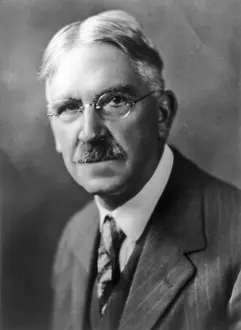
American philosopher, psychologist and educational reformer (1859–1952)
Dewey was a pragmatist who treated democracy as a way of shared living and joint inquiry rather than only a form of government, and distrusted rule by experts or elites. From the 1930s he rejected laissez-faire liberalism and argued for a socialized, planned economy reached by democratic means, supported unions, workers' rights and a welfare state, and opposed both fascism and Soviet communism. He criticized national-sovereignty absolutism, backed the outlawry of war and an international order, and held that policies and institutions should be judged by tested consequences rather than by general doctrines.
Closest ideologies
Based on the 44 statements where John Dewey has a known position.
- Left-Wing Populism (94% match)
- One-state solution (93% match)
- Democratic Socialism (93% match)
- Eurocommunism (92% match)
- Socialist democracy (92% match)
Similar people
- Albert Einstein (94% alike)
- Kyle Kulinski (91% alike)
- Dilma Rousseff (91% alike)
- Hakeem Jeffries (91% alike)
- Olof Palme (91% alike)
Known positions
- Strongly: Where they conflict, evidence and reasoning should count for more than faith, God, revelation or scripture.
- Strongly: Judge policies by what they achieve, independently of whether they match an ideology.
- Strongly: Working together internationally should count at least as much as my country's own priorities.
- Strongly: Employees should have voting rights in the management of large companies.
- Strongly: Democracy is best even when voters make poor choices.
- Strongly: Government should impose strict rules on how corporations operate.
- Strongly: A country can get through deadlock among its institutions without a leader who overrides them.
- Strongly: How someone turns out is shaped more by upbringing, society and experience than by the traits they are born with.
- Strongly: The law should impose no restrictions on strikes.
- Strongly: Officials decide what gets made and who gets it at least as well as prices and competition do.
- Strongly: Workers are better off for having labor unions.
- Strongly: People should have a direct role in making decisions where they work, live and study, rather than having those decisions made entirely for them.
- Strongly: Being free requires having the practical resources to act on one's choices, such as an adequate livelihood.
- Strongly: The general public should have at least as much say in policy as experts.
- Strongly: A nation does not need one main ethnic group: it can be made up of people of many ancestries.
- Strongly: No one is better suited by nature to govern than anyone else.
- Strongly: Other things drive humanity forward at least as much as rivalry and conflict between peoples.
- Strongly: Other forces move history at least as much as conflict between classes does.
- Strongly: Very large concentrations of wealth threaten a free society.
- Strongly: The holy scripture of one's faith is not God's own error-free word.
- Strongly: Whatever their circumstances, everyone should be able to count on the state for enough to live decently, through benefits, pensions or public services.
- Strongly: War does not strengthen a nation's character.
- Strongly: The law should treat everyone as an equal, whatever their birth, sex, race or status.
- Strongly: No party's ideology should give it an exclusive right to lead the state.
- Strongly: Women should be able to vote and stand for office on the same terms as men.
- Strongly: Society needs government of some kind.
- Leans: An economy whose production is directed by a central plan is capable of working better than an economy directed by market exchange.
- Leans: The UN should have authority to compel member states to comply with its decisions.
- Leans: Schools should not cultivate patriotic feeling, meaning loyalty to and pride in the nation.
- Leans: Countries should hand part of their decision-making power to a union of nations, such as the European Union.
- Leans: Wage work cuts people off from the meaning and creativity of what they make.
- Leans: Countries should maintain only the weapons needed for national safety.
- Leans: Society should follow a third course beyond capitalism and communism.
- Leans: Production should be organised to provide what people need, instead of being organised around what yields a profit.
- Leans: Laws, institutions and customs still favor men over women.
- Leans: Industries such as energy, rail and utilities should be owned by the state or public bodies, not private companies.
- Leans: Every treaty and agreement between governments should be made public.
- Leans: The government should steer investment into industries it sees as key to the country's future.
- Leans: Owners' rights to their property need not be protected against being overridden for public goals.
- Leans: Constantly seeking additional possessions is harmful overall, despite any benefits it brings.
- Leans: The law should not assign different roles in public life on the basis of sex.
- Leans: Private ownership is legitimate only insofar as it benefits society.
- Leans: A people with a shared national identity is entitled to its own self-governing state.
- Leans: A government needs more than fair elections to be democratic.