Political Ideology Atlas · All people · Take the test
North America · born 1928
Noam Chomsky
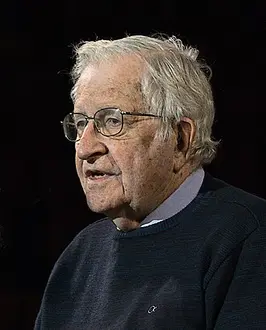
American linguist and political writer, MIT professor emeritus; anarcho-syndicalist critic of US foreign policy and of corporate power
Chomsky calls himself a libertarian socialist in the anarchist tradition: he wants workplaces and communities run by their participants, regards private corporate power and state bureaucracies as illegitimate authorities, and treats Leninist states as the opposite of socialism. He criticizes US and allied foreign policy as imperial, defends near-absolute free speech, and argues that media and elites manufacture consent. In the short term he defends state social protections and votes tactically.
Closest ideologies
Based on the 115 statements where Noam Chomsky has a known position.
- Antifa (91% match)
- Chicana feminism (90% match)
- Green municipalism (90% match)
- Marxist humanism (90% match)
- Eco-Socialism (89% match)
Similar people
- Peter Kropotkin (90% alike)
- Bill Ayers (90% alike)
- Angela Davis (87% alike)
- Helen Keller (86% alike)
- Hasan Piker (85% alike)
Known positions
- Strongly: Political power should rest on councils elected in workplaces in place of parliaments.
- Strongly: In the society we should aim for, a person's needs should determine their share of goods.
- Strongly: Those who elected someone should be able to remove them before their term ends, whenever they choose.
- Strongly: Land claimed as a historic homeland may be given up in exchange for peace.
- Strongly: Force is for self-defence alone.
- Strongly: The Soviet economy was capitalist under state ownership, with the state taking the place of private capitalists.
- Strongly: The state should be barred from executing people convicted of the gravest crimes, such as terrorism.
- Strongly: Working together internationally should count at least as much as my country's own priorities.
- Strongly: Payment to a union should be permitted as a condition of employment in at least some circumstances.
- Strongly: Settlers from abroad who displace a land's people and found a state there are carrying out colonialism.
- Strongly: Employees should have voting rights in the management of large companies.
- Strongly: Wage work cuts people off from the meaning and creativity of what they make.
- Strongly: Trade unions should control their own affairs without state direction.
- Strongly: Entertainment produced for mass audiences tends to weaken people's willingness to challenge the established social order.
- Strongly: Businesses should belong to the people who work in them, for example as cooperatives.
- Strongly: Countries should maintain only the weapons needed for national safety.
- Strongly: The ruling class stays in power mainly through people going along with its ideas.
- Strongly: Some race-based affirmative action should continue.
- Strongly: Governments may refuse permission for new oil, gas and coal extraction.
- Strongly: High earners and the very rich should pay tax at a much higher rate than everyone else.
- Strongly: Production should be organised to provide what people need, instead of being organised around what yields a profit.
- Strongly: Government surveillance is not acceptable, even to prevent terrorism.
- Strongly: Full-time work at the legal wage floor should pay enough to meet basic living costs.
- Strongly: Laws, institutions and customs still favor men over women.
- Strongly: My country may keep a military no stronger than its rivals'.
- Strongly: Defeating communism should not take priority over coexistence with it.
- Strongly: The foreign debts of poor countries should be written off, ending their obligation to repay them.
- Strongly: Without workers' own political power, state ownership is not socialism.
- Strongly: Formal press freedom is hollow when wealth decides who can actually be heard.
- Strongly: Climate change calls for drastic action by governments.
- Strongly: Universal social programmes should be kept, not replaced by programmes limited to the poorest.
- Strongly: Government should impose strict rules on how corporations operate.
- Strongly: Free trade does not benefit everyone in the long run.
- Strongly: Land that a state declares its own against its people's will is still illegally occupied by that state.
- Strongly: You can't reach a free, fair society by unfree or unfair means.
- Strongly: Hate speech should be legal.
- Strongly: Owners' rights to their property need not be protected against being overridden for public goals.
- Strongly: A country should not be ready to use military force abroad without UN Security Council authorization.
- Strongly: Officials decide what gets made and who gets it at least as well as prices and competition do.
- Strongly: Workers are better off for having labor unions.
- Strongly: People should have a direct role in making decisions where they work, live and study, rather than having those decisions made entirely for them.
- Strongly: The general public should have at least as much say in policy as experts.
- Strongly: No one is better suited by nature to govern than anyone else.
- Strongly: The state should guarantee health care to everyone, whether it runs the services itself or pays for them.
- Strongly: Other things drive humanity forward at least as much as rivalry and conflict between peoples.
- Strongly: Very large concentrations of wealth threaten a free society.
- Strongly: My country should not send weapons to foreign insurgents, whatever it thinks of the governments they fight.
- Strongly: An economy directed by a central plan is not capable of working better than one directed by market exchange.
- Strongly: Whatever their circumstances, everyone should be able to count on the state for enough to live decently, through benefits, pensions or public services.
- Strongly: Being powerful does not mean a country should bring more land within its borders.
- Strongly: The government should let its political opponents organise, speak and compete for power.
- Strongly: A country may leave other nations to choose their own political systems.
- Strongly: State pensions funded by current workers' contributions should stay in place rather than be replaced by privately managed individual accounts.
- Strongly: Businesses gain too much influence over government policy from their lobbying.
- Strongly: A government needs more than fair elections to be democratic.
- Strongly: Workers do not need a disciplined revolutionary party to lead them.
- Strongly: Looking after your own interests is not a moral good in itself.
- Strongly: News media should decide for themselves what they publish, whoever holds power.
- Strongly: No party's ideology should give it an exclusive right to lead the state.
- Strongly: We have a duty to leave the planet in good condition for those who come after us.
- Strongly: Some areas of life should remain outside state direction.
- Strongly: A workers' state does not need to suppress the old ruling class, even for a time.
- Strongly: Government should have other tasks besides protecting people from physical violence.
- Strongly: Collecting taxes does not in itself amount to stealing people's money.
- Strongly: Great powers should have no right to send troops against allied governments' wishes for the purpose of preserving those countries' political systems.
- Strongly: Public spaces such as schools and facilities should not be separated by race under the law.
- Strongly: The Holocaust happened as historians describe it.
- Leans: Society would be better off without governments at all.
- Leans: Eventually people should produce and share without money.
- Leans: In the long run people should be free to live and work in any country.
- Leans: Protecting nature can mean accepting less economic growth.
- Leans: The left should put workers' pay, jobs and living costs ahead of cultural identity causes.
- Leans: Political change should replace the existing administrative and coercive institutions with new forms of organization, rather than put new leaders in charge of the old apparatus.
- Leans: Towns and cities should link through councils whose delegates coordinate and administer what local assemblies decide, without making policy themselves.
- Leans: Socialism in a single country will not endure without successful socialist revolutions in other countries.
- Leans: Choices that harm no one else should never be crimes.
- Leans: International criminal courts should try political leaders responsible for atrocities such as genocide, crimes against humanity and war crimes.
- Leans: Ideas and creative works should be free to copy, with no one holding a legal monopoly on them.
- Leans: People should live and work in communities that own land and goods together and govern themselves.
- Leans: Where they conflict, evidence and reasoning should count for more than faith, God, revelation or scripture.
- Leans: Owners' profit is value taken from workers' labor.
- Leans: Strict legal limits should apply to owning a gun.
- Leans: Currency trades and similar international financial deals should carry a small tax of their own.
- Leans: Firms should compete in markets, but be owned by the people who work in them.
- Leans: Adults may legally buy and use drugs such as cannabis, possibly with regulation.
- Leans: A country should not tie itself to other countries through lasting military alliances.
- Leans: Major laws should be decided by citizens voting on them themselves.
- Leans: Delegates selected by councils at one level should select officeholders at higher levels.
- Leans: Religious values and institutions should not have a major part in shaping laws, schools and public life.
- Leans: State schools should not teach religion.
- Leans: Making polluters pay a tax protects the environment more than setting rules for them does.
- Leans: Elected officials have at least as much real power as the people who run the press, universities and other cultural institutions.
- Leans: Foreign powers sometimes have a right to intervene in a country's internal affairs.
- Leans: Firms and banks bear the cost of their own failures, with no rescue from taxpayers.
- Leans: Democracy is best even when voters make poor choices.
- Leans: Society should take active steps to make up for the harm done by past racial injustices.
- Leans: Automation should be directed towards making the time people need to spend working as short as feasible.
- Leans: A state of their own in the Land of Israel is not something Jews are owed as a people.
- Leans: Publicly funded services such as hospitals and schools should not be run by private companies and charities.
- Leans: People who became refugees during a conflict should be permitted to return to the homes they themselves left.
- Leans: Voters should be able to remove elected officials before their terms end.
- Leans: Some things are right or wrong for everyone, in every culture and era.
- Leans: State institutions may allow visible religious dress for staff and pupils.
- Leans: A country should reject spending cuts demanded in return for loans and set its own course.
- Leans: Being free requires having the practical resources to act on one's choices, such as an adequate livelihood.
- Leans: Spreading democracy does not bring peace.
- Leans: Constantly seeking additional possessions is harmful overall, despite any benefits it brings.
- Leans: Most people in political office look after themselves first and the public second.
- Leans: Political violence is sometimes justified.