Political Ideology Atlas · All ideologies · Take the test
Chinese unification
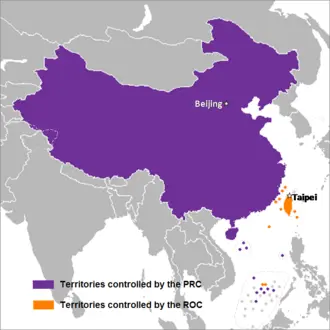
Chinese unification, as Beijing advances it, holds that Taiwan is an inseparable part of China and that the divided state left by the civil war must be reunified, preferably peacefully under one country, two systems, but with force reserved against secession or foreign interference. It ties unification to national rejuvenation and treats the question as purely internal. It is a single-issue territorial doctrine, so it says little on economic, social or cultural questions.
What it stands for
- Which country a disputed territory belongs to may be settled without a vote of its inhabitants.
- The national parliament stays the final authority and can take powers back from the regions.
- Many political decisions should rest with national or wider authorities, even where a smaller community could handle them.
- Outside governments have no entitlement to interfere in another country's internal affairs for any purpose.
- A country has the right to stop a region becoming independent by using its military.
- When national priorities conflict with working together internationally, my country should choose its own priorities.
Key figures
- Deng Xiaoping: Developed the one country, two systems formula, which he also proposed for Taiwan
- Xi Jinping: CCP General Secretary who calls the 1992 Consensus the political bottom line and ties unification to national rejuvenation
Closest ideologies
- Statism (90% match)
- Pan-nationalism (88% match)
- Tridemism (88% match)
- Sovereign democracy (87% match)
- Turanism (87% match)
People closest to it
- Deng Xiaoping (89% alike)
- Niccolò Machiavelli (88% alike)
- Xi Jinping (88% alike)
- Vladimir Putin (87% alike)
- Jean-Jacques Dessalines (87% alike)
Key positions
- Strongly: Which country a disputed territory belongs to may be settled without a vote of its inhabitants.
- Strongly: The national parliament stays the final authority and can take powers back from the regions.
- Strongly: Many political decisions should rest with national or wider authorities, even where a smaller community could handle them.
- Strongly: Outside governments have no entitlement to interfere in another country's internal affairs for any purpose.
- Strongly: A country has the right to stop a region becoming independent by using its military.
- Strongly: When national priorities conflict with working together internationally, my country should choose its own priorities.
- Strongly: Defeating communism should not take priority over coexistence with it.
- Strongly: Joining a larger state should leave a region free to keep its existing economic arrangements.
- Strongly: Land claimed as the historic homeland should not be traded away, even for peace.
- Strongly: A country's constitution should prevail when it conflicts with international legal obligations.
- Strongly: A country may keep a region that wants to leave.
- Strongly: A country may keep all its decisions in its own hands rather than pooling them with other nations.
- Strongly: Schools should cultivate patriotic feeling: loyalty to and pride in the nation, expressed for example through respect for its flag and anthem.
- Strongly: A people split by an imposed border should be brought together in a single state.
- Strongly: National policy should give priority to preventing outside powers from splitting the country territorially.
- Strongly: Political violence is sometimes justified.
- Strongly: Being the first to use force can be right, depending on what it is meant to achieve.
- Strongly: Keeping a nation's inherited culture alive, including its language, customs and traditions, matters.
- Strongly: There is no deliberate plan behind immigration aimed at replacing the native population.
- Strongly: People of different races should not be discouraged from forming a family together, including through marriage and children.
- Strongly: No state may force a minority out of the country, however hostile it judges that minority to be.
- Strongly: Public offices may be filled by methods other than drawing lots.
- Strongly: Society needs government of some kind.
- Strongly: Countries should keep their armed forces.
- Strongly: Government should have other tasks besides protecting people from physical violence.
- Strongly: Killing another person can be right in self-defence or in defence of others.
- Strongly: Public spaces such as schools and facilities should not be separated by race under the law.
- Strongly: Courts need not be handed over to private businesses.
- Strongly: Museums, libraries and other inherited culture should not be destroyed, even when they stand in the way of new creation.
- Strongly: Farmers should have the legal freedom to leave the estates they work.
- Leans: The governing party's own leadership should control the armed forces.
- Leans: One ideologically correct party should hold state leadership without competing parties having a right to replace it.
- Leans: The people in power should decide what the country's news media publish.
- Leans: Workers require political leadership from a tightly organised revolutionary party.
- Leans: Consent of the governed is not the only basis of legitimate political authority.
- Leans: My country should possess its own nuclear arsenal with independent authority over its use.
- Leans: A nation should be mainly one ethnic people.
- Leans: A country should be ready to use military force abroad on its own judgment, even if the UN Security Council has not authorized it.
- Leans: Marriage, inheritance and family law may differ between religious communities.
- Leans: My country's military strength should exceed that of its rivals.
- Leans: Allied countries are free to decide for themselves whether to help one that is attacked.
- Leans: Armaments need not be limited to the minimum needed for national safety.
- Leans: Businesses need not belong to the people who work in them.
- Leans: Politics should prioritise a single common good identified by reasoning over compromises among organised interests.
- Leans: The worst crimes can be punished by death.
- Leans: Areas where an ethnic minority makes up most of the population should be able to run many of their own affairs within the state.
- Leans: Belonging to the nation ties a person's life to a sacred community that goes on after their death.
- Leans: A government should outlaw political parties that aim to do away with its constitutional order.
- Leans: Armed forces may sometimes be used for purposes beyond defending the country against attack.
- Leans: The law should limit the making or sale of pornography.
- Leans: What you owe your community matters more than your personal rights.
- Leans: A constitution does not have to be drafted by an assembly elected for that purpose.
- Leans: After members debate and adopt a party decision, every member should have to help implement it, including those who opposed it.
- Leans: A people should have one region of its own rather than being split across several.
- Leans: A nation need not wait for a cultural revival before building its state.
- Leans: An ancestral bond to a land gives a people a claim that outweighs the claims of other peoples who now live there.
- Leans: Direct action does not have to take the place of elections and parliament as the way to achieve political change.
- Leans: Political authority need not rest on oaths of loyalty sworn to a lord.
- Leans: Today's nation is the same people as its ancient and medieval forebears.
- Leans: Gathering all the people in the homeland should have at least as much priority as supporting diaspora culture.
- Leans: Officials decide what gets made and who gets it at least as well as prices and competition do.
- Leans: Today, nobody is bound by a colonial-era treaty that divided a people without asking them.
- Leans: Profit made from owning businesses does not come from exploiting the workers who produce it.
- Leans: The state should not be managed the way a well-run business is.
- Leans: The ruler should be subject to the country's laws.
- Leans: Political institutions developed in the West are not a suitable model for every civilization.
- Leans: The nation's cause and the cause of its ordinary working people are one and the same.
- Leans: Some decisions should bind people who have not consented to them.
- Leans: The vote keeps a government in check at least as well as being able to leave the country does.
- Leans: In the long run people should still produce and share using money.
- Leans: Work may stay divided into separate specialized jobs held by different people.
- Leans: Lasting socialism in one country does not require socialist revolutions abroad.
- Leans: Member states should keep the final decision on whether to follow UN decisions.
- Leans: Economic growth should not be limited for the sake of the environment.
- Leans: Political power may rest on something other than workplace-elected councils.
- Leans: War does not strengthen a nation's character.
- Leans: A people with a shared national identity is entitled to its own self-governing state.
- Leans: A people's connection to its ancestral land is spiritual, beyond practical interests or ordinary affection.
- Leans: A country may leave other nations to choose their own political systems.