Political Ideology Atlas · All people · Take the test
North America · born 1856, historical
Woodrow Wilson
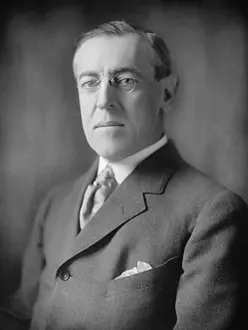
28th president of the United States (1913-1921); Princeton scholar and university president
A progressive Democrat who, as president, backed regulation of trusts and banks, a graduated income tax, lower tariffs and women's suffrage, and who built the League of Nations into his foreign policy. His record also includes segregation of parts of the federal workforce, support for racial segregation, and wartime measures against dissent, and he was a sharp critic of separated powers and of government controlled by business interests.
Closest ideologies
Based on the 61 statements where Woodrow Wilson has a known position.
- Person Dignity Theory (86% match)
- German nationalism (84% match)
- Tridemism (84% match)
- Arab socialism (83% match)
- Islamic Socialism (83% match)
Similar people
- Wang Jingwei (89% alike)
- Sun Yat-sen (86% alike)
- Chiang Kai-shek (86% alike)
- Abraham Lincoln (85% alike)
- William McKinley (85% alike)
Known positions
- Strongly: Law should require people of different races to use separate public spaces, such as schools and public facilities.
- Strongly: Spreading our political system abroad should be a special calling of our nation.
- Strongly: The UN should have authority to compel member states to comply with its decisions.
- Strongly: More democracies means fewer wars, so promoting democracy serves peace.
- Strongly: A national emergency sometimes justifies temporarily withdrawing normal legal safeguards against people the government regards as internal enemies, such as protections against detention without trial.
- Strongly: Fewer tariffs and trade barriers make all countries better off over time.
- Strongly: Free citizens need the freedom to own property, trade and choose work, or political freedom cannot last.
- Strongly: Governments should set legal price ceilings on essential foods when supplies are scarce.
- Strongly: Working together internationally should count at least as much as my country's own priorities.
- Strongly: Tariffs should not be used to protect domestic industry from foreign competition.
- Strongly: Farmers should get price floors, state buying or cheap credit to keep them secure.
- Strongly: Religious values and institutions should shape laws, schools and public life.
- Strongly: High earners and the very rich should pay tax at a much higher rate than everyone else.
- Strongly: Foreign powers sometimes have a right to intervene in a country's internal affairs.
- Strongly: The government should be able to require citizens to serve in the military.
- Strongly: Armed forces may sometimes be used for purposes beyond defending the country against attack.
- Strongly: Workers' pay should be settled in collective bargaining between their union and their employer.
- Strongly: Government should impose strict rules on how corporations operate.
- Strongly: Voters should be able to remove elected officials before their terms end.
- Strongly: A person loses freedom from being at another person's mercy, even if that power is never exercised.
- Strongly: Employers and workers should treat each other as partners whose cooperation comes before conflict, even where their interests differ.
- Strongly: Workers are better off for having labor unions.
- Strongly: Where they conflict, religious faith should count for at least as much as evidence and reasoning.
- Strongly: Private charity does not help people in poverty better than government programs do.
- Strongly: Restoring a lost social order does not matter more than pursuing progress.
- Strongly: Income-tax percentages may differ between income levels.
- Strongly: Most people in political office look after themselves first and the public second.
- Strongly: Very large concentrations of wealth threaten a free society.
- Strongly: Politics should support people's spiritual well-being.
- Strongly: Businesses gain too much influence over government policy from their lobbying.
- Strongly: Governments should give no subsidies, licences or protections that favour firms close to them.
- Strongly: Central banks should keep a role in controlling the money supply.
- Strongly: Women should be able to vote and stand for office on the same terms as men.
- Strongly: Government should have other tasks besides protecting people from physical violence.
- Strongly: Overseas territories need not be run mainly for the ruling country's economic benefit.
- Leans: The government should stop its political opponents from organising, speaking or competing for power.
- Leans: A society holds together less well when its members belong to different ethnic groups.
- Leans: Prices and competition generally decide better than officials what gets made and who gets it.
- Leans: Defense should rest with armed ordinary citizens, not a standing force.
- Leans: Newcomers should adopt the host nation's culture in place of their original culture.
- Leans: Changes to society should be introduced a little at a time.
- Leans: A country should not tie itself to other countries through lasting military alliances.
- Leans: Society may deal with racial discrimination as it arises today without programs aimed at past wrongs.
- Leans: Major laws should be decided by citizens voting on them themselves.
- Leans: Businesses should be legally barred from agreements with competitors to suppress competition, such as fixing prices.
- Leans: Political power may be concentrated in one body.
- Leans: Allies are bound to defend one another against armed attack.
- Leans: Property should belong to many people in small holdings.
- Leans: Military intervention abroad is sometimes necessary to protect human rights.
- Leans: My country should stay neutral and join neither of the opposing great-power alliances.
- Leans: Every treaty and agreement between governments should be made public.
- Leans: The government should steer investment into industries it sees as key to the country's future.
- Leans: Land that a state declares its own against its people's will is still illegally occupied by that state.
- Leans: The general public should have at least as much say in policy as experts.
- Leans: Rulers have a right to rule only because the people they rule have agreed to it.
- Leans: Private ownership is legitimate only insofar as it benefits society.
- Leans: We have a duty to leave the planet in good condition for those who come after us.
- Leans: Unequal results between racial groups do not by themselves make a policy discriminatory.
- Leans: A people with a shared national identity is entitled to its own self-governing state.