Political Ideology Atlas · All people · Take the test
Europe · born 1877, historical
Wilhelm Frick
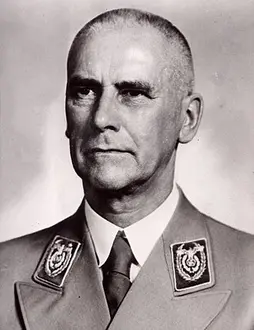
Nazi German interior minister (1933–1943) and Reich Protector of Bohemia and Moravia (1943–1945)
Frick helped replace parliamentary and federal government with Nazi dictatorship. He directed racial legislation, including the exclusion of Jews from citizenship, and compulsory sterilization policy.
Closest ideologies
Based on the 52 statements where Wilhelm Frick has a known position.
- Volksgemeinschaft (95% match)
- Völkisch movement (92% match)
- Fascism in Europe (91% match)
- Fascist syndicalism (89% match)
- Fascism (88% match)
Similar people
- Hermann Göring (91% alike)
- Heinrich Himmler (91% alike)
- Reinhard Heydrich (90% alike)
- Joseph Goebbels (88% alike)
- Idi Amin (87% alike)
Known positions
- Strongly: Law should require people of different races to use separate public spaces, such as schools and public facilities.
- Strongly: Only members of one racial or ethnic group should have the right to vote.
- Strongly: Public policy, such as sterilization or incentives, should reduce the passing on of inherited disabilities.
- Strongly: The ruler should not be bound by the country's laws, including those made by that ruler and by earlier ones.
- Strongly: Every part of life should be subject to state direction.
- Strongly: A state may force a minority it sees as hostile to leave the country.
- Strongly: People of different races should be discouraged from forming a family together, whether through marriage or having children.
- Strongly: People of other ethnic groups should be made to leave the country.
- Strongly: One ideologically correct party should hold state leadership without competing parties having a right to replace it.
- Strongly: The people in power should decide what the country's news media publish.
- Strongly: The law may treat people differently according to such things as birth, sex, race and status.
- Strongly: The government should stop its political opponents from organising, speaking or competing for power.
- Strongly: A powerful country should bring more land within its borders.
- Strongly: The country's majority national group should have the leading role in controlling economic life.
- Strongly: A nation should be mainly one ethnic people.
- Strongly: Peoples who share an ethnic heritage, such as the Slavic, Arab or Turkic peoples, should come together in one state, even across present borders.
- Strongly: The government may spend public money without first getting its budget approved by an elected legislature.
- Strongly: Land that a state declares its own against its people's will is not illegally occupied by that state.
- Strongly: The country would benefit from a strong leader with the power to act despite deadlock among its political institutions.
- Strongly: A national emergency sometimes justifies temporarily withdrawing normal legal safeguards against people the government regards as internal enemies, such as protections against detention without trial.
- Strongly: A country should press its neighbour to give back land taken from it in an old war.
- Strongly: Democracy is not the best form of government when voters choose badly.
- Strongly: Many political decisions should rest with national or wider authorities, even where a smaller community could handle them.
- Strongly: Collective goals can justify treating a person merely as a tool.
- Strongly: The political goal should be victory over communism ahead of accommodation with it.
- Strongly: Political power may be concentrated in one body.
- Strongly: Trade unions may be subject to state direction of their affairs.
- Strongly: Government should not be bound by a written bill of rights protected against easy amendment by ordinary majorities.
- Strongly: Some race-based affirmative action should continue.
- Strongly: The directly elected parliament should be a legislature's only chamber.
- Strongly: The nation has decayed and must be reborn.
- Strongly: The government should be able to require citizens to serve in the military.
- Strongly: A head of state may take a side in party politics.
- Strongly: What you owe your community matters more than your personal rights.
- Strongly: Another body may have the final say over what the legislature passes.
- Strongly: Racial categories are not merely social constructs without a scientific basis.
- Strongly: A healthy society depends on the traditional family, such as a married mother and father raising their children.
- Strongly: Schools should cultivate patriotic feeling: loyalty to and pride in the nation, expressed for example through respect for its flag and anthem.
- Strongly: A state should take responsibility for the welfare of its national communities across neighbouring borders.
- Strongly: Political violence is sometimes justified.
- Strongly: School history should mostly tell the story of the student's own nation.
- Strongly: Belonging to the nation does not go with sharing its religion.
- Strongly: At least some revolutions have been justified.
- Strongly: Keeping a nation's inherited culture alive, including its language, customs and traditions, matters.
- Strongly: Police forces should continue to exist.
- Strongly: Society needs government of some kind.
- Strongly: Countries should keep their armed forces.
- Strongly: Government should have other tasks besides protecting people from physical violence.
- Leans: A person's sex should affect the public roles legally assigned to them.
- Leans: The presence of people belonging to the same nation gives a state a legitimate territorial claim outside its borders.
- Leans: The government should have authority over religious institutions' internal affairs.
- Leans: Religious minorities should not be exempt from general laws that burden their practice.