Political Ideology Atlas · All people · Take the test
North America · born 1890, historical
Dwight D. Eisenhower
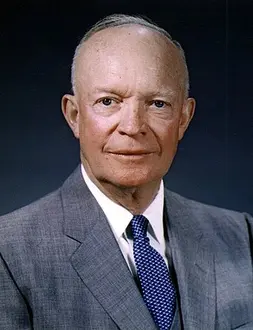
US president (1953-1961); Supreme Allied Commander in Europe; five-star general
Eisenhower described himself as a 'moderate' who sought a middle way: he cut taxes and federal spending and aimed to balance the budget, yet kept and extended social security and the New Deal's core programs and built the interstate highway system. In foreign policy he led the Cold War alliance system and relied on nuclear deterrence and covert action, while pursuing arms control and warning in his farewell of the military-industrial complex. He enforced school desegregation at Little Rock and signed the first civil rights acts since Reconstruction.
Closest ideologies
Based on the 66 statements where Dwight D. Eisenhower has a known position.
- Illiberal democracy (91% match)
- Sahrawi nationalism (90% match)
- Neo-Ottomanism (89% match)
- Christian Democracy (89% match)
- Centrism (88% match)
Similar people
- Soong May-ling (90% alike)
- Hassan Sheikh Mohamud (90% alike)
- Shinzō Abe (90% alike)
- Gerald Ford (90% alike)
- Keiko Fujimori (90% alike)
Known positions
- Strongly: A country may let foreign allies keep troops and bases on its land.
- Strongly: Population growth should be deliberately held down.
- Strongly: My country should possess its own nuclear arsenal with independent authority over its use.
- Strongly: Private businesses and markets should run most of the economy, while the government supports people who cannot meet their basic needs.
- Strongly: My country may join a military alliance led by one of the great powers.
- Strongly: Businesses should be legally barred from agreements with competitors to suppress competition, such as fixing prices.
- Strongly: Government should support building nuclear power plants.
- Strongly: Government should be bound by written guarantees of basic rights protected against easy amendment by ordinary majorities.
- Strongly: Countries should maintain only the weapons needed for national safety.
- Strongly: Allies are bound to defend one another against armed attack.
- Strongly: Political power should be split among separate branches and levels that can each limit the others.
- Strongly: Religious values and institutions should shape laws, schools and public life.
- Strongly: A country with nuclear weapons should keep them for as long as its rivals retain theirs.
- Strongly: Foreign powers sometimes have a right to intervene in a country's internal affairs.
- Strongly: The government should be able to require citizens to serve in the military.
- Strongly: Government should serve people's good while respecting each person as more than an instrument of the state or community.
- Strongly: A country may join permanent military alliances.
- Strongly: An electorate should choose the head of state, either directly or through elected representatives.
- Strongly: Workers are better off for having labor unions.
- Strongly: Where they conflict, religious faith should count for at least as much as evidence and reasoning.
- Strongly: Politics should support people's spiritual well-being.
- Strongly: An economy directed by a central plan is not capable of working better than one directed by market exchange.
- Strongly: Being powerful does not mean a country should bring more land within its borders.
- Strongly: Islam is compatible with Western values.
- Strongly: A workers' state does not need to suppress the old ruling class, even for a time.
- Strongly: Society needs government of some kind.
- Strongly: Countries should keep their armed forces.
- Strongly: The ruler should be subject to the country's laws.
- Strongly: Government should have other tasks besides protecting people from physical violence.
- Strongly: Voting should not be limited to members of one ethnic group.
- Strongly: Public spaces such as schools and facilities should not be separated by race under the law.
- Strongly: The Holocaust happened as historians describe it.
- Leans: My country should give weapons to foreign insurgents fighting governments it regards as enemies.
- Leans: The UN should have authority to compel member states to comply with its decisions.
- Leans: Art, poetry and stories that harm people's moral character should be censored.
- Leans: Choices that harm no one else should never be crimes.
- Leans: The state should not guarantee health care to everyone.
- Leans: At its core, politics is a struggle between spiritual good and evil.
- Leans: Prices and competition generally decide better than officials what gets made and who gets it.
- Leans: A country should be ready to use military force abroad on its own judgment, even if the UN Security Council has not authorized it.
- Leans: There should be legal limits on strike action.
- Leans: Fewer tariffs and trade barriers make all countries better off over time.
- Leans: Changes to society should be introduced a little at a time.
- Leans: My country's military strength should exceed that of its rivals.
- Leans: State schools should not teach religion.
- Leans: Distance and nationality do not weaken the duty of the rich to help the poor abroad.
- Leans: Full-time work at the legal wage floor should pay enough to meet basic living costs.
- Leans: Political decisions should rest with the smallest local community able to handle them, with wider authorities handling matters that need a wider reach.
- Leans: Governments should not borrow heavily, spending much more than they collect in taxes, to boost the economy.
- Leans: A government should outlaw political parties that aim to do away with its constitutional order.
- Leans: Society should take active steps to make up for the harm done by past racial injustices.
- Leans: Workers' pay should be settled in collective bargaining between their union and their employer.
- Leans: Rents should be left uncapped by law in areas of housing shortage.
- Leans: The general public should have at least as much say in policy as experts.
- Leans: Public institutions should have the power to constrain a national majority's decisions in a liberal democracy.
- Leans: We have a duty to leave the planet in good condition for those who come after us.
- Leans: Whatever their circumstances, everyone should be able to count on the state for enough to live decently, through benefits, pensions or public services.
- Leans: A people with a shared national identity is entitled to its own self-governing state.
- Leans: The law should treat everyone as an equal, whatever their birth, sex, race or status.