Political Ideology Atlas · All people · Take the test
Russia & Central Asia · born 1842, historical
Peter Kropotkin
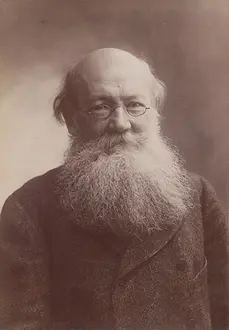
Russian anarchist communist theorist, geographer and revolutionary (1842–1921)
Kropotkin advocated common access to wealth through voluntary, decentralized associations, rejecting capitalist ownership and state socialism. He treated mutual aid as a foundation of social development, sought integration of manual and intellectual work, and criticized prisons. His later record combines support for Allied resistance in 1916 with opposition to foreign intervention and party dictatorship in revolutionary Russia.
Closest ideologies
Based on the 44 statements where Peter Kropotkin has a known position.
- Black anarchism (90% match)
- Antifa (89% match)
- Magonism (88% match)
- Autonomism (87% match)
- Autonomist Marxism (86% match)
Similar people
- Bill Ayers (91% alike)
- Noam Chomsky (90% alike)
- Angela Davis (89% alike)
- Helen Keller (85% alike)
- Mikhail Bakunin (84% alike)
Known positions
- Strongly: Society would be better off without governments at all.
- Strongly: Police forces should be abolished and replaced with other ways of keeping people safe.
- Strongly: Eventually people should produce and share without money.
- Strongly: In the long run people should be free to live and work in any country.
- Strongly: Political power should rest on councils elected in workplaces in place of parliaments.
- Strongly: Farms, factories and utilities belong to the town or city that uses them.
- Strongly: Towns and cities should link through councils whose delegates coordinate and administer what local assemblies decide, without making policy themselves.
- Strongly: The fact that something is law is not, by itself, a moral reason to obey it.
- Strongly: Housework and childcare should be provided as public services in place of being done within families.
- Strongly: People should live and work in communities that own land and goods together and govern themselves.
- Strongly: A region should be entitled to leave its current country.
- Strongly: Laws, police and government mainly serve the interests of whoever owns the economy and holds power.
- Strongly: Where they conflict, evidence and reasoning should count for more than faith, God, revelation or scripture.
- Strongly: Owners' profit is value taken from workers' labor.
- Strongly: In the society we should aim for, a person's needs should determine their share of goods.
- Strongly: People seeking political change should act directly—for example, with strikes, boycotts or occupations—instead of pursuing change through elections and parliaments.
- Strongly: The state should be barred from executing people convicted of the gravest crimes, such as terrorism.
- Strongly: Women's subordination is tied to how the economy is organised, so reform of laws and attitudes is not enough.
- Strongly: Production should be organised to provide what people need, instead of being organised around what yields a profit.
- Strongly: The goods people consume should mainly come from nearby producers.
- Strongly: Political decisions should rest with the smallest local community able to handle them, with wider authorities handling matters that need a wider reach.
- Strongly: Without workers' own political power, state ownership is not socialism.
- Strongly: Land that a state declares its own against its people's will is still illegally occupied by that state.
- Strongly: You can't reach a free, fair society by unfree or unfair means.
- Strongly: Firms in a market economy need not be owned by the people who work in them.
- Strongly: Owners' rights to their property need not be protected against being overridden for public goals.
- Strongly: Workers are better off for having labor unions.
- Strongly: Even a purely ceremonial head of state should not hold the position by birth.
- Strongly: Private ownership is legitimate only insofar as it benefits society.
- Strongly: Very large concentrations of wealth threaten a free society.
- Strongly: Political violence is sometimes justified.
- Strongly: Being powerful does not mean a country should bring more land within its borders.
- Strongly: The government should let its political opponents organise, speak and compete for power.
- Strongly: The law should treat everyone as an equal, whatever their birth, sex, race or status.
- Strongly: News media should decide for themselves what they publish, whoever holds power.
- Strongly: No party's ideology should give it an exclusive right to lead the state.
- Strongly: Population growth does not mainly drive lasting poverty.
- Strongly: Government should have other tasks besides protecting people from physical violence.
- Strongly: Killing another person can be right in self-defence or in defence of others.
- Leans: Work should no longer be divided into separate specialized jobs held by different people.
- Leans: Automation should be directed towards making the time people need to spend working as short as feasible.
- Leans: How someone turns out is shaped more by upbringing, society and experience than by the traits they are born with.
- Leans: In a war between great powers, workers need not seek their own government's defeat.
- Leans: Soldiers and conscripts need not refuse to fight when their state goes to war.