Political Ideology Atlas · All people · Take the test
Russia & Central Asia · born 1894, historical
Nikita Khrushchev
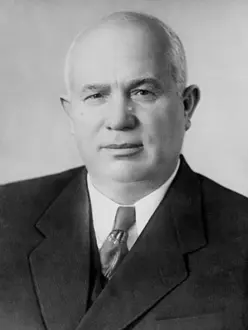
First Secretary of the CPSU (1953-1964) and Soviet premier (1958-1964)
Khrushchev was a Marxist-Leninist who led the Soviet Union under single-party rule, a planned economy and collective farming. He denounced Stalin's cult of personality and mass repression in 1956, promoted peaceful coexistence and disarmament proposals, and also crushed the Hungarian uprising, ran an anti-religious campaign and kept Party control of press and arts.
Closest ideologies
Based on the 77 statements where Nikita Khrushchev has a known position.
- Taistoism (90% match)
- Soviet democracy (89% match)
- Kaysone Phomvihane Thought (89% match)
- Marxism–Leninism–Maoism–Prachanda Path (87% match)
- Titoism (86% match)
Similar people
- Maxim Gorky (89% alike)
- Nikolai Bukharin (89% alike)
- Josip Broz Tito (88% alike)
- Leon Trotsky (86% alike)
- Salvador Allende (85% alike)
Known positions
- Strongly: Education provided by the state should encourage people to reject belief in God.
- Strongly: A country can and should do without a standing military.
- Strongly: A workers' state must suppress the old ruling class for a time.
- Strongly: A state whose economy is publicly owned and planned should be defended against a return to capitalism even if a bureaucracy rules it.
- Strongly: One ideologically correct party should hold state leadership without competing parties having a right to replace it.
- Strongly: The people in power should decide what the country's news media publish.
- Strongly: Workers require political leadership from a tightly organised revolutionary party.
- Strongly: Farming should be organized as joint cultivation by groups of farmers instead of separate individual farm operations.
- Strongly: An economy whose production is directed by a central plan is capable of working better than an economy directed by market exchange.
- Strongly: My country should possess its own nuclear arsenal with independent authority over its use.
- Strongly: Laws, police and government mainly serve the interests of whoever owns the economy and holds power.
- Strongly: Owners' profit is value taken from workers' labor.
- Strongly: The government should have authority over religious institutions' internal affairs.
- Strongly: In the society we should aim for, a person's needs should determine their share of goods.
- Strongly: Cooperation between employers and workers should not come before conflict where their interests differ.
- Strongly: The state should offer public work to anyone who wants a job and cannot find one.
- Strongly: Religious values and institutions should not have a major part in shaping laws, schools and public life.
- Strongly: Property need not be spread among many small owners.
- Strongly: Countries should maintain only the weapons needed for national safety.
- Strongly: Production should be organised to provide what people need, instead of being organised around what yields a profit.
- Strongly: Industries such as energy, rail and utilities should be owned by the state or public bodies, not private companies.
- Strongly: The Soviet economy was not capitalism under state ownership with the state in place of private capitalists.
- Strongly: Defeating communism should not take priority over coexistence with it.
- Strongly: Without workers' own political power, state ownership is not socialism.
- Strongly: The government should steer investment into industries it sees as key to the country's future.
- Strongly: After members debate and adopt a party decision, every member should have to help implement it, including those who opposed it.
- Strongly: Workers' solidarity with workers in other countries should count at least as much as solidarity with their own nation.
- Strongly: Owners' rights to their property need not be protected against being overridden for public goals.
- Strongly: Officials decide what gets made and who gets it at least as well as prices and competition do.
- Strongly: Political independence means little unless the economic and property system is also transformed.
- Strongly: Publicly honouring a national leader as the personification of the nation is not acceptable.
- Strongly: Society need not promote ways of living that differ from custom.
- Strongly: The state should guarantee health care to everyone, whether it runs the services itself or pays for them.
- Strongly: Foreign armies should not be based on the country's territory.
- Strongly: Class struggle does not continue under socialism.
- Strongly: Economic growth should not be limited for the sake of the environment.
- Strongly: Whatever their circumstances, everyone should be able to count on the state for enough to live decently, through benefits, pensions or public services.
- Strongly: War does not strengthen a nation's character.
- Strongly: Political violence is sometimes justified.
- Strongly: Income from useful work should be rewarded ahead of income from merely owning property.
- Strongly: A people with a shared national identity is entitled to its own self-governing state.
- Strongly: A country may leave other nations to choose their own political systems.
- Strongly: Minority groups are not, as groups, secretly plotting to harm the nation.
- Strongly: Looking after your own interests is not a moral good in itself.
- Strongly: At least some revolutions have been justified.
- Strongly: No state may force a minority out of the country, however hostile it judges that minority to be.
- Strongly: No society has the right to rule another for its supposed improvement, however advanced it is.
- Strongly: The ruler should be subject to the country's laws.
- Strongly: Overseas territories need not be run mainly for the ruling country's economic benefit.
- Strongly: The holder of the highest state office need not be treated as holy.
- Strongly: Public spaces such as schools and facilities should not be separated by race under the law.
- Leans: My country should give weapons to foreign insurgents fighting governments it regards as enemies.
- Leans: Art, poetry and stories that harm people's moral character should be censored.
- Leans: Elected politicians should serve only a small number of terms.
- Leans: A poor country should rely on foreign money at least as much as on its own resources.
- Leans: A country should not tie itself to other countries through lasting military alliances.
- Leans: Force is for self-defence alone.
- Leans: Governments should answer in law for past abuses by their security forces, including unlawful killings.
- Leans: New oil and gas wells and coal mines should be permitted.
- Leans: Government should support building nuclear power plants.
- Leans: Farmers should get price floors, state buying or cheap credit to keep them secure.
- Leans: A country with nuclear weapons should keep them for as long as its rivals retain theirs.
- Leans: The global economic system keeps poorer countries poor by directing their wealth toward richer countries.
- Leans: Countries that feel dominated by Western powers should band together to resist them.
- Leans: Each country's communist party should decide its strategy for socialism without taking orders from another country's party.
- Leans: Social duty should not take the place of material rewards as the main reason people work.
- Leans: Capitalism does not inevitably cause wars between great powers.
- Leans: A people split by an imposed border should be brought together in a single state.
- Leans: Rulers must act under lasting, publicly known laws administered by recognised courts.
- Leans: Lasting socialism in one country does not require socialist revolutions abroad.
- Leans: The existing governing institutions should be retained, even if their personnel, policies or procedures change.
- Leans: In an economy with common ownership of productive assets, people should still own their personal belongings.