Political Ideology Atlas · All people · Take the test
Europe · born 1483, historical
Martin Luther
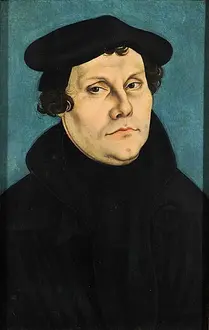
German theologian and leader of the Protestant Reformation (1483-1546)
Luther taught that God rules through two governments, a spiritual one by the Word and a temporal one by the sword, and that Christians owe rulers obedience except where commanded to sin. He attacked papal and clerical privilege, wanted rulers to restrain luxury, usury, monopolies and begging and to found schools, backed the princes against the peasants in 1525, and in later years called for suppressing Jewish worship and expelling Jews.
Closest ideologies
Based on the 53 statements where Martin Luther has a known position.
- Brazilian Integralism (88% match)
- Sinhalese Buddhist nationalism (87% match)
- Greater Romania (86% match)
- Right-Wing Populism (86% match)
- Neo-Nazism (86% match)
Similar people
- Chiang Kai-shek (89% alike)
- Bashar al-Assad (87% alike)
- Ali Khamenei (86% alike)
- Viktor Orbán (85% alike)
- Oliver Cromwell (85% alike)
Known positions
- Strongly: A state may force a minority it sees as hostile to leave the country.
- Strongly: The state should punish people who publicly insult what a religion holds sacred.
- Strongly: Overthrowing a government by revolution is never justified, whatever the cause.
- Strongly: God is the ultimate source of the right to exercise political authority.
- Strongly: The holy scripture of one's faith is God's own word and contains no errors.
- Strongly: At its core, politics is a struggle between spiritual good and evil.
- Strongly: The government should have authority over religious institutions' internal affairs.
- Strongly: Governments should set legal price ceilings on essential foods when supplies are scarce.
- Strongly: Force is for self-defence alone.
- Strongly: Businesses should be legally barred from agreements with competitors to suppress competition, such as fixing prices.
- Strongly: Rich people have an obligation to help those worse off than they are.
- Strongly: State schools may teach pupils a religious faith, for example through lessons in its beliefs and practice.
- Strongly: Religious values and institutions should shape laws, schools and public life.
- Strongly: The worst crimes can be punished by death.
- Strongly: Ending a marriage should not be possible without proving fault.
- Strongly: A woman who has sex outside marriage is doing something wrong.
- Strongly: Sex work between consenting adults should be illegal.
- Strongly: Government should impose strict rules on how corporations operate.
- Strongly: Where they conflict, religious faith should count for at least as much as evidence and reasoning.
- Strongly: A healthy society depends on the traditional family, such as a married mother and father raising their children.
- Strongly: Constantly seeking additional possessions is harmful overall, despite any benefits it brings.
- Strongly: The state may restrict what adults do for reasons other than preventing harm to others.
- Strongly: Being the law gives a rule a moral claim to be obeyed.
- Strongly: The great religions need not share a single underlying truth.
- Strongly: Political violence is sometimes justified.
- Strongly: Income from useful work should be rewarded ahead of income from merely owning property.
- Strongly: Being powerful does not mean a country should bring more land within its borders.
- Strongly: Looking after your own interests is not a moral good in itself.
- Strongly: In a war between great powers, workers need not seek their own government's defeat.
- Strongly: Society needs government of some kind.
- Strongly: Countries should keep their armed forces.
- Strongly: Government should have other tasks besides protecting people from physical violence.
- Strongly: Collecting taxes does not in itself amount to stealing people's money.
- Strongly: Killing another person can be right in self-defence or in defence of others.
- Strongly: Final authority over a state's laws need not belong to its most senior religious scholars.
- Leans: Charging interest on loans is banned by law.
- Leans: Owners' rights to their property should almost never be overridden, even for public goals.
- Leans: A national emergency sometimes justifies temporarily withdrawing normal legal safeguards against people the government regards as internal enemies, such as protections against detention without trial.
- Leans: Changes to society should be introduced a little at a time.
- Leans: Living in the countryside does more for a person's moral wellbeing than living in a city.
- Leans: Some institutional ties between government and religion are acceptable.
- Leans: People able to work should get welfare benefits only in return for some work, such as a job or a work scheme.
- Leans: People should want as few material things as possible.
- Leans: Free trade does not benefit everyone in the long run.
- Leans: Some things are right or wrong for everyone, in every culture and era.
- Leans: Government should rely at least as much on legal enforcement as on its rulers' moral example.
- Leans: Most people in political office look after themselves first and the public second.
- Leans: Whatever their circumstances, everyone should be able to count on the state for enough to live decently, through benefits, pensions or public services.
- Leans: Soldiers and conscripts need not refuse to fight when their state goes to war.
- Leans: Laws should not be required to follow religious texts.
- Leans: The law should treat everyone as an equal, whatever their birth, sex, race or status.