Political Ideology Atlas · All ideologies · Take the test
Greater Romania
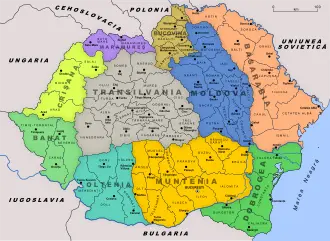
Greater Romania is the Romanian nationalist ideal of uniting all Romanians in one state, first realised in 1918 with Transylvania, Bessarabia and Bukovina and lost in part in 1940. Today it survives as irredentism toward Moldova and parts of Ukraine, most visibly in the Greater Romania Party. Adherents combine ethnic nationalism, Orthodox-tinged social conservatism, and a state-centred, populist approach to the economy.
What it stands for
- A powerful country should bring more land within its borders.
- The country's majority national group should have the leading role in controlling economic life.
- The presence of people belonging to the same nation gives a state a legitimate territorial claim outside its borders.
- A nation should be mainly one ethnic people.
- Peoples who share an ethnic heritage, such as the Slavic, Arab or Turkic peoples, should come together in one state, even across present borders.
- A national emergency sometimes justifies temporarily withdrawing normal legal safeguards against people the government regards as internal enemies, such as protections against detention without trial.
Key figures
- Corneliu Vadim Tudor: Founder and long-time leader of the Greater Romania Party
- Ion I. C. Brătianu: Liberal leader who governed during and after the 1918 unions
Closest ideologies
- Akhand Bharat (92% match)
- Idealism (92% match)
- Ilminism (89% match)
- Sinhalese Buddhist nationalism (89% match)
- Right-Wing Populism (89% match)
People closest to it
- Viktor Orbán (91% alike)
- Oliver Cromwell (87% alike)
- Asmongold (87% alike)
- Otto von Bismarck (87% alike)
- Alexander I of Yugoslavia (86% alike)
Key positions
- Strongly: A powerful country should bring more land within its borders.
- Strongly: The country's majority national group should have the leading role in controlling economic life.
- Strongly: The presence of people belonging to the same nation gives a state a legitimate territorial claim outside its borders.
- Strongly: A nation should be mainly one ethnic people.
- Strongly: Peoples who share an ethnic heritage, such as the Slavic, Arab or Turkic peoples, should come together in one state, even across present borders.
- Strongly: A national emergency sometimes justifies temporarily withdrawing normal legal safeguards against people the government regards as internal enemies, such as protections against detention without trial.
- Strongly: A country should press its neighbour to give back land taken from it in an old war.
- Strongly: Areas where an ethnic minority is the majority may be governed in the same way as the rest of the state.
- Strongly: Only children of citizens should be citizens at birth: being born in the country should not be enough.
- Strongly: Speaking a common language is sufficient for people to constitute one nation.
- Strongly: When national priorities conflict with working together internationally, my country should choose its own priorities.
- Strongly: Past abuses by a state's security forces may be put behind it without anyone answering for them in court.
- Strongly: Belonging to the nation ties a person's life to a sacred community that goes on after their death.
- Strongly: Land claimed as the historic homeland should not be traded away, even for peace.
- Strongly: An ancestral bond to a land gives a people a claim that outweighs the claims of other peoples who now live there.
- Strongly: Land that a state declares its own against its people's will is still illegally occupied by that state.
- Strongly: Today's nation is the same people as its ancient and medieval forebears.
- Strongly: People belonging to a nation but living abroad should be entitled to settle in that nation's ancestral homeland.
- Strongly: People who give their lives for the nation deserve to be remembered as martyrs, with reverence beyond ordinary thanks.
- Strongly: A healthy society depends on the traditional family, such as a married mother and father raising their children.
- Strongly: Schools should cultivate patriotic feeling: loyalty to and pride in the nation, expressed for example through respect for its flag and anthem.
- Strongly: A people split by an imposed border should be brought together in a single state.
- Strongly: A state should take responsibility for the welfare of its national communities across neighbouring borders.
- Strongly: Lasting socialism in one country does not require socialist revolutions abroad.
- Strongly: Population growth may be left to run its course.
- Strongly: Other forces move history at least as much as conflict between classes does.
- Strongly: Most people in political office look after themselves first and the public second.
- Strongly: A people with a shared national identity is entitled to its own self-governing state.
- Strongly: A people's connection to its ancestral land is spiritual, beyond practical interests or ordinary affection.
- Strongly: Groups have rights of their own.
- Strongly: School history should mostly tell the story of the student's own nation.
- Strongly: Being the first to use force can be right, depending on what it is meant to achieve.
- Strongly: Lending money at interest should be legal.
- Strongly: Political power may rest on something other than workplace-elected councils.
- Strongly: Countries may keep controls on who enters and settles, even in the long run.
- Strongly: Keeping a nation's inherited culture alive, including its language, customs and traditions, matters.
- Strongly: In a war between great powers, workers need not seek their own government's defeat.
- Strongly: The armed forces may be controlled by someone other than the governing party's leadership.
- Strongly: Industrial society has done at least as much good as harm to humanity.
- Strongly: Work may stay divided into separate specialized jobs held by different people.
- Strongly: In the long run people should still produce and share using money.
- Strongly: Each country should hold ultimate authority over its natural resources, without foreign interests controlling them.
- Strongly: The vote keeps a government in check at least as well as being able to leave the country does.
- Strongly: A workers' state does not need to suppress the old ruling class, even for a time.
- Strongly: Public offices may be filled by methods other than drawing lots.
- Strongly: Society needs government of some kind.
- Strongly: Countries should keep their armed forces.
- Strongly: The state should not be managed the way a well-run business is.
- Strongly: Government should have other tasks besides protecting people from physical violence.
- Strongly: Political authority need not rest on oaths of loyalty sworn to a lord.
- Strongly: Courts need not be handed over to private businesses.
- Strongly: Museums, libraries and other inherited culture should not be destroyed, even when they stand in the way of new creation.
- Strongly: Humanity would gain nothing by going back to living off hunting and gathering.
- Strongly: Farmers should have the legal freedom to leave the estates they work.
- Leans: A minority group is working in secret to harm the nation.
- Leans: Most of the average difference in ability between racial groups comes from genes.
- Leans: Belonging to the nation goes with sharing its religion.
- Leans: Members of every racial group should organise politically around interests specific to their group.
- Leans: Recovering how society used to be matters more than moving forward.
- Leans: It is acceptable to praise a national leader openly as the one who stands for the whole nation.
- Leans: At its core, politics is a struggle between spiritual good and evil.
- Leans: The national church is recognised in law above other religions.
- Leans: A society holds together less well when its members belong to different ethnic groups.
- Leans: A country should try to sell more abroad than it buys from abroad.
- Leans: There should be legal limits on strike action.
- Leans: Strict legal limits should apply to owning a gun.
- Leans: Eligibility for citizenship should require immigrants to have lived in the country for ten years or longer.
- Leans: The state should make one language the only common language of government, schooling and public life, limiting the use of others.
- Leans: The country would benefit from a strong leader with the power to act despite deadlock among its political institutions.
- Leans: The representative legislature should have the final say on legislation.
- Leans: Public institutions do not need to help minority languages be used in public life.
- Leans: Workers' solidarity with their own nation should take priority over solidarity with workers across borders.
- Leans: Countries within one civilization should unite politically.
- Leans: An assembly elected by the people for that purpose should draft the constitution.
- Leans: The nation's figurehead should be non-partisan and belong to everyone.
- Leans: Real authority to command the military should rest with the head of state.
- Leans: Governments may spend well beyond their tax revenue to support a weak economy.
- Leans: Many political decisions should rest with national or wider authorities, even where a smaller community could handle them.
- Leans: New oil and gas wells and coal mines should be permitted.
- Leans: Land stays in the hands of citizens; foreigners may not buy it.
- Leans: Taxes on imports should shield domestic producers from foreign competition.
- Leans: Allies are bound to defend one another against armed attack.
- Leans: Wealthy countries have no duty to give substantial aid to the world's poor abroad.
- Leans: Living in the countryside does more for a person's moral wellbeing than living in a city.
- Leans: State schools may teach pupils a religious faith, for example through lessons in its beliefs and practice.
- Leans: Religious values and institutions should shape laws, schools and public life.
- Leans: The worst crimes can be punished by death.
- Leans: The nation has decayed and must be reborn.
- Leans: Some institutional ties between government and religion are acceptable.
- Leans: Cultural life inside a state should not be placed under the control of each national minority.
- Leans: A government should outlaw political parties that aim to do away with its constitutional order.
- Leans: Armed forces may sometimes be used for purposes beyond defending the country against attack.
- Leans: Marriage, inheritance and family law should be the same for everyone, not set by each religious community.
- Leans: Whether a policy fits an ideology should count independently of its results.
- Leans: The country should impose strict limits on immigration.
- Leans: The government should steer investment into industries it sees as key to the country's future.
- Leans: A country may join permanent military alliances.
- Leans: Final authority over a state's laws need not belong to its most senior religious scholars.
- Leans: Public spaces such as schools and facilities should not be separated by race under the law.
- Leans: The state should stop foreign buyers from taking over key national businesses.
- Leans: A nation need not wait for a cultural revival before building its state.
- Leans: Direct action does not have to take the place of elections and parliament as the way to achieve political change.
- Leans: Some cultures are superior to others.
- Leans: Employers and workers should treat each other as partners whose cooperation comes before conflict, even where their interests differ.
- Leans: Gathering all the people in the homeland should have at least as much priority as supporting diaspora culture.
- Leans: Officials decide what gets made and who gets it at least as well as prices and competition do.
- Leans: Religious institutions should be independent of government direction in their internal affairs.
- Leans: Capitalism does not inevitably cause wars between great powers.
- Leans: Where they conflict, religious faith should count for at least as much as evidence and reasoning.
- Leans: The people who own the economy and hold power are not the ones the state mainly serves.
- Leans: A country may keep all its decisions in its own hands rather than pooling them with other nations.
- Leans: People may live and work outside communities that own their property together.
- Leans: National policy should give priority to preventing outside powers from splitting the country territorially.
- Leans: Women should be able to vote and stand for office on the same terms as men.
- Leans: Some areas of life should remain outside state direction.
- Leans: Population growth does not mainly drive lasting poverty.
- Leans: The state should guarantee health care to everyone, whether it runs the services itself or pays for them.
- Leans: The state may restrict what adults do for reasons other than preventing harm to others.
- Leans: Private ownership is legitimate only insofar as it benefits society.
- Leans: Small, informal, trust-based groups should not take the place of lasting parties, unions and federations in political action.
- Leans: No party's ideology should give it an exclusive right to lead the state.
- Leans: Whatever their circumstances, everyone should be able to count on the state for enough to live decently, through benefits, pensions or public services.
- Leans: Looking after your own interests is not a moral good in itself.
- Leans: Workers do not need a disciplined revolutionary party to lead them.
- Leans: A country may leave other nations to choose their own political systems.
- Leans: Individual farms should not give way to joint cultivation by groups of farmers.