Political Ideology Atlas · All people · Take the test
North America · born 1929, historical
Martin Luther King Jr.
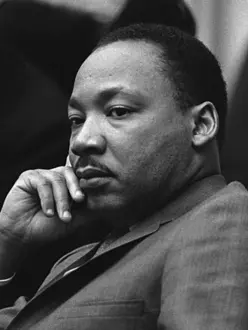
Baptist minister and civil rights leader; SCLC president (1957-1968)
King led the nonviolent civil rights movement against segregation, grounding civil disobedience in a higher moral law. In his last years he extended his aims to economic justice, calling for a guaranteed income, jobs and a restructuring of American society, and opposed the Vietnam War. He rejected both communism and laissez-faire capitalism and favored a synthesis of the two.
Key figure of
Closest ideologies
Based on the 36 statements where Martin Luther King Jr. has a known position.
- Spiritual left (94% match)
- Radical democracy (92% match)
- Native American feminism (92% match)
- Egalitarianism (92% match)
- Religious socialism (92% match)
Similar people
- Jasmine Crockett (91% alike)
- Cesar Chavez (91% alike)
- Diane Abbott (91% alike)
- Rabindranath Tagore (91% alike)
- Justin Welby (91% alike)
Known positions
- Strongly: The government should pay all adults a regular sum with no strings attached.
- Strongly: Society should follow a third course beyond capitalism and communism.
- Strongly: The state should offer public work to anyone who wants a job and cannot find one.
- Strongly: Distance and nationality do not weaken the duty of the rich to help the poor abroad.
- Strongly: Society may be changed in large, rapid steps.
- Strongly: Society should take active steps to make up for the harm done by past racial injustices.
- Strongly: Some things are right or wrong for everyone, in every culture and era.
- Strongly: A law imposes no moral duty to obey it if the law is unjust.
- Strongly: At least one other factor explains as much of history as changes in how economies are organized do.
- Strongly: Meeting poor people's needs should be the first consideration in public policy.
- Strongly: You can't reach a free, fair society by unfree or unfair means.
- Strongly: The law should treat everyone as an equal, whatever their birth, sex, race or status.
- Strongly: Armed conflict does not generally make a people stronger in character.
- Strongly: Constantly seeking additional possessions is harmful overall, despite any benefits it brings.
- Strongly: The reassurance people draw from faith in the face of material hardship need not be founded on false hopes.
- Strongly: Racism now holds disadvantaged racial groups back at least as much as any other single barrier.
- Strongly: Private owners' choice of whom they deal with should be subject to some restrictions.
- Strongly: Voting should not be limited to members of one ethnic group.
- Strongly: Public spaces such as schools and facilities should not be separated by race under the law.
- Leans: The fact that something is law is not, by itself, a moral reason to obey it.
- Leans: Democracy is best even when voters make poor choices.
- Leans: The farmers who work large estates should take ownership from the landowners, with the transfer compulsory if owners refuse.
- Leans: Countries should maintain only the weapons needed for national safety.
- Leans: Religious values and institutions should shape laws, schools and public life.
- Leans: Owners' rights to their property need not be protected against being overridden for public goals.
- Leans: The global economic system keeps poorer countries poor by directing their wealth toward richer countries.
- Leans: Workers are better off for having labor unions.
- Leans: Politics should support people's spiritual well-being.
- Leans: Rulers have a right to rule only because the people they rule have agreed to it.
- Leans: Being allowed to make a choice only counts as freedom if you have the resources to act on it.
- Leans: People should have a direct role in making decisions where they work, live and study, rather than having those decisions made entirely for them.
- Leans: A people with a shared national identity is entitled to its own self-governing state.
- Leans: Whatever their circumstances, everyone should be able to count on the state for enough to live decently, through benefits, pensions or public services.
- Leans: Owning things privately is justified only if it benefits society as a whole.