Political Ideology Atlas · All people · Take the test
North America · born 1927, historical
Cesar Chavez
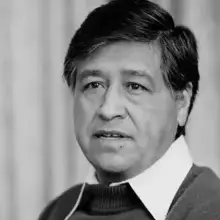
Labor leader and co-founder of the United Farm Workers (1927–1993)
A farmworkers' union leader who co-founded the National Farm Workers Association and the United Farm Workers. He pursued change through nonviolent direct action such as boycotts, marches and fasts, grounded in Catholic social teaching and in Mexican-American and Chicano identity. He defended collective bargaining, attacked pesticide use and grower influence on politics, and changed his position on undocumented immigration over the 1970s.
Closest ideologies
Based on the 38 statements where Cesar Chavez has a known position.
- Nouvelle Droite (94% match)
- Melanesian socialism (94% match)
- Katarism (94% match)
- Spiritual left (93% match)
- Economic democracy (93% match)
Similar people
- Aurobindo Ghosh (95% alike)
- Eugene McCarthy (92% alike)
- Óscar Romero (92% alike)
- Abdul El-Sayed (91% alike)
- Martin Luther King Jr. (91% alike)
Known positions
- Strongly: Democracy is best even when voters make poor choices.
- Strongly: Property should belong to many people in small holdings.
- Strongly: Society should take active steps to make up for the harm done by past racial injustices.
- Strongly: Workers' pay should be settled in collective bargaining between their union and their employer.
- Strongly: One worker's pay should cover the living needs of that worker's family, including the worker.
- Strongly: The law should impose no restrictions on strikes.
- Strongly: Workers are better off for having labor unions.
- Strongly: People should have a direct role in making decisions where they work, live and study, rather than having those decisions made entirely for them.
- Strongly: The law should treat everyone as an equal, whatever their birth, sex, race or status.
- Strongly: It is legitimate to take pride in the racial group one belongs to.
- Strongly: The reassurance people draw from faith in the face of material hardship need not be founded on false hopes.
- Strongly: Looking after your own interests is not a moral good in itself.
- Strongly: When companies press officials for policies they want, they gain more sway over public decisions than they should have.
- Strongly: Private owners' choice of whom they deal with should be subject to some restrictions.
- Strongly: Taking part in politics is at least as good a way to live as living privately away from public affairs.
- Leans: People of each race should organize politically as a group to stand up for concerns specific to them.
- Leans: Society should not aim to minimise necessary working hours using automation.
- Leans: People with a university education have a poor understanding of how most people live.
- Leans: Business owners make their profit by taking for themselves part of the value their employees create, which is exploitation.
- Leans: Farmers should get price floors, state buying or cheap credit to keep them secure.
- Leans: Private businesses and markets should run most of the economy, while the government supports people who cannot meet their basic needs.
- Leans: Lack of full certainty is no reason to delay protective action.
- Leans: The farmers who work large estates should take ownership from the landowners, with the transfer compulsory if owners refuse.
- Leans: Technology will leave most of humanity's problems unsolved.
- Leans: Employees should have voting rights in the management of large companies.
- Leans: Religious values and institutions should shape laws, schools and public life.
- Leans: Governments should give no subsidies, licences or protections that favour firms close to them.
- Leans: Citizens should have a legal right to see government information.
- Leans: We have a duty to leave the planet in good condition for those who come after us.
- Leans: Small, informal, trust-based groups should not take the place of lasting parties, unions and federations in political action.
- Leans: To work for your country's interests is to work for the interests of its workers.
- Leans: Politics should support people's spiritual well-being.
- Leans: Nature matters for its own sake, not only because it is useful to people.
- Leans: Most people in political office look after themselves first and the public second.
- Leans: Meeting poor people's needs should be the first consideration in public policy.
- Leans: Whatever their circumstances, everyone should be able to count on the state for enough to live decently, through benefits, pensions or public services.