Political Ideology Atlas · All people · Take the test
East Asia · born 1893, historical
Mao Zedong
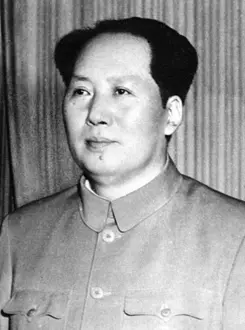
Chinese Communist Party chairman (1943–1976) and leader of the People’s Republic of China
Mao advocated Communist Party leadership, socialist public ownership, collective agriculture and continuing class struggle. His revolutionary mass campaigns sought to transform political authority and culture as well as economic production; his later diplomacy pursued cooperation against Soviet power.
Closest ideologies
Based on the 72 statements where Mao Zedong has a known position.
- Marxism–Leninism–Maoism (91% match)
- Maoism–Third Worldism (90% match)
- Communism (90% match)
- Maoism (89% match)
- Marxism–Leninism (88% match)
Similar people
- Maxim Gorky (91% alike)
- Kwame Nkrumah (90% alike)
- Josip Broz Tito (89% alike)
- Vladimir Lenin (88% alike)
- Che Guevara (88% alike)
Known positions
- Strongly: A workers' state must suppress the old ruling class for a time.
- Strongly: Every part of life should be subject to state direction.
- Strongly: The governing party's own leadership should control the armed forces.
- Strongly: One ideologically correct party should hold state leadership without competing parties having a right to replace it.
- Strongly: The people in power should decide what the country's news media publish.
- Strongly: Workers require political leadership from a tightly organised revolutionary party.
- Strongly: Farming should be organized as joint cultivation by groups of farmers instead of separate individual farm operations.
- Strongly: A socialist state with hostile countries all around it should work to make its state power stronger.
- Strongly: The government should stop its political opponents from organising, speaking or competing for power.
- Strongly: Conflicts between social classes persist after a society becomes socialist.
- Strongly: An economy whose production is directed by a central plan is capable of working better than an economy directed by market exchange.
- Strongly: History is mainly driven by conflict between economic classes.
- Strongly: Political change should replace the existing administrative and coercive institutions with new forms of organization, rather than put new leaders in charge of the old apparatus.
- Strongly: Historical change comes mainly from changes in how society produces and exchanges goods.
- Strongly: My country should possess its own nuclear arsenal with independent authority over its use.
- Strongly: Religious teaching and institutions are a main reason women have been held down.
- Strongly: Laws, police and government mainly serve the interests of whoever owns the economy and holds power.
- Strongly: Wars between great powers are an unavoidable consequence of capitalism.
- Strongly: Owners' profit is value taken from workers' labor.
- Strongly: Cooperation between employers and workers should not come before conflict where their interests differ.
- Strongly: People seeking political change should act directly—for example, with strikes, boycotts or occupations—instead of pursuing change through elections and parliaments.
- Strongly: Society should push new technology forward faster, even where it overturns established institutions.
- Strongly: Workers should form a party of their own, separate from the parties already in place.
- Strongly: The farmers who work large estates should take ownership from the landowners, with the transfer compulsory if owners refuse.
- Strongly: Society does not need a third course beyond capitalism and communism.
- Strongly: Women's subordination is tied to how the economy is organised, so reform of laws and attitudes is not enough.
- Strongly: Property need not be spread among many small owners.
- Strongly: Businesses should belong to the people who work in them, for example as cooperatives.
- Strongly: The worst crimes can be punished by death.
- Strongly: Laws, institutions and customs still favor men over women.
- Strongly: Industries such as energy, rail and utilities should be owned by the state or public bodies, not private companies.
- Strongly: Countries that feel dominated by Western powers should band together to resist them.
- Strongly: Defeating communism should not take priority over coexistence with it.
- Strongly: The government should steer investment into industries it sees as key to the country's future.
- Strongly: Society should take active steps to make up for the harm done by past racial injustices.
- Strongly: A poor country should develop mainly with its own resources.
- Strongly: Society may be changed in large, rapid steps.
- Strongly: Workers' solidarity with workers in other countries should count at least as much as solidarity with their own nation.
- Strongly: The nation's cause and the cause of its ordinary working people are one and the same.
- Strongly: A nation does not need one main ethnic group: it can be made up of people of many ancestries.
- Strongly: Meeting poor people's needs should be the first consideration in public policy.
- Strongly: Spouses should make marital decisions as equals.
- Strongly: The law should not assign different roles in public life on the basis of sex.
- Strongly: Political violence is sometimes justified.
- Strongly: Being powerful does not mean a country should bring more land within its borders.
- Strongly: A government needs more than fair elections to be democratic.
- Strongly: Being the first to use force can be right, depending on what it is meant to achieve.
- Strongly: At least some revolutions have been justified.
- Strongly: Small, informal, trust-based groups should not take the place of lasting parties, unions and federations in political action.
- Strongly: Industrial society has done at least as much good as harm to humanity.
- Strongly: Each country should hold ultimate authority over its natural resources, without foreign interests controlling them.
- Strongly: Women should be able to vote and stand for office on the same terms as men.
- Strongly: Society needs government of some kind.
- Strongly: Countries should keep their armed forces.
- Strongly: Killing another person can be right in self-defence or in defence of others.
- Strongly: People without property should also have the right to vote.
- Strongly: Courts need not be handed over to private businesses.
- Strongly: Farmers should have the legal freedom to leave the estates they work.
- Leans: Museums, libraries and other inherited culture that stand in the way of new creation should be destroyed.
- Leans: War develops virtues in a nation, such as courage and discipline.
- Leans: Society should aim for people to end up with broadly equal material conditions.
- Leans: A healthy society does not depend on the traditional family, such as a married mother and father raising their children.
- Leans: Where they conflict, evidence and reasoning should count for more than faith, God, revelation or scripture.
- Leans: Democracy is not the best form of government when voters choose badly.
- Leans: Working together internationally should count at least as much as my country's own priorities.
- Leans: Entertainment produced for mass audiences tends to weaken people's willingness to challenge the established social order.
- Leans: Prisons should mainly help offenders rejoin society.
- Leans: A market economy is incompatible with socialism under communist-party leadership.
- Leans: World power should be distributed among several independent major powers, without one dominant power.