Political Ideology Atlas · All people · Take the test
South & Southeast Asia · born 1955
Mamata Banerjee
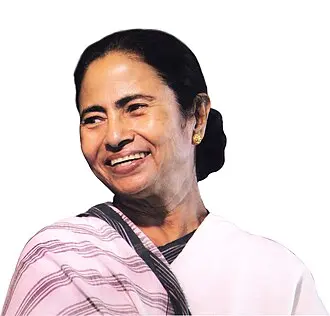
Indian politician; Chief Minister of West Bengal 2011-2026 and founder-leader of the Trinamool Congress; also Union Railway Minister (1999-2000, 2009-2011)
Banerjee is a populist, welfare-oriented politician of the Bengali centre-left who rose by opposing forcible farmland acquisition at Singur and Nandigram. She backs wide cash-transfer and health schemes, legal crop price guarantees and a strong federal role for states, and opposes the CAA, NRC and a Uniform Civil Code while stressing communal harmony. She courts industry, favours rapid growth and tough punishment for rape, and accuses the BJP-led Centre of undermining federalism and democracy.
Closest ideologies
Based on the 48 statements where Mamata Banerjee has a known position.
- Sahrawi nationalism (92% match)
- Illiberal democracy (91% match)
- Producerism (87% match)
- Peronism (87% match)
- Zionism (86% match)
Similar people
- Harry S. Truman (91% alike)
- Hassan Sheikh Mohamud (91% alike)
- Soong May-ling (90% alike)
- Lyndon B. Johnson (90% alike)
- Charles de Gaulle (89% alike)
Known positions
- Strongly: Marriage, inheritance and family law may differ between religious communities.
- Strongly: Farmers should get price floors, state buying or cheap credit to keep them secure.
- Strongly: The worst crimes can be punished by death.
- Strongly: Full-time work at the legal wage floor should pay enough to meet basic living costs.
- Strongly: Public institutions should help minority languages be used in public life, for example through teaching or services in those languages.
- Strongly: The state should guarantee health care to everyone, whether it runs the services itself or pays for them.
- Strongly: Whatever their circumstances, everyone should be able to count on the state for enough to live decently, through benefits, pensions or public services.
- Strongly: The law should treat everyone as an equal, whatever their birth, sex, race or status.
- Strongly: Belonging to the nation does not go with sharing its religion.
- Strongly: The armed forces may be controlled by someone other than the governing party's leadership.
- Strongly: The slaughter of cattle should be legal.
- Leans: A government should sometimes be entitled to stop internet connectivity across an area for public-order reasons.
- Leans: Elected governments should leave central banks free to make monetary-policy decisions within their legal mandates.
- Leans: Violence is never an acceptable way to pursue political goals.
- Leans: Binding composition rules should ensure that public bodies have approximately equal numbers of women and men.
- Leans: There should be legal limits on strike action.
- Leans: Owners' rights to their property should almost never be overridden, even for public goals.
- Leans: Publicly funded services such as hospitals and schools should be run by private companies and charities as well as the state.
- Leans: New oil and gas wells and coal mines should be permitted.
- Leans: The state should offer public work to anyone who wants a job and cannot find one.
- Leans: Besides its directly elected parliament, a legislature should have a second chamber, such as a senate.
- Leans: Political power should be split among separate branches and levels that can each limit the others.
- Leans: The nation has decayed and must be reborn.
- Leans: Some institutional ties between government and religion are acceptable.
- Leans: Industries such as energy, rail and utilities should be owned by the state or public bodies, not private companies.
- Leans: Military intervention abroad is sometimes necessary to protect human rights.
- Leans: Political decisions should rest with the smallest local community able to handle them, with wider authorities handling matters that need a wider reach.
- Leans: Belonging to the nation ties a person's life to a sacred community that goes on after their death.
- Leans: Indigenous peoples should control their traditional territories.
- Leans: Citizens should have a legal right to see government information.
- Leans: The government should steer investment into industries it sees as key to the country's future.
- Leans: The national legislature should not be able to take back powers given to regions on its own.
- Leans: After members debate and adopt a party decision, every member should have to help implement it, including those who opposed it.
- Leans: Society may hold back technological change that would overturn established institutions.
- Leans: Universal social programmes should be kept, not replaced by programmes limited to the poorest.
- Leans: Parties and offices should cut across religious lines.
- Leans: Purchases of basic necessities should carry no consumption tax.
- Leans: Religious institutions should be independent of government direction in their internal affairs.
- Leans: Ethnic diversity does not weaken a society's ability to hold together.
- Leans: Meeting poor people's needs should be the first consideration in public policy.
- Leans: Politics should support people's spiritual well-being.
- Leans: Keeping a nation's inherited culture alive, including its language, customs and traditions, matters.
- Leans: No party's ideology should give it an exclusive right to lead the state.
- Leans: Economic growth should not be limited for the sake of the environment.
- Leans: A people's connection to its ancestral land is spiritual, beyond practical interests or ordinary affection.
- Leans: Businesses gain too much influence over government policy from their lobbying.