Political Ideology Atlas · All people · Take the test
Russia & Central Asia · born 1828, historical
Leo Tolstoy
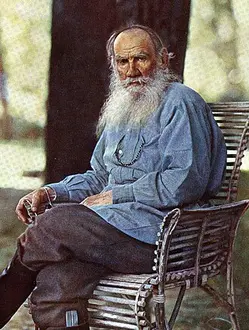
Russian novelist and Christian pacifist and anarchist thinker (1828-1910)
From the 1880s Tolstoy held that Christ's teaching forbids all violence and so rules out the state, the army, courts, prisons and taxes, which he saw as organised violence that enslaves workers. He condemned private property in land and rent, interest and wages, backed Henry George's land tax, rejected revolution and parliamentary reform alike, and called patriotism a fraud. He urged simple living, vegetarianism, chastity and a religion of love freed from Church dogma.
Closest ideologies
Based on the 108 statements where Leo Tolstoy has a known position.
- Tolstoyan movement (94% match)
- Anarcho-Pacifism (93% match)
- Christian Anarchism (92% match)
- Pacifism (86% match)
- Green Anarchism (86% match)
Similar people
- Ted Kaczynski (81% alike)
- Emma Goldman (80% alike)
- Theodor W. Adorno (79% alike)
- William Morris (78% alike)
- Mikhail Bakunin (77% alike)
Known positions
- Strongly: Taking a life is never justified, even to stop an attacker.
- Strongly: Taking people's earnings by force is wrong, whatever it pays for.
- Strongly: A country can and should do without a standing military.
- Strongly: Society would be better off without governments at all.
- Strongly: Keeping a nation's inherited culture alive, including its language, customs and traditions, is not important.
- Strongly: Overthrowing a government by revolution is never justified, whatever the cause.
- Strongly: Individual soldiers and conscripts have a duty to refuse to fight in state wars.
- Strongly: Starting the use of force against someone, or against their property, is wrong whatever it is meant to achieve.
- Strongly: School history need not centre on the story of the student's own nation.
- Strongly: Having a shared national identity does not by itself entitle a people to its own self-governing state.
- Strongly: Violence is never an acceptable way to pursue political goals.
- Strongly: Behind their different forms, the great religions point to one shared truth.
- Strongly: The fact that something is law is not, by itself, a moral reason to obey it.
- Strongly: People should lose their right to a plot of land when they no longer use it.
- Strongly: Serving the nation does not mean serving its working people.
- Strongly: Schools should not cultivate patriotic feeling, meaning loyalty to and pride in the nation.
- Strongly: Laws, police and government mainly serve the interests of whoever owns the economy and holds power.
- Strongly: Owners' profit is value taken from workers' labor.
- Strongly: Taxing the value of land, not work or trade, should fund most of government.
- Strongly: Democracy is not the best form of government when voters choose badly.
- Strongly: Killing animals for food remains morally unacceptable even with suffering minimised.
- Strongly: Belonging to the nation does not tie a person's life to a sacred community that goes on after their death.
- Strongly: Military service should always be voluntary.
- Strongly: Industries such as energy, rail and utilities do not need to be publicly owned.
- Strongly: The state should be barred from executing people convicted of the gravest crimes, such as terrorism.
- Strongly: Working together internationally should count at least as much as my country's own priorities.
- Strongly: The ruling class stays in power mainly through people going along with its ideas.
- Strongly: Living in the countryside does more for a person's moral wellbeing than living in a city.
- Strongly: Society should follow a third course beyond capitalism and communism.
- Strongly: A woman who has sex outside marriage is doing something wrong.
- Strongly: People should want as few material things as possible.
- Strongly: My country may keep a military no stronger than its rivals'.
- Strongly: Technology will not solve most of humanity's problems.
- Strongly: Whoever uses land or resources owes the rest of society a share of their value.
- Strongly: A law imposes no moral duty to obey it if the law is unjust.
- Strongly: Society may hold back technological change that would overturn established institutions.
- Strongly: Ordinary legal protections, such as the right not to be held without trial, should stay in force even in a national emergency.
- Strongly: A country can get through deadlock among its institutions without a leader who overrides them.
- Strongly: Some things are right or wrong for everyone, in every culture and era.
- Strongly: You can't reach a free, fair society by unfree or unfair means.
- Strongly: The state should not make one language the only common language of government, schooling and public life at the cost of limiting others.
- Strongly: Defense should not rest with armed ordinary citizens in place of a standing force.
- Strongly: Owners' rights to their property need not be protected against being overridden for public goals.
- Strongly: A country should not be ready to use military force abroad without UN Security Council authorization.
- Strongly: In law, a country's traditional national church should rank no higher than other religious bodies.
- Strongly: The general public should have at least as much say in policy as experts.
- Strongly: Nobody should hold a special rank by birth, such as a noble title, a hereditary crown or a caste position, or the special rights attached to one.
- Strongly: Young people should not be organised into uniformed, drilled groups that prepare them to serve the nation.
- Strongly: Animals can suffer, and that suffering counts in how we treat them.
- Strongly: Publicly honouring a national leader as the personification of the nation is not acceptable.
- Strongly: Constantly seeking additional possessions is harmful overall, despite any benefits it brings.
- Strongly: No one is better suited by nature to govern than anyone else.
- Strongly: Other things drive humanity forward at least as much as rivalry and conflict between peoples.
- Strongly: Even a purely ceremonial head of state should not hold the position by birth.
- Strongly: Art should not be censored for its effect on people's moral character.
- Strongly: Most people in political office look after themselves first and the public second.
- Strongly: Very large concentrations of wealth threaten a free society.
- Strongly: My country should not send weapons to foreign insurgents, whatever it thinks of the governments they fight.
- Strongly: Politics should support people's spiritual well-being.
- Strongly: The holy scripture of one's faith is not God's own error-free word.
- Strongly: An economy directed by a central plan is not capable of working better than one directed by market exchange.
- Strongly: War does not strengthen a nation's character.
- Strongly: Income from useful work should be rewarded ahead of income from merely owning property.
- Strongly: Being powerful does not mean a country should bring more land within its borders.
- Strongly: The government should let its political opponents organise, speak and compete for power.
- Strongly: Political authority does not ultimately come from God.
- Strongly: A country may leave other nations to choose their own political systems.
- Strongly: The law should treat everyone as an equal, whatever their birth, sex, race or status.
- Strongly: An armed minority's actions are incapable of bringing about the conditions for a broader revolutionary uprising.
- Strongly: Religion does not offer illusory comfort for material suffering.
- Strongly: Looking after your own interests is not a moral good in itself.
- Strongly: News media should decide for themselves what they publish, whoever holds power.
- Strongly: No party's ideology should give it an exclusive right to lead the state.
- Strongly: Religious conversion should be free of legal restriction.
- Strongly: Publicly insulting a religion's sacred beliefs should be left outside the criminal law.
- Strongly: Some areas of life should remain outside state direction.
- Strongly: No society has the right to rule another for its supposed improvement, however advanced it is.
- Strongly: A workers' state does not need to suppress the old ruling class, even for a time.
- Strongly: Government should have other tasks besides protecting people from physical violence.
- Strongly: Overseas territories need not be run mainly for the ruling country's economic benefit.
- Strongly: The holder of the highest state office need not be treated as holy.
- Strongly: Final authority over a state's laws need not belong to its most senior religious scholars.
- Strongly: People must be free to leave their religion without legal penalty.
- Strongly: Suspected drug dealers should never be put to death without a trial.
- Leans: Eventually people should produce and share without money.
- Leans: Industrial society has done more harm than good to humanity.
- Leans: At its core, politics is a struggle between spiritual good and evil.
- Leans: Government should depend more on leaders setting a good example than on enforcing laws with penalties.
- Leans: People seeking political change should act directly—for example, with strikes, boycotts or occupations—instead of pursuing change through elections and parliaments.
- Leans: Rules on how corporations operate may be light.
- Leans: A country should not tie itself to other countries through lasting military alliances.
- Leans: The farmers who work large estates should take ownership from the landowners, with the transfer compulsory if owners refuse.
- Leans: Government should maintain a strict institutional separation from religion.
- Leans: Wage work cuts people off from the meaning and creativity of what they make.
- Leans: Entertainment produced for mass audiences tends to weaken people's willingness to challenge the established social order.
- Leans: Countries should maintain only the weapons needed for national safety.
- Leans: Businesses need not belong to the people who work in them.
- Leans: Prisons should mainly help offenders rejoin society.
- Leans: Political decisions should rest with the smallest local community able to handle them, with wider authorities handling matters that need a wider reach.
- Leans: The state should treat all streams and interpretations of a religion equally under the law.
- Leans: Workers may be represented through the parties already in place.
- Leans: Sex work between consenting adults should be illegal.
- Leans: Public institutions should help minority languages be used in public life, for example through teaching or services in those languages.
- Leans: Work may stay divided into separate specialized jobs held by different people.
- Leans: Private ownership is legitimate only insofar as it benefits society.
- Leans: Someone who actually governs a state should not hand that power on to their own child.