Political Ideology Atlas · All people · Take the test
Middle East & North Africa · born 1930, historical
Hafez al-Assad
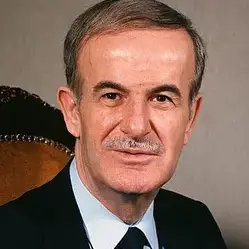
President of Syria (1971–2000)
Hafez al-Assad took power in a 1970 coup and ruled Syria as an authoritarian presidential system built around the Ba'ath Party, the army and the security services. He held to pan-Arab and anti-Israel positions, allied with the Soviet Union, intervened in Lebanon and crushed the Muslim Brotherhood uprising at Hama in 1982, while later accepting a negotiated peace on a land-for-peace basis.
Closest ideologies
Based on the 45 statements where Hafez al-Assad has a known position.
- Totalitarian democracy (89% match)
- Pahlavism (89% match)
- Eurasianism (87% match)
- Arab socialism (87% match)
- Burmese Way to Socialism (86% match)
Similar people
- Ibrahim Traoré (92% alike)
- Sukarno (91% alike)
- Alexander Lukashenka (89% alike)
- Kim Jong-il (89% alike)
- Bashar al-Assad (89% alike)
Known positions
- Strongly: One ideologically correct party should hold state leadership without competing parties having a right to replace it.
- Strongly: Someone who actually governs a state may hand that power on to their own child, whether as a king or as a republic's leader.
- Strongly: The government should stop its political opponents from organising, speaking or competing for power.
- Strongly: Staying out of other countries' internal affairs should not be the default for foreign policy.
- Strongly: Real authority to command the military should rest with the head of state.
- Strongly: A national emergency sometimes justifies temporarily withdrawing normal legal safeguards against people the government regards as internal enemies, such as protections against detention without trial.
- Strongly: The country would benefit from a strong leader with the power to act despite deadlock among its political institutions.
- Strongly: A president should be free to stand for re-election as many times as they like.
- Strongly: A country should press its neighbour to give back land taken from it in an old war.
- Strongly: Past abuses by a state's security forces may be put behind it without anyone answering for them in court.
- Strongly: Peoples who share an ethnic heritage, such as the Slavic, Arab or Turkic peoples, should come together in one state, even across present borders.
- Strongly: Political power may be concentrated in one body.
- Strongly: The worst crimes can be punished by death.
- Strongly: Democracy is not the best form of government when voters choose badly.
- Strongly: The government should be able to require citizens to serve in the military.
- Strongly: The state should offer public work to anyone who wants a job and cannot find one.
- Strongly: Defeating communism should not take priority over coexistence with it.
- Strongly: Elected politicians should be able to serve any number of terms in any office.
- Strongly: A head of state should have the power to dissolve parliament.
- Strongly: A country should use its armed forces to advance policy goals beyond national self-defence.
- Strongly: Students should pay no tuition to attend public higher education institutions.
- Strongly: Schools should cultivate patriotic feeling: loyalty to and pride in the nation, expressed for example through respect for its flag and anthem.
- Strongly: People who give their lives for the nation deserve to be remembered as martyrs, with reverence beyond ordinary thanks.
- Strongly: A people split by an imposed border should be brought together in a single state.
- Strongly: Owning things privately is justified only if it benefits society as a whole.
- Strongly: Armed resistance to a foreign military occupation is justified.
- Strongly: Society needs government of some kind.
- Strongly: Women should be able to vote and stand for office on the same terms as men.
- Strongly: Countries should keep their armed forces.
- Strongly: Final authority over a state's laws need not belong to its most senior religious scholars.
- Strongly: Failure to govern under religious law does not justify armed overthrow of a ruler.
- Leans: Countries should hand part of their decision-making power to a union of nations, such as the European Union.
- Leans: My country's military strength should exceed that of its rivals.
- Leans: Trade unions may be subject to state direction of their affairs.
- Leans: The government should steer investment into industries it sees as key to the country's future.
- Leans: Some institutional ties between government and religion are acceptable.
- Leans: High earners and the very rich should pay tax at a much higher rate than everyone else.
- Leans: Industries such as energy, rail and utilities should be owned by the state or public bodies, not private companies.
- Leans: Owners' rights to their property need not be protected against being overridden for public goals.
- Leans: Keeping a nation's inherited culture alive, including its language, customs and traditions, matters.
- Leans: Another body may have the final say over what the legislature passes.
- Leans: An elected legislature must approve the government's budget before the government spends public money.
- Leans: Society relies for its well-being on longstanding family arrangements, such as a married mother and father raising their children.
- Leans: The state should guarantee health care to everyone, whether it runs the services itself or pays for them.