Political Ideology Atlas · All people · Take the test
South & Southeast Asia · born 1901, historical
Sukarno
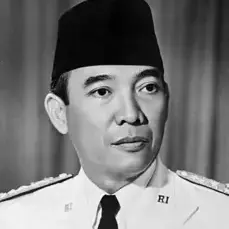
First president of Indonesia (1945–1967)
Indonesian nationalist leader and first president, who framed his politics as anti-imperialist nationalism combined with internationalism, democracy by deliberation and consensus, social justice and belief in God (Pancha Shila). He rejected both the liberal and the communist model and led the non-aligned movement. This local-phase draft rests on his 1960 UN speech only.
Closest ideologies
Based on the 47 statements where Sukarno has a known position.
- Eurasianism (91% match)
- Totalitarian democracy (89% match)
- Pahlavism (89% match)
- Arab socialism (88% match)
- Burmese Way to Socialism (87% match)
Similar people
- Mobutu Sese Seko (92% alike)
- Ibrahim Traoré (92% alike)
- Hafez al-Assad (91% alike)
- Mohammad Reza I of Iran (90% alike)
- Alexander Lukashenka (89% alike)
Known positions
- Strongly: It is acceptable to praise a national leader openly as the one who stands for the whole nation.
- Strongly: The government may spend public money without first getting its budget approved by an elected legislature.
- Strongly: A national emergency sometimes justifies temporarily withdrawing normal legal safeguards against people the government regards as internal enemies, such as protections against detention without trial.
- Strongly: The country would benefit from a strong leader with the power to act despite deadlock among its political institutions.
- Strongly: A country has the right to stop a region becoming independent by using its military.
- Strongly: Political power may be concentrated in one body.
- Strongly: A constitution does not have to be drafted by an assembly elected for that purpose.
- Strongly: Defeating communism should not take priority over coexistence with it.
- Strongly: A healthy democracy does not need a clash of opposing political positions.
- Strongly: A head of state should have the power to dissolve parliament.
- Strongly: A country should use its armed forces to advance policy goals beyond national self-defence.
- Strongly: A country may keep a region that wants to leave.
- Strongly: Another body may have the final say over what the legislature passes.
- Strongly: A people with a shared national identity is entitled to its own self-governing state.
- Strongly: Armed resistance to a foreign military occupation is justified.
- Strongly: No society has the right to rule another for its supposed improvement, however advanced it is.
- Strongly: State schools need not steer pupils away from belief in God.
- Strongly: Overseas territories need not be run mainly for the ruling country's economic benefit.
- Strongly: A weaker state need not formally treat a stronger power as its superior.
- Leans: The people in power should decide what the country's news media publish.
- Leans: The government should stop its political opponents from organising, speaking or competing for power.
- Leans: A powerful country should bring more land within its borders.
- Leans: Staying out of other countries' internal affairs should not be the default for foreign policy.
- Leans: People should gain political representation through social bodies such as families, local communities and occupational associations instead of political parties.
- Leans: The head of state should not have to be chosen by election.
- Leans: Armaments need not be limited to the minimum needed for national safety.
- Leans: A president should be free to stand for re-election as many times as they like.
- Leans: My country's military strength should exceed that of its rivals.
- Leans: Working together internationally should count at least as much as my country's own priorities.
- Leans: Democracy is not the best form of government when voters choose badly.
- Leans: A government should outlaw political parties that aim to do away with its constitutional order.
- Leans: Society should follow a third course beyond capitalism and communism.
- Leans: The farmers who work large estates should take ownership from the landowners, with the transfer compulsory if owners refuse.
- Leans: The government should steer investment into industries it sees as key to the country's future.
- Leans: Elected politicians should be able to serve any number of terms in any office.
- Leans: Industries such as energy, rail and utilities should be owned by the state or public bodies, not private companies.
- Leans: Distance and nationality do not weaken the duty of the rich to help the poor abroad.
- Leans: Officials decide what gets made and who gets it at least as well as prices and competition do.
- Leans: Religious values and institutions should shape laws, schools and public life.
- Leans: My country should stay neutral and join neither of the opposing great-power alliances.
- Leans: Each country should hold ultimate authority over its natural resources, without foreign interests controlling them.
- Leans: Political independence means little unless the economic and property system is also transformed.
- Leans: The people who make up the nation today are the same people, generation after generation, all the way back to its beginnings in antiquity.
- Leans: Some things are right or wrong for everyone, in every culture and era.
- Leans: Belonging to the nation does not go with sharing its religion.
- Leans: A country should reject spending cuts demanded in return for loans and set its own course.
- Leans: Laws should not be required to follow religious texts.