Political Ideology Atlas · All people · Take the test
Europe · born 1954
Alexander Lukashenka
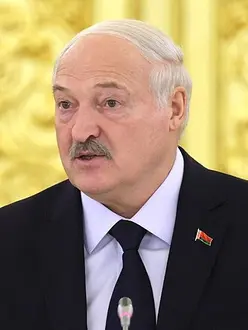
President of Belarus (1994–present)
Lukashenka has preserved state ownership in major sectors and used presidential powers to steer investment and regulate prices. He has concentrated political authority in the presidency and suppressed organised opposition. His foreign policy has increasingly tied Belarus to Russia through economic integration and military cooperation.
Closest ideologies
Based on the 77 statements where Alexander Lukashenka has a known position.
- Arab socialism (88% match)
- Syrian nationalism (86% match)
- Burmese Way to Socialism (86% match)
- Totalitarian democracy (85% match)
- Eurasianism (85% match)
Similar people
- Sheikh Hasina (91% alike)
- Mohammad Reza I of Iran (90% alike)
- Hafez al-Assad (89% alike)
- Sukarno (89% alike)
- Hosni Mubarak (89% alike)
Known positions
- Strongly: A government should sometimes be entitled to stop internet connectivity across an area for public-order reasons.
- Strongly: Legal limits on how far prices, including pay, may rise are a good way to fight inflation.
- Strongly: The people in power should decide what the country's news media publish.
- Strongly: The government should stop its political opponents from organising, speaking or competing for power.
- Strongly: Voters themselves should elect the head of state, without an intermediary body selecting the officeholder.
- Strongly: Reforms should take existing institutions and their role in society seriously.
- Strongly: Countries should hand part of their decision-making power to a union of nations, such as the European Union.
- Strongly: My country may join a military alliance led by one of the great powers.
- Strongly: Real authority to command the military should rest with the head of state.
- Strongly: Changes to society should be introduced a little at a time.
- Strongly: The country would benefit from a strong leader with the power to act despite deadlock among its political institutions.
- Strongly: The state should give families money to have more children, such as through payments and tax breaks.
- Strongly: Trade unions may be subject to state direction of their affairs.
- Strongly: Past abuses by a state's security forces may be put behind it without anyone answering for them in court.
- Strongly: Public authorities should help get new facilities built to generate electricity from nuclear energy.
- Strongly: Political power may be concentrated in one body.
- Strongly: The state should limit or screen money that foreign donors give to charities, campaign groups, the press and universities.
- Strongly: Besides its directly elected parliament, a legislature should have a second chamber, such as a senate.
- Strongly: The worst crimes can be punished by death.
- Strongly: Democracy is not the best form of government when voters choose badly.
- Strongly: A country may join permanent military alliances.
- Strongly: The government should be able to require citizens to serve in the military.
- Strongly: The government should steer investment into industries it sees as key to the country's future.
- Strongly: Industries such as energy, rail and utilities should be owned by the state or public bodies, not private companies.
- Strongly: A head of state should have the power to dissolve parliament.
- Strongly: Creating new money should be reserved to public institutions, excluding private banks' creation of money through lending.
- Strongly: The state should not make one language the only common language of government, schooling and public life at the cost of limiting others.
- Strongly: Population growth may be left to run its course.
- Strongly: Another body may have the final say over what the legislature passes.
- Strongly: The law should not extend marriage to same-sex couples.
- Strongly: Society relies for its well-being on longstanding family arrangements, such as a married mother and father raising their children.
- Strongly: Countries that feel dominated by Western powers should band together to resist them.
- Strongly: The state should guarantee health care to everyone, whether it runs the services itself or pays for them.
- Strongly: There should be a central bank.
- Strongly: Governments are under no obligation to fund media that decide their own editorial content.
- Strongly: World power should be distributed among several independent major powers, without one dominant power.
- Strongly: We have a duty to leave the planet in good condition for those who come after us.
- Strongly: Central banks should keep a role in controlling the money supply.
- Strongly: Keeping a nation's inherited culture alive, including its language, customs and traditions, matters.
- Strongly: Society needs government of some kind.
- Strongly: Countries should keep their armed forces.
- Strongly: Each country should hold ultimate authority over its natural resources, without foreign interests controlling them.
- Strongly: Government should have other tasks besides protecting people from physical violence.
- Strongly: Courts need not be handed over to private businesses.
- Leans: Rulers are not bound to act only under lasting, publicly known laws administered by recognised courts.
- Leans: There should be legal limits on strike action.
- Leans: The government should have authority over religious institutions' internal affairs.
- Leans: A national emergency sometimes justifies temporarily withdrawing normal legal safeguards against people the government regards as internal enemies, such as protections against detention without trial.
- Leans: Major laws should be decided by citizens voting on them themselves.
- Leans: Countries are better off sharing one currency than each having its own.
- Leans: The law should make earning a living or doing other work compulsory for anyone capable of working.
- Leans: Peoples who share an ethnic heritage, such as the Slavic, Arab or Turkic peoples, should come together in one state, even across present borders.
- Leans: Countries within one civilization should unite politically.
- Leans: A government should outlaw political parties that aim to do away with its constitutional order.
- Leans: Some institutional ties between government and religion are acceptable.
- Leans: Governments should encourage contact between cultural groups.
- Leans: The existing governing institutions should be retained, even if their personnel, policies or procedures change.
- Leans: Officials decide what gets made and who gets it at least as well as prices and competition do.
- Leans: Employers and workers should treat each other as partners whose cooperation comes before conflict, even where their interests differ.
- Leans: Governments need to make sweeping changes to deal with global warming.
- Leans: Government should take sides on how people live, backing the ways of life it judges good.
- Leans: An electorate should choose the head of state, either directly or through elected representatives.
- Leans: Ethnic diversity does not weaken a society's ability to hold together.
- Leans: A nation can be made up of several ethnic groups with none forming most of its people.
- Leans: Grown children owe care to parents who need it.
- Leans: Elected governments need not leave monetary policy to central banks acting on their own.
- Leans: One worker's pay should cover the living needs of that worker's family, including the worker.
- Leans: Spouses should make marital decisions as equals.
- Leans: Being powerful does not mean a country should bring more land within its borders.
- Leans: Inventions and creative works should remain legally ownable, as under patents and copyrights.
- Leans: People who give their lives for the nation deserve to be remembered as martyrs, with reverence beyond ordinary thanks.
- Leans: Torture should be subject to a blanket legal ban.
- Leans: Political power may rest on something other than workplace-elected councils.
- Leans: Belonging to the nation does not go with sharing its religion.
- Leans: Owning things privately is justified only if it benefits society as a whole.