Political Ideology Atlas · All people · Take the test
North America · born 1882, historical
Franklin Delano Roosevelt
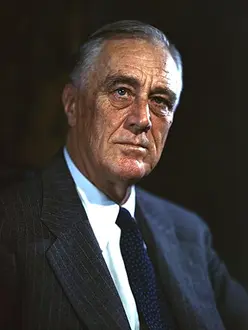
32nd President of the United States (1933-1945)
A Democrat who answered the Great Depression with the New Deal: banking and securities regulation, work relief, Social Security, labor-rights and wage-and-hours laws, public power through the TVA, and higher taxes on large incomes, always defending private enterprise and constitutional democracy. He moved the United States from neutrality toward aid to the Allies, led it in World War II, ordered the removal of Japanese Americans from the West Coast, and made a postwar United Nations a central goal.
Closest ideologies
Based on the 89 statements where Franklin Delano Roosevelt has a known position.
- Progressivism (90% match)
- Nordic Social Democracy (88% match)
- Pan-Americanism (88% match)
- Browderism (87% match)
- Sahrawi nationalism (87% match)
Similar people
- Shabana Mahmood (90% alike)
- Harold Wilson (89% alike)
- Wes Streeting (89% alike)
- Mario Draghi (89% alike)
- Volodymyr Zelenskyy (89% alike)
Known positions
- Strongly: The UN should have authority to compel member states to comply with its decisions.
- Strongly: Private businesses and markets should run most of the economy, while the government supports people who cannot meet their basic needs.
- Strongly: Judge policies by what they achieve, independently of whether they match an ideology.
- Strongly: My country may join a military alliance led by one of the great powers.
- Strongly: Governments should set legal price ceilings on essential foods when supplies are scarce.
- Strongly: Those who inherit a large fortune should hand over a big share of it in tax.
- Strongly: Failing companies should not always be left to fail.
- Strongly: Working together internationally should count at least as much as my country's own priorities.
- Strongly: Capitalism is not bound to suffer a general collapse.
- Strongly: Countries should maintain only the weapons needed for national safety.
- Strongly: Political power should be split among separate branches and levels that can each limit the others.
- Strongly: Farmers should get price floors, state buying or cheap credit to keep them secure.
- Strongly: High earners and the very rich should pay tax at a much higher rate than everyone else.
- Strongly: The government should be able to require citizens to serve in the military.
- Strongly: Democracy is best even when voters make poor choices.
- Strongly: A country may join permanent military alliances.
- Strongly: Workers' pay should be settled in collective bargaining between their union and their employer.
- Strongly: Government should impose strict rules on how corporations operate.
- Strongly: Direct action does not have to take the place of elections and parliament as the way to achieve political change.
- Strongly: Employers and workers should treat each other as partners whose cooperation comes before conflict, even where their interests differ.
- Strongly: An electorate should choose the head of state, either directly or through elected representatives.
- Strongly: Workers are better off for having labor unions.
- Strongly: Capitalism does not inevitably cause wars between great powers.
- Strongly: Being free requires having the practical resources to act on one's choices, such as an adequate livelihood.
- Strongly: Private charity does not help people in poverty better than government programs do.
- Strongly: Meeting poor people's needs should be the first consideration in public policy.
- Strongly: Rulers have a right to rule only because the people they rule have agreed to it.
- Strongly: Very large concentrations of wealth threaten a free society.
- Strongly: Whatever their circumstances, everyone should be able to count on the state for enough to live decently, through benefits, pensions or public services.
- Strongly: Being powerful does not mean a country should bring more land within its borders.
- Strongly: The government should let its political opponents organise, speak and compete for power.
- Strongly: A mother country and its colonies may trade with the outside world.
- Strongly: State pensions funded by current workers' contributions should stay in place rather than be replaced by privately managed individual accounts.
- Strongly: Businesses gain too much influence over government policy from their lobbying.
- Strongly: Soldiers and conscripts need not refuse to fight when their state goes to war.
- Strongly: News media should decide for themselves what they publish, whoever holds power.
- Strongly: No party's ideology should give it an exclusive right to lead the state.
- Strongly: Industrial society has done at least as much good as harm to humanity.
- Strongly: Some areas of life should remain outside state direction.
- Strongly: Private owners' choice of whom they deal with should be subject to some restrictions.
- Strongly: Society needs government of some kind.
- Strongly: Countries should keep their armed forces.
- Strongly: The ruler should be subject to the country's laws.
- Strongly: Government should have other tasks besides protecting people from physical violence.
- Strongly: Collecting taxes does not in itself amount to stealing people's money.
- Leans: Once the national majority has decided, public institutions, including courts and independent bodies, should not limit its decision.
- Leans: Officially recognized bodies representing employers and workers should negotiate wages together.
- Leans: Civil servants should be recruited according to their performance in competitive examinations.
- Leans: The country would benefit from a strong leader with the power to act despite deadlock among its political institutions.
- Leans: A national emergency sometimes justifies temporarily withdrawing normal legal safeguards against people the government regards as internal enemies, such as protections against detention without trial.
- Leans: Fewer tariffs and trade barriers make all countries better off over time.
- Leans: Free citizens need the freedom to own property, trade and choose work, or political freedom cannot last.
- Leans: Force is for self-defence alone.
- Leans: Governments may spend well beyond their tax revenue to support a weak economy.
- Leans: Many political decisions should rest with national or wider authorities, even where a smaller community could handle them.
- Leans: A president should be free to stand for re-election as many times as they like.
- Leans: My country's military strength should exceed that of its rivals.
- Leans: Industries such as energy, rail and utilities do not need to be publicly owned.
- Leans: Businesses should be legally barred from agreements with competitors to suppress competition, such as fixing prices.
- Leans: The state should offer public work to anyone who wants a job and cannot find one.
- Leans: Government should be bound by written guarantees of basic rights protected against easy amendment by ordinary majorities.
- Leans: Rich people have an obligation to help those worse off than they are.
- Leans: Property should belong to many people in small holdings.
- Leans: Tariffs should not be used to protect domestic industry from foreign competition.
- Leans: Full-time work at the legal wage floor should pay enough to meet basic living costs.
- Leans: People able to work should get welfare benefits only in return for some work, such as a job or a work scheme.
- Leans: Military intervention abroad is sometimes necessary to protect human rights.
- Leans: Defeating communism should not take priority over coexistence with it.
- Leans: Every treaty and agreement between governments should be made public.
- Leans: Capitalism built the productive power and wealth that later and better societies rest on.
- Leans: Citizens should have a legal right to see government information.
- Leans: Elected politicians should be able to serve any number of terms in any office.
- Leans: Owners' rights to their property need not be protected against being overridden for public goals.
- Leans: Officials decide what gets made and who gets it at least as well as prices and competition do.
- Leans: Where they conflict, religious faith should count for at least as much as evidence and reasoning.
- Leans: Constantly seeking additional possessions is harmful overall, despite any benefits it brings.
- Leans: The state should guarantee health care to everyone, whether it runs the services itself or pays for them.
- Leans: Equality of outcomes should not be society's goal.
- Leans: Private ownership is legitimate only insofar as it benefits society.
- Leans: Politics should support people's spiritual well-being.
- Leans: We have a duty to leave the planet in good condition for those who come after us.
- Leans: An economy directed by a central plan is not capable of working better than one directed by market exchange.
- Leans: War does not strengthen a nation's character.
- Leans: Looking after your own interests is not a moral good in itself.
- Leans: A people with a shared national identity is entitled to its own self-governing state.
- Leans: Governments should give no subsidies, licences or protections that favour firms close to them.