Political Ideology Atlas · All ideologies · Take the test
Pan-Americanism
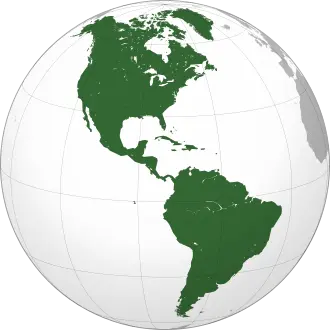
Pan-Americanism is the policy of cooperation among the states of the Western Hemisphere that grew from Bolivar's call for union and Blaine's 1889 conference into the Pan-American Union and the OAS. It stresses the equality and sovereignty of states, non-intervention, no conquest, peaceful settlement of disputes, collective defense, representative democracy and, from the 1950s, cooperative economic and social development. It is a diplomatic framework, silent on most domestic questions.
What it stands for
- Allies are bound to defend one another against armed attack.
- Political power should be split among separate branches and levels that can each limit the others.
- Democracy is best even when voters make poor choices.
- A country may join permanent military alliances.
- Being powerful does not mean a country should bring more land within its borders.
- Rapid economic development does not justify temporary restrictions on political freedom.
Key figures
- Simón Bolívar: Convened the 1826 Congress of Panama and championed a union of the American republics.
- James G. Blaine: US Secretary of State who convened the 1889-90 First International Conference of American States.
Closest ideologies
- Communitarianism (96% match)
- Nordic Social Democracy (95% match)
- Green Zionism (94% match)
- Poporanism (92% match)
- Sahrawi nationalism (92% match)
People closest to it
- Atal Bihari Vajpayee (93% alike)
- Robert F. Kennedy (93% alike)
- Péter Magyar (93% alike)
- Shabana Mahmood (93% alike)
- Soong May-ling (93% alike)
Key positions
- Strongly: Allies are bound to defend one another against armed attack.
- Strongly: Political power should be split among separate branches and levels that can each limit the others.
- Strongly: Democracy is best even when voters make poor choices.
- Strongly: A country may join permanent military alliances.
- Strongly: Being powerful does not mean a country should bring more land within its borders.
- Strongly: Rapid economic development does not justify temporary restrictions on political freedom.
- Strongly: The law should treat everyone as an equal, whatever their birth, sex, race or status.
- Strongly: Poor countries should retain economic ties with rich countries.
- Strongly: News media should decide for themselves what they publish, whoever holds power.
- Strongly: No party's ideology should give it an exclusive right to lead the state.
- Strongly: The armed forces may be controlled by someone other than the governing party's leadership.
- Strongly: Some areas of life should remain outside state direction.
- Strongly: No society has the right to rule another for its supposed improvement, however advanced it is.
- Strongly: A workers' state does not need to suppress the old ruling class, even for a time.
- Strongly: The ruler should be subject to the country's laws.
- Strongly: Public spaces such as schools and facilities should not be separated by race under the law.
- Leans: The farmers who work large estates should take ownership from the landowners, with the transfer compulsory if owners refuse.
- Leans: Businesses should be legally barred from agreements with competitors to suppress competition, such as fixing prices.
- Leans: Working together internationally should count at least as much as my country's own priorities.
- Leans: High earners and the very rich should pay tax at a much higher rate than everyone else.
- Leans: Land that a state declares its own against its people's will is still illegally occupied by that state.
- Leans: Employers and workers should treat each other as partners whose cooperation comes before conflict, even where their interests differ.
- Leans: Workers are better off for having labor unions.
- Leans: A country may keep all its decisions in its own hands rather than pooling them with other nations.
- Leans: Meeting poor people's needs should be the first consideration in public policy.
- Leans: My country can do without nuclear weapons that it alone controls.
- Leans: Population growth does not mainly drive lasting poverty.
- Leans: Public institutions should have the power to constrain a national majority's decisions in a liberal democracy.
- Leans: Other things drive humanity forward at least as much as rivalry and conflict between peoples.
- Leans: Rulers have a right to rule only because the people they rule have agreed to it.
- Leans: Art should not be censored for its effect on people's moral character.
- Leans: The law should not assign different roles in public life on the basis of sex.
- Leans: Whatever their circumstances, everyone should be able to count on the state for enough to live decently, through benefits, pensions or public services.
- Leans: A people with a shared national identity is entitled to its own self-governing state.
- Leans: A country may leave other nations to choose their own political systems.
- Leans: A mother country and its colonies may trade with the outside world.