Political Ideology Atlas · All people · Take the test
Europe · born 1947
Mario Draghi
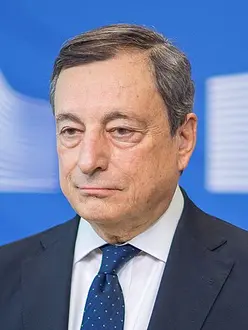
Italian prime minister (2021–2022) and European Central Bank president (2011–2019)
Draghi advocates deeper European integration, competitive markets supported by social protection, strategic investment and a rapid clean-energy transition. His later proposals combine greater European defense capacity with continued transatlantic cooperation, and favor pragmatic institutional reform over blanket protectionism or economic isolation.
Closest ideologies
Based on the 50 statements where Mario Draghi has a known position.
- Browderism (92% match)
- Clintonism (90% match)
- Liberalism in the United States (89% match)
- Nordic Social Democracy (88% match)
- Pan-Americanism (87% match)
Similar people
- Bill Clinton (93% alike)
- Ursula von der Leyen (92% alike)
- Howard Dean (91% alike)
- Harold Wilson (90% alike)
- Andy Burnham (90% alike)
Known positions
- Strongly: Elected governments should leave central banks free to make monetary-policy decisions within their legal mandates.
- Strongly: Countries should hand part of their decision-making power to a union of nations, such as the European Union.
- Strongly: Countries are better off sharing one currency than each having its own.
- Strongly: Private businesses and markets should run most of the economy, while the government supports people who cannot meet their basic needs.
- Strongly: Judge policies by what they achieve, independently of whether they match an ideology.
- Strongly: My country may join a military alliance led by one of the great powers.
- Strongly: Government should maintain a strict institutional separation from religion.
- Strongly: Working together internationally should count at least as much as my country's own priorities.
- Strongly: Government should support building nuclear power plants.
- Strongly: Allies are bound to defend one another against armed attack.
- Strongly: Political power should be split among separate branches and levels that can each limit the others.
- Strongly: The government should steer investment into industries it sees as key to the country's future.
- Strongly: A country may join permanent military alliances.
- Strongly: Climate change calls for drastic action by governments.
- Strongly: Public institutions should have the power to constrain a national majority's decisions in a liberal democracy.
- Strongly: The state should guarantee health care to everyone, whether it runs the services itself or pays for them.
- Strongly: Income-tax percentages may differ between income levels.
- Strongly: Economic growth should not be limited for the sake of the environment.
- Strongly: A mother country and its colonies may trade with the outside world.
- Strongly: We have a duty to leave the planet in good condition for those who come after us.
- Strongly: Keeping a nation's inherited culture alive, including its language, customs and traditions, matters.
- Strongly: Central banks should keep a role in controlling the money supply.
- Strongly: Countries should keep their armed forces.
- Strongly: Government should have other tasks besides protecting people from physical violence.
- Strongly: Final authority over a state's laws need not belong to its most senior religious scholars.
- Strongly: Museums, libraries and other inherited culture should not be destroyed, even when they stand in the way of new creation.
- Leans: A country need not reject spending cuts demanded in return for loans.
- Leans: Prices and competition generally decide better than officials what gets made and who gets it.
- Leans: Fewer tariffs and trade barriers make all countries better off over time.
- Leans: A country's constitution should not automatically take precedence over international law.
- Leans: Publicly funded services such as hospitals and schools should be run by private companies and charities as well as the state.
- Leans: Society should push new technology forward faster, even where it overturns established institutions.
- Leans: Governments may spend well beyond their tax revenue to support a weak economy.
- Leans: Failing companies should not always be left to fail.
- Leans: Distance and nationality do not weaken the duty of the rich to help the poor abroad.
- Leans: Taxes on imports should shield domestic producers from foreign competition.
- Leans: Government borrowing should be subject to binding legal limits.
- Leans: A country should seek ties with the United States at least as close as its ties with China.
- Leans: Democracy is best even when voters make poor choices.
- Leans: Workers' pay should be settled in collective bargaining between their union and their employer.
- Leans: The state should stop foreign buyers from taking over key national businesses.
- Leans: Land that a state declares its own against its people's will is still illegally occupied by that state.
- Leans: Employers and workers should treat each other as partners whose cooperation comes before conflict, even where their interests differ.
- Leans: A country need not treat an excess of exports over imports as something to aim for.
- Leans: Workers are better off for having labor unions.
- Leans: Meeting poor people's needs should be the first consideration in public policy.
- Leans: Rulers have a right to rule only because the people they rule have agreed to it.
- Leans: Countries may keep controls on who enters and settles, even in the long run.
- Leans: Governments should give no subsidies, licences or protections that favour firms close to them.