Political Ideology Atlas · All people · Take the test
North America · born 1916, historical
Eugene McCarthy
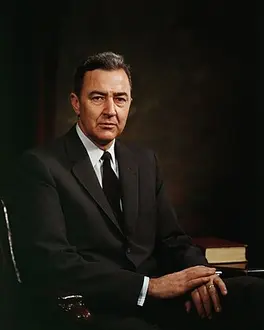
US senator from Minnesota (1959–1971) and repeated presidential candidate
McCarthy challenged US militarism and defended constitutional restraints on presidential power. His economic proposals included universal healthcare, wealth taxation and shorter working hours; his later positions combined civil liberties with protectionism and reduced immigration.
Closest ideologies
Based on the 36 statements where Eugene McCarthy has a known position.
- Economic democracy (95% match)
- Nordic model (93% match)
- Green Zionism (93% match)
- Communitarianism (93% match)
- Pan-Americanism (92% match)
Similar people
- John Maynard Keynes (95% alike)
- Robert F. Kennedy (93% alike)
- Tulsi Gabbard (93% alike)
- John Rawls (93% alike)
- John Quincy Adams (93% alike)
Known positions
- Strongly: A president should be free to stand for re-election as many times as they like.
- Strongly: Government should be bound by written guarantees of basic rights protected against easy amendment by ordinary majorities.
- Strongly: Political power should be split among separate branches and levels that can each limit the others.
- Strongly: High earners and the very rich should pay tax at a much higher rate than everyone else.
- Strongly: Countries should maintain only the weapons needed for national safety.
- Strongly: A country can get through deadlock among its institutions without a leader who overrides them.
- Strongly: The country should impose strict limits on immigration.
- Strongly: Society should take active steps to make up for the harm done by past racial injustices.
- Strongly: The head of state should not be elected directly by the voters.
- Strongly: The state should guarantee health care to everyone, whether it runs the services itself or pays for them.
- Strongly: The law should treat everyone as an equal, whatever their birth, sex, race or status.
- Strongly: Countries may keep controls on who enters and settles, even in the long run.
- Strongly: Armed conflict does not generally make a people stronger in character.
- Strongly: The law should not assign different roles in public life on the basis of sex.
- Strongly: When companies press officials for policies they want, they gain more sway over public decisions than they should have.
- Strongly: The ruler should be subject to the country's laws.
- Strongly: Public spaces such as schools and facilities should not be separated by race under the law.
- Leans: Public institutions do not need to help minority languages be used in public life.
- Leans: Taxes on imports should shield domestic producers from foreign competition.
- Leans: A country with nuclear weapons may give them up even while its rivals keep theirs.
- Leans: Women can legally choose to end most pregnancies.
- Leans: Governments may refuse permission for new oil, gas and coal extraction.
- Leans: Elected politicians should be able to serve any number of terms in any office.
- Leans: A country can miss out on lasting gains when barriers to international commerce come down.
- Leans: Ordinary legal protections, such as the right not to be held without trial, should stay in force even in a national emergency.
- Leans: Real command of the military may rest with someone other than the head of state.
- Leans: Government should impose strict rules on how corporations operate.
- Leans: The state should stop foreign buyers from taking over key national businesses.
- Leans: Private owners' choice of whom they deal with should be subject to some restrictions.
- Leans: Political decisions should rest with the smallest local community able to handle them, with wider authorities handling matters that need a wider reach.
- Leans: Keeping a nation's inherited culture alive, including its language, customs and traditions, matters.
- Leans: A country may leave other nations to choose their own political systems.
- Leans: People are entitled to resist a ruler's unconstitutional exercise of power.
- Leans: Meeting poor people's needs should be the first consideration in public policy.
- Leans: Whatever their circumstances, everyone should be able to count on the state for enough to live decently, through benefits, pensions or public services.
- Leans: You can't reach a free, fair society by unfree or unfair means.