Political Ideology Atlas · All people · Take the test
Europe · born 1883, historical
John Maynard Keynes
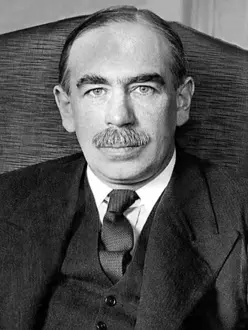
British economist, Liberal supporter and Bretton Woods negotiator (1883-1946)
Keynes described himself as a liberal who rejected both laissez-faire and doctrinaire state socialism, wanting central control of money, credit and investment to secure full employment inside a market economy. He favoured graduated taxation, the 'euthanasia of the rentier', pacifism and arbitration, and opposed Bolshevism and totalitarian rule while stressing personal liberty and variety.
Closest ideologies
Based on the 56 statements where John Maynard Keynes has a known position.
- Economic democracy (94% match)
- Nordic model (93% match)
- Sahrawi nationalism (92% match)
- Social liberalism (92% match)
- Communitarianism (92% match)
Similar people
- Eugene McCarthy (95% alike)
- Robert F. Kennedy (94% alike)
- John Quincy Adams (94% alike)
- John Rawls (94% alike)
- Enrique Peña Nieto (94% alike)
Known positions
- Strongly: Governments may spend well beyond their tax revenue to support a weak economy.
- Strongly: Governments should limit how money and investment can be moved across borders.
- Strongly: Capitalism is not bound to suffer a general collapse.
- Strongly: Judge policies by what they achieve, independently of whether they match an ideology.
- Strongly: Countries should maintain only the weapons needed for national safety.
- Strongly: The government should keep some form of income tax.
- Strongly: There should be a central bank.
- Strongly: The government should let its political opponents organise, speak and compete for power.
- Strongly: No party's ideology should give it an exclusive right to lead the state.
- Strongly: Income from useful work should be rewarded ahead of income from merely owning property.
- Strongly: A workers' state does not need to suppress the old ruling class, even for a time.
- Strongly: Central banks should keep a role in controlling the money supply.
- Strongly: Some areas of life should remain outside state direction.
- Strongly: Society needs government of some kind.
- Strongly: Collecting taxes does not in itself amount to stealing people's money.
- Strongly: Government should have other tasks besides protecting people from physical violence.
- Leans: The UN should have authority to compel member states to comply with its decisions.
- Leans: Specialists should have more weight in decisions than public opinion.
- Leans: The representative legislature should have the final say on legislation.
- Leans: Changes to society should be introduced a little at a time.
- Leans: Prices and competition generally decide better than officials what gets made and who gets it.
- Leans: People should be encouraged to live in ways that differ from social custom.
- Leans: Opening markets across borders leaves every trading country better off over time.
- Leans: A country should not tie itself to other countries through lasting military alliances.
- Leans: Those who inherit a large fortune should hand over a big share of it in tax.
- Leans: To keep their political freedoms, people need the freedom to own property, trade and choose their work.
- Leans: Communist one-party regimes should be condemned as severely as fascist regimes.
- Leans: Allied countries are free to decide for themselves whether to help one that is attacked.
- Leans: Society should follow a third course beyond capitalism and communism.
- Leans: The government should steer investment into industries it sees as key to the country's future.
- Leans: High earners and the very rich should pay tax at a much higher rate than everyone else.
- Leans: Industries such as energy, rail and utilities should be owned by the state or public bodies, not private companies.
- Leans: The world's most powerful countries can avoid going to war with one another under capitalism.
- Leans: Employers and workers should treat each other as partners whose cooperation comes before conflict, even where their interests differ.
- Leans: Government should impose strict rules on how corporations operate.
- Leans: Capitalism built the productive power and wealth that later and better societies rest on.
- Leans: Automation should be directed towards making the time people need to spend working as short as feasible.
- Leans: Owners' rights to their property need not be protected against being overridden for public goals.
- Leans: Countries should accept binding international arbitration of their disputes.
- Leans: Political decisions should rest with the smallest local community able to handle them, with wider authorities handling matters that need a wider reach.
- Leans: The people living in a disputed territory should choose by voting which country it joins.
- Leans: A mother country and its colonies may trade with the outside world.
- Leans: A country need not treat an excess of exports over imports as something to aim for.
- Leans: Income-tax percentages may differ between income levels.
- Leans: Equality of outcomes should not be society's goal.
- Leans: Whatever their circumstances, everyone should be able to count on the state for enough to live decently, through benefits, pensions or public services.
- Leans: An economy directed by a central plan is not capable of working better than one directed by market exchange.