Political Ideology Atlas · All people · Take the test
North America · born 1767, historical
John Quincy Adams
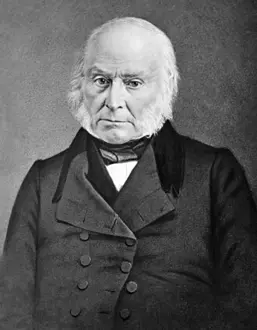
US secretary of state (1817–1825), president (1825–1829), and representative (1831–1848)
Adams grounded government in the Declaration's natural rights and the sovereignty of the people, defended the Union against nullification and secession, and favored federal improvements and a moderately protective tariff. He opposed slavery as inconsistent with the Declaration and valued civil and religious liberty, neutrality abroad and a civilian-led army.
Closest ideologies
Based on the 38 statements where John Quincy Adams has a known position.
- Sahrawi nationalism (93% match)
- Pan-Americanism (93% match)
- New Confucianism (91% match)
- Producerism (91% match)
- Nordic Social Democracy (91% match)
Similar people
- Atal Bihari Vajpayee (94% alike)
- Soong May-ling (92% alike)
- Tulsi Gabbard (92% alike)
- Robert F. Kennedy (91% alike)
- Péter Magyar (91% alike)
Known positions
- Strongly: Government should be bound by written guarantees of basic rights protected against easy amendment by ordinary majorities.
- Strongly: Countries should maintain only the weapons needed for national safety.
- Strongly: Government should serve people's good while respecting each person as more than an instrument of the state or community.
- Strongly: A government must obtain the resident nation's agreement before rewriting or ending their treaty.
- Strongly: Democracy is best even when voters make poor choices.
- Strongly: Some things are right or wrong for everyone, in every culture and era.
- Strongly: People are entitled to resist a ruler's unconstitutional exercise of power.
- Strongly: Inventions and creative works should remain legally ownable, as under patents and copyrights.
- Strongly: Public institutions should have the power to constrain a national majority's decisions in a liberal democracy.
- Strongly: Rulers have a right to rule only because the people they rule have agreed to it.
- Strongly: Protecting the constitution should be left to civilian institutions, not the armed forces.
- Strongly: The law should treat everyone as an equal, whatever their birth, sex, race or status.
- Strongly: At least some revolutions have been justified.
- Strongly: Industrial society has done at least as much good as harm to humanity.
- Strongly: The ruler should be subject to the country's laws.
- Strongly: Government should have other tasks besides protecting people from physical violence.
- Strongly: Farmers should have the legal freedom to leave the estates they work.
- Leans: Spreading our political system abroad should be a special calling of our nation.
- Leans: Owners' rights to their property should almost never be overridden, even for public goals.
- Leans: In regions where an indigenous people were originally the majority, the authorities should put limits on outsiders moving in to settle.
- Leans: Fewer tariffs and trade barriers make all countries better off over time.
- Leans: Changes to society should be introduced a little at a time.
- Leans: Outside governments have no entitlement to interfere in another country's internal affairs for any purpose.
- Leans: Government should maintain a strict institutional separation from religion.
- Leans: Taxes on imports should shield domestic producers from foreign competition.
- Leans: Political power should be split among separate branches and levels that can each limit the others.
- Leans: A president should be limited in how many times he or she may stand for re-election.
- Leans: Political decisions should rest with the smallest local community able to handle them, with wider authorities handling matters that need a wider reach.
- Leans: My country should stay neutral and join neither of the opposing great-power alliances.
- Leans: The government should steer investment into industries it sees as key to the country's future.
- Leans: A country may keep a region that wants to leave.
- Leans: Central banks should keep a role in controlling the money supply.
- Leans: Even a purely ceremonial head of state should not hold the position by birth.
- Leans: War does not strengthen a nation's character.
- Leans: Political authority does not ultimately come from God.