Political Ideology Atlas · All people · Take the test
Europe · born 1890, historical
Charles de Gaulle
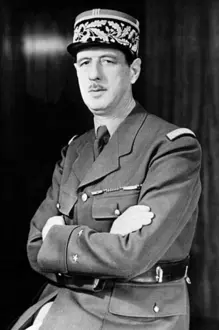
French general, leader of Free France, head of the provisional government (1944-46) and President of France (1959-69)
De Gaulle was a nationalist statesman who combined a strong, independent state with an executive above parties. He wrote the Fifth Republic's presidential model, pursued nuclear and diplomatic independence, favoured state-guided growth with worker participation as a 'third way', and ended French Algeria through self-determination.
Closest ideologies
Based on the 79 statements where Charles de Gaulle has a known position.
- Sahrawi nationalism (90% match)
- Illiberal democracy (89% match)
- Zionism (89% match)
- Producerism (88% match)
- Tridemism (87% match)
Similar people
- Abraham Lincoln (91% alike)
- James A. Garfield (90% alike)
- William McKinley (89% alike)
- Mamata Banerjee (89% alike)
- Ulysses S. Grant (89% alike)
Known positions
- Strongly: My country should possess its own nuclear arsenal with independent authority over its use.
- Strongly: A former empire may keep a special relationship with its old territories.
- Strongly: Voters themselves should elect the head of state, without an intermediary body selecting the officeholder.
- Strongly: The country would benefit from a strong leader with the power to act despite deadlock among its political institutions.
- Strongly: The nation's figurehead should be non-partisan and belong to everyone.
- Strongly: Real authority to command the military should rest with the head of state.
- Strongly: Besides its directly elected parliament, a legislature should have a second chamber, such as a senate.
- Strongly: Political power should be split among separate branches and levels that can each limit the others.
- Strongly: A country with nuclear weapons should keep them for as long as its rivals retain theirs.
- Strongly: Society should follow a third course beyond capitalism and communism.
- Strongly: When national priorities conflict with working together internationally, my country should choose its own priorities.
- Strongly: The worst crimes can be punished by death.
- Strongly: An elected legislature must approve the government's budget before the government spends public money.
- Strongly: Defense should not rest with armed ordinary citizens in place of a standing force.
- Strongly: Employers and workers should treat each other as partners whose cooperation comes before conflict, even where their interests differ.
- Strongly: An electorate should choose the head of state, either directly or through elected representatives.
- Strongly: A country may keep all its decisions in its own hands rather than pooling them with other nations.
- Strongly: Rulers have a right to rule only because the people they rule have agreed to it.
- Strongly: Population growth may be left to run its course.
- Strongly: Other forces move history at least as much as conflict between classes does.
- Strongly: Foreign armies should not be based on the country's territory.
- Strongly: World power should be distributed among several independent major powers, without one dominant power.
- Strongly: Political violence is sometimes justified.
- Strongly: A people with a shared national identity is entitled to its own self-governing state.
- Strongly: Protecting the constitution should be left to civilian institutions, not the armed forces.
- Strongly: Political authority does not ultimately come from God.
- Strongly: The law should treat everyone as an equal, whatever their birth, sex, race or status.
- Strongly: No party's ideology should give it an exclusive right to lead the state.
- Strongly: Keeping a nation's inherited culture alive, including its language, customs and traditions, matters.
- Strongly: In a war between great powers, workers need not seek their own government's defeat.
- Strongly: The armed forces may be controlled by someone other than the governing party's leadership.
- Strongly: Some areas of life should remain outside state direction.
- Strongly: Women should be able to vote and stand for office on the same terms as men.
- Strongly: A workers' state does not need to suppress the old ruling class, even for a time.
- Strongly: Police forces should continue to exist.
- Strongly: Society needs government of some kind.
- Strongly: Countries should keep their armed forces.
- Strongly: The ruler should be subject to the country's laws.
- Strongly: Government should have other tasks besides protecting people from physical violence.
- Strongly: Voting should not be limited to members of one ethnic group.
- Strongly: People without property should also have the right to vote.
- Strongly: Public spaces such as schools and facilities should not be separated by race under the law.
- Leans: The leader should bypass parties and organised interest groups in dealing with the people.
- Leans: A region should be entitled to leave its current country.
- Leans: A national emergency sometimes justifies temporarily withdrawing normal legal safeguards against people the government regards as internal enemies, such as protections against detention without trial.
- Leans: Dividing politics into left and right no longer makes sense.
- Leans: Land claimed as a historic homeland may be given up in exchange for peace.
- Leans: Major laws should be decided by citizens voting on them themselves.
- Leans: Private businesses and markets should run most of the economy, while the government supports people who cannot meet their basic needs.
- Leans: Employees should have voting rights in the management of large companies.
- Leans: A country should seek closer ties with China than with the United States.
- Leans: Allies are bound to defend one another against armed attack.
- Leans: Politics should prioritise a single common good identified by reasoning over compromises among organised interests.
- Leans: A country does not have the right to stop a region becoming independent by using its military.
- Leans: The nation has decayed and must be reborn.
- Leans: Industries such as energy, rail and utilities should be owned by the state or public bodies, not private companies.
- Leans: Officeholders at higher levels may be chosen by means other than delegates picked by lower councils.
- Leans: Defeating communism should not take priority over coexistence with it.
- Leans: Belonging to the nation ties a person's life to a sacred community that goes on after their death.
- Leans: My country should stay neutral and join neither of the opposing great-power alliances.
- Leans: Democracy is best even when voters make poor choices.
- Leans: The government should steer investment into industries it sees as key to the country's future.
- Leans: A country may join permanent military alliances.
- Leans: Another body may have the final say over what the legislature passes.
- Leans: Land that a state declares its own against its people's will is still illegally occupied by that state.
- Leans: People are entitled to resist a ruler's unconstitutional exercise of power.
- Leans: Today's nation is the same people as its ancient and medieval forebears.
- Leans: Officials decide what gets made and who gets it at least as well as prices and competition do.
- Leans: People should have a direct role in making decisions where they work, live and study, rather than having those decisions made entirely for them.
- Leans: Political institutions developed in the West are not a suitable model for every civilization.
- Leans: The nation's cause and the cause of its ordinary working people are one and the same.
- Leans: Public institutions should have the power to constrain a national majority's decisions in a liberal democracy.
- Leans: The state should guarantee health care to everyone, whether it runs the services itself or pays for them.
- Leans: Whatever their circumstances, everyone should be able to count on the state for enough to live decently, through benefits, pensions or public services.