Political Ideology Atlas · All people · Take the test
North America · born 1831, historical
James A. Garfield
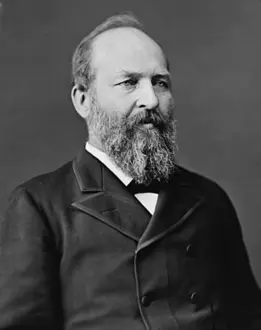
U.S. Representative from Ohio (1863-1880) and 20th President of the United States (1881)
Republican hard-money, Union-first politician who backed Black citizenship and suffrage, federal aid to universal education, a legally regulated civil service and a tariff for revenue with incidental protection. He was cautious about federal coercion in some Reconstruction measures and skeptical of unions and monopolies alike. Most modern-issue statements are anachronistic and left blank.
Closest ideologies
Based on the 39 statements where James A. Garfield has a known position.
- Gaullism (91% match)
- Illiberal democracy (90% match)
- New Nationalism (89% match)
- Kemalism (87% match)
- Sahrawi nationalism (87% match)
Similar people
- Ulysses S. Grant (90% alike)
- Shinzō Abe (90% alike)
- Theresa May (90% alike)
- Charles de Gaulle (90% alike)
- William McKinley (89% alike)
Known positions
- Strongly: Political power should be split among separate branches and levels that can each limit the others.
- Strongly: The government should be able to require citizens to serve in the military.
- Strongly: Democracy is best even when voters make poor choices.
- Strongly: Employers and workers should treat each other as partners whose cooperation comes before conflict, even where their interests differ.
- Strongly: In law, a country's traditional national church should rank no higher than other religious bodies.
- Strongly: A country may keep a region that wants to leave.
- Strongly: Schools should cultivate patriotic feeling: loyalty to and pride in the nation, expressed for example through respect for its flag and anthem.
- Strongly: Rulers have a right to rule only because the people they rule have agreed to it.
- Strongly: Very large concentrations of wealth threaten a free society.
- Strongly: The government should let its political opponents organise, speak and compete for power.
- Strongly: School history should mostly tell the story of the student's own nation.
- Strongly: The law should treat everyone as an equal, whatever their birth, sex, race or status.
- Strongly: News media should decide for themselves what they publish, whoever holds power.
- Strongly: No party's ideology should give it an exclusive right to lead the state.
- Strongly: Industrial society has done at least as much good as harm to humanity.
- Strongly: The ruler should be subject to the country's laws.
- Strongly: Voting should not be limited to members of one ethnic group.
- Strongly: Public spaces such as schools and facilities should not be separated by race under the law.
- Leans: Labor unions do not necessarily make workers better off.
- Leans: The government should have authority over religious institutions' internal affairs.
- Leans: Prices and competition generally decide better than officials what gets made and who gets it.
- Leans: Civil servants should be recruited according to their performance in competitive examinations.
- Leans: A national emergency sometimes justifies temporarily withdrawing normal legal safeguards against people the government regards as internal enemies, such as protections against detention without trial.
- Leans: Many political decisions should rest with national or wider authorities, even where a smaller community could handle them.
- Leans: Government should maintain a strict institutional separation from religion.
- Leans: Businesses should be legally barred from agreements with competitors to suppress competition, such as fixing prices.
- Leans: A country has the right to stop a region becoming independent by using its military.
- Leans: Capitalism is not bound to suffer a general collapse.
- Leans: Taxes on imports should shield domestic producers from foreign competition.
- Leans: Marriage, inheritance and family law should be the same for everyone, not set by each religious community.
- Leans: Society should take active steps to make up for the harm done by past racial injustices.
- Leans: People without property should also have the right to vote.
- Leans: Government should impose strict rules on how corporations operate.
- Leans: Free trade does not benefit everyone in the long run.
- Leans: Religious minorities should not be exempt from general laws that burden their practice.
- Leans: Public schooling money may go straight to schools instead of to parents as vouchers.
- Leans: Businesses gain too much influence over government policy from their lobbying.
- Leans: Governments should give no subsidies, licences or protections that favour firms close to them.