Political Ideology Atlas · All people · Take the test
North America · born 1801, historical
Brigham Young
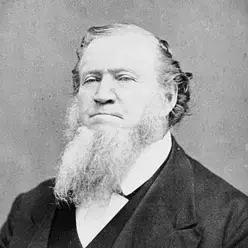
President of the Church of Jesus Christ of Latter-day Saints (1847–1877) and first governor of Utah Territory (1851–1858)
Founder-governor of Mormon Utah, Young taught a "republican theocracy" in which church and civil rule are one, property is a stewardship held for use, and the people govern by a united voice rather than by party. He opposed secession and wars of conquest, backed the Constitution, and urged industry, home production and cooperative economy.
Closest ideologies
Based on the 73 statements where Brigham Young has a known position.
- Confucianism (92% match)
- Identitarian movement (90% match)
- Neue Rechte (89% match)
- Islamic fundamentalism (89% match)
- Person Dignity Theory (88% match)
Similar people
- William Lyon Mackenzie King (91% alike)
- Jean-Jacques Rousseau (89% alike)
- Mahmoud Ahmadinejad (88% alike)
- Joseph Smith (88% alike)
- Fyodor Dostoyevsky (88% alike)
Known positions
- Strongly: The law may treat people differently according to such things as birth, sex, race and status.
- Strongly: One spouse may have more authority than the other within a marriage.
- Strongly: The right to govern traces back to God, even when people confer it on their leaders.
- Strongly: A woman who has sex outside marriage is doing something wrong.
- Strongly: A healthy democracy does not need a clash of opposing political positions.
- Strongly: People able to work should get welfare benefits only in return for some work, such as a job or a work scheme.
- Strongly: Some institutional ties between government and religion are acceptable.
- Strongly: Religious values and institutions should shape laws, schools and public life.
- Strongly: A country may keep a region that wants to leave.
- Strongly: Population growth may be left to run its course.
- Strongly: In law, a country's traditional national church should rank no higher than other religious bodies.
- Strongly: The goods people consume should mainly come from nearby producers.
- Strongly: Religious institutions should be independent of government direction in their internal affairs.
- Strongly: Owning things privately is justified only if it benefits society as a whole.
- Strongly: Politics should support people's spiritual well-being.
- Strongly: Being a civilian on the opposing side should normally protect someone from being deliberately attacked in wartime.
- Strongly: War should never be started to bring other peoples under a religion's rule.
- Strongly: Society needs government of some kind.
- Strongly: The ruler should be subject to the country's laws.
- Strongly: Religious conversion should be free of legal restriction.
- Strongly: Government should have other tasks besides protecting people from physical violence.
- Strongly: People must be free to leave their religion without legal penalty.
- Leans: The most senior religious scholars should have the highest authority over the state and its laws.
- Leans: Shoppers should choose to stay away from shops whose owners belong to a particular religious minority.
- Leans: Only members of one racial or ethnic group should have the right to vote.
- Leans: Laws should follow religious texts.
- Leans: A wife should not be able to end the marriage when her husband refuses.
- Leans: Reforms should take existing institutions and their role in society seriously.
- Leans: People should lose their right to a plot of land when they no longer use it.
- Leans: Government should depend more on leaders setting a good example than on enforcing laws with penalties.
- Leans: People should live and work in communities that own land and goods together and govern themselves.
- Leans: The fact that something is law is not, by itself, a moral reason to obey it.
- Leans: Dividing politics into left and right no longer makes sense.
- Leans: Changes to society should be introduced a little at a time.
- Leans: A national emergency sometimes justifies temporarily withdrawing normal legal safeguards against people the government regards as internal enemies, such as protections against detention without trial.
- Leans: Starting the use of physical force outside defence against an attack is morally unjustified in all cases.
- Leans: Believers can be excused from rules, such as dress or work-day rules, that conflict with their faith.
- Leans: The nation's figurehead should be non-partisan and belong to everyone.
- Leans: A president should be free to stand for re-election as many times as they like.
- Leans: At its core, politics is a struggle between spiritual good and evil.
- Leans: State schools may teach pupils a religious faith, for example through lessons in its beliefs and practice.
- Leans: Inherited religious teachings may stay as handed down, without being rethought for present conditions.
- Leans: Ending a marriage should not be possible without proving fault.
- Leans: Government should be bound by written guarantees of basic rights protected against easy amendment by ordinary majorities.
- Leans: The worst crimes can be punished by death.
- Leans: Marriage, inheritance and family law should be the same for everyone, not set by each religious community.
- Leans: State schools need not steer pupils away from belief in God.
- Leans: Elected politicians should be able to serve any number of terms in any office.
- Leans: Goods get their economic worth from the work it takes to make them.
- Leans: Politics should prioritise a single common good identified by reasoning over compromises among organised interests.
- Leans: People should want as few material things as possible.
- Leans: Taking part in politics is at least as good a way to live as living privately away from public affairs.
- Leans: Rich people have an obligation to help those worse off than they are.
- Leans: Employers and workers should treat each other as partners whose cooperation comes before conflict, even where their interests differ.
- Leans: Government should take sides on how people live, backing the ways of life it judges good.
- Leans: An electorate should choose the head of state, either directly or through elected representatives.
- Leans: Women should be able to vote and stand for office on the same terms as men.
- Leans: Grown children owe care to parents who need it.
- Leans: Society relies for its well-being on longstanding family arrangements, such as a married mother and father raising their children.
- Leans: People are entitled to resist a ruler's unconstitutional exercise of power.
- Leans: A law imposes no moral duty to obey it if the law is unjust.
- Leans: Indigenous peoples should control their traditional territories.
- Leans: Everyone able to work should do some physical labour.
- Leans: Those who hold public office should be paid no more than an average worker.
- Leans: Being powerful does not mean a country should bring more land within its borders.
- Leans: Very large concentrations of wealth threaten a free society.
- Leans: Most people in political office look after themselves first and the public second.
- Leans: Rulers have a right to rule only because the people they rule have agreed to it.
- Leans: Rulers must act under lasting, publicly known laws administered by recognised courts.
- Leans: Lending money at interest should be legal.
- Leans: People should have a way to vote an officeholder out between regular elections.
- Leans: Belonging to the nation does not go with sharing its religion.