Political Ideology Atlas · All people · Take the test
Russia & Central Asia · born 1821, historical
Fyodor Dostoyevsky
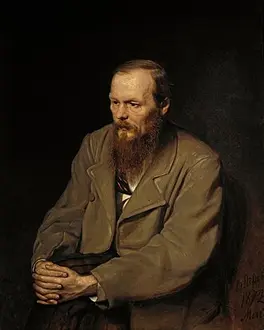
Russian novelist and author of A Writer's Diary (1821–1881)
Dostoevsky joined the Petrashevsky circle in the 1840s, was sentenced to death in 1849 and had the sentence commuted to exile. In his later journalism he defended Orthodox Christianity, Russian messianism, Slavic unity under Russia and the Tsarist monarchy, and opposed Western liberalism, bourgeois materialism, Catholicism and atheist socialism. His Diary also contains antisemitic passages on the 'Jewish question' that he said were not hatred of Jews as a people.
Key figure of
Closest ideologies
Based on the 39 statements where Fyodor Dostoyevsky has a known position.
- German nationalism (93% match)
- Hindu nationalism (91% match)
- Confucianism (91% match)
- Finnish nationalism (90% match)
- The Fourth Political Theory (90% match)
Similar people
- Sher Shah Suri (89% alike)
- William Lyon Mackenzie King (89% alike)
- Steve Bannon (89% alike)
- Jean-Jacques Rousseau (89% alike)
- Bashar al-Assad (89% alike)
Known positions
- Strongly: Belonging to the nation goes with sharing its religion.
- Strongly: War develops virtues in a nation, such as courage and discipline.
- Strongly: People with a university education have a poor understanding of how most people live.
- Strongly: State schools may teach pupils a religious faith, for example through lessons in its beliefs and practice.
- Strongly: Society should follow a third course beyond capitalism and communism.
- Strongly: Religious values and institutions should shape laws, schools and public life.
- Strongly: Where they conflict, religious faith should count for at least as much as evidence and reasoning.
- Strongly: People who give their lives for the nation deserve to be remembered as martyrs, with reverence beyond ordinary thanks.
- Strongly: The law should treat everyone as an equal, whatever their birth, sex, race or status.
- Strongly: Constantly seeking additional possessions is harmful overall, despite any benefits it brings.
- Strongly: Politics should support people's spiritual well-being.
- Strongly: Very large concentrations of wealth threaten a free society.
- Strongly: The reassurance people draw from faith in the face of material hardship need not be founded on false hopes.
- Strongly: Looking after your own interests is not a moral good in itself.
- Strongly: Keeping a nation's inherited culture alive, including its language, customs and traditions, matters.
- Strongly: Farmers should have the legal freedom to leave the estates they work.
- Leans: Colonies should be run mainly to supply markets, materials and outlets for the ruling country.
- Leans: A minority group is working in secret to harm the nation.
- Leans: The country's majority national group should have the leading role in controlling economic life.
- Leans: A powerful country should bring more land within its borders.
- Leans: The national church is recognised in law above other religions.
- Leans: Innate nature shapes a person's character at least as much as their environment does.
- Leans: The country would benefit from a strong leader with the power to act despite deadlock among its political institutions.
- Leans: An economy based on private ownership and profit makes armed conflict among the most powerful countries unavoidable.
- Leans: At its core, politics is a struggle between spiritual good and evil.
- Leans: Prisons should mainly help offenders rejoin society.
- Leans: Some institutional ties between government and religion are acceptable.
- Leans: What you owe your community matters more than your personal rights.
- Leans: Living in the countryside does more for a person's moral wellbeing than living in a city.
- Leans: Rich people have an obligation to help those worse off than they are.
- Leans: The nation has decayed and must be reborn.
- Leans: A people's ties to a place through its history give its claim priority over the claims of other peoples who live there today.
- Leans: At least one other factor explains as much of history as changes in how economies are organized do.
- Leans: Animals can suffer, and that suffering counts in how we treat them.
- Leans: People should have a direct role in making decisions where they work, live and study, rather than having those decisions made entirely for them.
- Leans: A people with a shared national identity is entitled to its own self-governing state.
- Leans: Meeting poor people's needs should be the first consideration in public policy.
- Leans: National policy should give priority to preventing outside powers from splitting the country territorially.