Political Ideology Atlas · All people · Take the test
Latin America & Caribbean · born 1915, historical
Augusto Pinochet
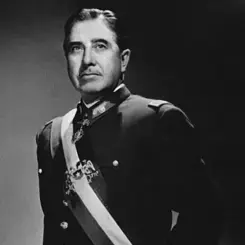
Military ruler of Chile (1973–1990)
Augusto Pinochet led the military coup that overthrew Salvador Allende, then governed Chile under a dictatorship that repressed political opposition. His government privatised major enterprises, established privately managed individual pension accounts and promulgated a constitution that gave the armed forces a formal role in safeguarding the institutional order.
Key figure of
Closest ideologies
Based on the 54 statements where Augusto Pinochet has a known position.
- Metaxism (90% match)
- Corporate statism (90% match)
- İttihadism (89% match)
- Absolutism (European history) (88% match)
- Neo-fascism (87% match)
Similar people
- Toussaint Louverture (91% alike)
- Jorge Rafael Videla (91% alike)
- Mohammed bin Salman Al Saud (90% alike)
- Catherine II of Russia (89% alike)
- Simón Bolívar (89% alike)
Known positions
- Strongly: Elected governments should leave central banks free to make monetary-policy decisions within their legal mandates.
- Strongly: Retirement benefits should come from each worker's own privately managed savings account in place of a state scheme using current contributions to pay current retirees.
- Strongly: The military should have a political role in protecting the constitution and public order, stepping in when they are threatened.
- Strongly: Art, poetry and stories that harm people's moral character should be censored.
- Strongly: The government should stop its political opponents from organising, speaking or competing for power.
- Strongly: Rulers are not bound to act only under lasting, publicly known laws administered by recognised courts.
- Strongly: There should be legal limits on strike action.
- Strongly: Failing companies should not always be left to fail.
- Strongly: Publicly funded services such as hospitals and schools should be run by private companies and charities as well as the state.
- Strongly: Owners' rights to their property should almost never be overridden, even for public goals.
- Strongly: Real authority to command the military should rest with the head of state.
- Strongly: Prices and competition generally decide better than officials what gets made and who gets it.
- Strongly: A national emergency sometimes justifies temporarily withdrawing normal legal safeguards against people the government regards as internal enemies, such as protections against detention without trial.
- Strongly: The country would benefit from a strong leader with the power to act despite deadlock among its political institutions.
- Strongly: Political change should replace the existing administrative and coercive institutions with new forms of organization, rather than put new leaders in charge of the old apparatus.
- Strongly: State schools may teach pupils a religious faith, for example through lessons in its beliefs and practice.
- Strongly: Abortion should be illegal in most cases.
- Strongly: Past abuses by a state's security forces may be put behind it without anyone answering for them in court.
- Strongly: Besides its directly elected parliament, a legislature should have a second chamber, such as a senate.
- Strongly: The worst crimes can be punished by death.
- Strongly: Democracy is not the best form of government when voters choose badly.
- Strongly: Businesses should be legally barred from agreements with competitors to suppress competition, such as fixing prices.
- Strongly: The government should be able to require citizens to serve in the military.
- Strongly: A government should outlaw political parties that aim to do away with its constitutional order.
- Strongly: Children of citizens are not the only ones who should be citizens at birth.
- Strongly: A constitution does not have to be drafted by an assembly elected for that purpose.
- Strongly: A head of state should have the power to dissolve parliament.
- Strongly: Seats may be allocated in ways that do not follow parties' shares of the vote closely.
- Strongly: Socialism cannot be reached just by winning elections and governing through parliament.
- Strongly: At least one other influence has shaped history as much as conflict between economic classes has.
- Strongly: There should be a central bank.
- Strongly: Central banks should keep a role in controlling the money supply.
- Strongly: Society needs government of some kind.
- Strongly: Countries should keep their armed forces.
- Leans: The people in power should decide what the country's news media publish.
- Leans: The law should not impose a blanket ban on torture.
- Leans: When people's freedom to do something harms the environment, the law should limit that freedom.
- Leans: Decisions about indigenous peoples' traditional lands may rest with the wider state, not with those peoples.
- Leans: The government may spend public money without first getting its budget approved by an elected legislature.
- Leans: Public higher education should not be universally tuition-free.
- Leans: Governments should limit how money and investment can be moved across borders.
- Leans: Industries such as energy, rail and utilities do not need to be publicly owned.
- Leans: A president should be limited in how many times he or she may stand for re-election.
- Leans: Some institutional ties between government and religion are acceptable.
- Leans: Employers and workers should treat each other as partners whose cooperation comes before conflict, even where their interests differ.
- Leans: Religious values and institutions should shape laws, schools and public life.
- Leans: Countries should accept binding international arbitration of their disputes.
- Leans: Women should be able to vote and stand for office on the same terms as men.
- Leans: Price controls do more harm than good against inflation.
- Leans: Keeping a nation's inherited culture alive, including its language, customs and traditions, matters.
- Leans: The law should allow people outside state forces to possess weapons.
- Leans: The state should guarantee health care to everyone, whether it runs the services itself or pays for them.
- Leans: Owning things privately is justified only if it benefits society as a whole.
- Leans: Making progress deserves at least as much weight as reviving an earlier way of organizing society.