Political Ideology Atlas · All people · Take the test
Europe · born 1894, historical
Aldous Huxley
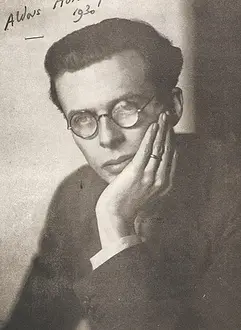
English writer and philosopher (1894–1963)
Huxley, author of Brave New World, was a critic of totalitarianism of left and right, of Big Business and Big Government, and of nationalism and war. He argued for decentralised, self-governing small groups, co-operative and mixed enterprises, wide distribution of property, non-violence and disarmament, and for population limitation. He saw technology, propaganda and over-organisation as threats to freedom.
Closest ideologies
Based on the 75 statements where Aldous Huxley has a known position.
- Bioregionalism (90% match)
- Pacifism (89% match)
- Jewish Autonomism (89% match)
- Đilasism (87% match)
- Indigenous feminism (87% match)
Similar people
- Rabindranath Tagore (91% alike)
- Malcolm X (88% alike)
- Rudolf Steiner (88% alike)
- Martin Luther King Jr. (88% alike)
- Hannah Arendt (87% alike)
Known positions
- Strongly: Schools should not cultivate patriotic feeling, meaning loyalty to and pride in the nation.
- Strongly: Population growth should be deliberately held down.
- Strongly: Using a country's armed forces for wider policy goals is a misuse of military power.
- Strongly: Starting the use of physical force outside defence against an attack is morally unjustified in all cases.
- Strongly: Individual rights matter at least as much as what citizens owe their community.
- Strongly: Opening markets across borders leaves every trading country better off over time.
- Strongly: Belonging to a nation does not give people's lives enduring meaning through a sacred tie to earlier and later generations.
- Strongly: Working together internationally should count at least as much as my country's own priorities.
- Strongly: Communist one-party regimes should be condemned as severely as fascist regimes.
- Strongly: Government should serve people's good while respecting each person as more than an instrument of the state or community.
- Strongly: Property should belong to many people in small holdings.
- Strongly: My country may keep a military no stronger than its rivals'.
- Strongly: Seats may be allocated in ways that do not follow parties' shares of the vote closely.
- Strongly: Employees should have voting rights in the management of large companies.
- Strongly: Political decisions should rest with the smallest local community able to handle them, with wider authorities handling matters that need a wider reach.
- Strongly: Publicly honouring a national leader as the personification of the nation is not acceptable.
- Strongly: Young people should not be organised into uniformed, drilled groups that prepare them to serve the nation.
- Strongly: Member states should keep the final decision on whether to follow UN decisions.
- Strongly: People should have a direct role in making decisions where they work, live and study, rather than having those decisions made entirely for them.
- Strongly: The government should let its political opponents organise, speak and compete for power.
- Strongly: You can't reach a free, fair society by unfree or unfair means.
- Strongly: Armed conflict does not generally make a people stronger in character.
- Strongly: No party's ideology should give it an exclusive right to lead the state.
- Strongly: Very large concentrations of wealth threaten a free society.
- Strongly: Being a civilian on the opposing side should normally protect someone from being deliberately attacked in wartime.
- Strongly: News media should decide for themselves what they publish, whoever holds power.
- Strongly: A workers' state does not need to suppress the old ruling class, even for a time.
- Strongly: A mother country and its colonies may trade with the outside world.
- Strongly: Some areas of life should remain outside state direction.
- Strongly: Government should have other tasks besides protecting people from physical violence.
- Strongly: Overseas territories need not be run mainly for the ruling country's economic benefit.
- Leans: Rising population contributes more to persistent poverty than any competing cause.
- Leans: A country can and should do without a standing military.
- Leans: School history need not centre on the story of the student's own nation.
- Leans: Becoming a capable ruler requires a natural talent for the job.
- Leans: Reforms should take existing institutions and their role in society seriously.
- Leans: Civil servants should be recruited according to their performance in competitive examinations.
- Leans: Countries should hand part of their decision-making power to a union of nations, such as the European Union.
- Leans: People should live and work in communities that own land and goods together and govern themselves.
- Leans: Innate nature shapes a person's character at least as much as their environment does.
- Leans: Changes to society should be introduced a little at a time.
- Leans: People should be encouraged to live in ways that differ from social custom.
- Leans: Government institutions chiefly protect the ruling class's power over the rest of society.
- Leans: Military service should always be voluntary.
- Leans: A country should not tie itself to other countries through lasting military alliances.
- Leans: Democracy is best even when voters make poor choices.
- Leans: Those who inherit a large fortune should hand over a big share of it in tax.
- Leans: Political power should be split among separate branches and levels that can each limit the others.
- Leans: Allied countries are free to decide for themselves whether to help one that is attacked.
- Leans: Society should follow a third course beyond capitalism and communism.
- Leans: The government should steer investment into industries it sees as key to the country's future.
- Leans: Major laws should not be decided by direct votes of citizens.
- Leans: High earners and the very rich should pay tax at a much higher rate than everyone else.
- Leans: Countries should maintain only the weapons needed for national safety.
- Leans: A country can get through deadlock among its institutions without a leader who overrides them.
- Leans: Tariffs should not be used to protect domestic industry from foreign competition.
- Leans: Living in the countryside does more for a person's moral wellbeing than living in a city.
- Leans: Businesses should belong to the people who work in them, for example as cooperatives.
- Leans: Technology will leave most of humanity's problems unsolved.
- Leans: Civilization's main goals may lie elsewhere than in spreading into space.
- Leans: Government should impose strict rules on how corporations operate.
- Leans: Countries should accept binding international arbitration of their disputes.
- Leans: Society needs government of some kind.
- Leans: We have a duty to leave the planet in good condition for those who come after us.
- Leans: Nobody should hold a special rank by birth, such as a noble title, a hereditary crown or a caste position, or the special rights attached to one.
- Leans: The goods people consume should mainly come from nearby producers.
- Leans: A government needs more than fair elections to qualify as democratic.
- Leans: Individual farms should not give way to joint cultivation by groups of farmers.
- Leans: Formal press freedom is hollow when wealth decides who can actually be heard.
- Leans: Making progress deserves at least as much weight as reviving an earlier way of organizing society.
- Leans: Someone who actually governs a state should not hand that power on to their own child.