Political Ideology Atlas · All ideologies · Take the test
Traditionalism (Spain)
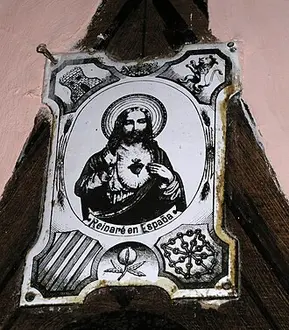
Traditionalism (Spain) is a Spanish political doctrine formulated in the early nineteenth century and developed by the neo-Catholic heirs of Jaime Balmes and Juan Donoso Cortés. It holds that politics should carry out Catholic teaching: a Catholic state under a legitimate monarchy that governs in fact, with representation by classes and corporations rather than parties, and the historic regional charters (fueros) respected within a single Spain. It rejects liberal parliamentarism, popular sovereignty, socialism and the state's claim on private wealth, and defends dictatorship where ordinary legality cannot protect society.
What it stands for
- Belonging to the nation goes with sharing its religion.
- Someone who actually governs a state may hand that power on to their own child, whether as a king or as a republic's leader.
- Consent of the governed is not the only basis of legitimate political authority.
- The right to govern traces back to God, even when people confer it on their leaders.
- Reforms should take existing institutions and their role in society seriously.
- People should gain political representation through social bodies such as families, local communities and occupational associations instead of political parties.
Key figure
- Juan Donoso Cortés: Thinker whom the scholarship presents, with Jaime Balmes, as the leading figure of the traditionalist political project
Closest ideologies
- Carlism (91% match)
- Monarchism in France (91% match)
- Clerical fascism (91% match)
- Integral nationalism (90% match)
- Monarchism (88% match)
People closest to it
- Pius IX (86% alike)
- Pat Buchanan (86% alike)
- Aristotle (85% alike)
- Stephen Miller (85% alike)
- Anna Paulina Luna (85% alike)
Key positions
- Strongly: Belonging to the nation goes with sharing its religion.
- Strongly: Someone who actually governs a state may hand that power on to their own child, whether as a king or as a republic's leader.
- Strongly: Consent of the governed is not the only basis of legitimate political authority.
- Strongly: The right to govern traces back to God, even when people confer it on their leaders.
- Strongly: Reforms should take existing institutions and their role in society seriously.
- Strongly: People should gain political representation through social bodies such as families, local communities and occupational associations instead of political parties.
- Strongly: Owners' rights to their property should almost never be overridden, even for public goals.
- Strongly: The head of state should not have to be chosen by election.
- Strongly: Innate nature shapes a person's character at least as much as their environment does.
- Strongly: The country would benefit from a strong leader with the power to act despite deadlock among its political institutions.
- Strongly: The state may give legal precedence to one stream of a religion over the others.
- Strongly: Inherited customs should carry authority beyond what the current generation chooses to give them.
- Strongly: Industries such as energy, rail and utilities do not need to be publicly owned.
- Strongly: The government may leave it to investors to decide which industries receive investment.
- Strongly: Large landed estates should not be compulsorily transferred to the people who farm them.
- Strongly: Marriage, inheritance and family law may differ between religious communities.
- Strongly: Democracy is not the best form of government when voters choose badly.
- Strongly: Some institutional ties between government and religion are acceptable.
- Strongly: Seats may be allocated in ways that do not follow parties' shares of the vote closely.
- Strongly: Employers and workers should treat each other as partners whose cooperation comes before conflict, even where their interests differ.
- Strongly: The national legislature should not be able to take back powers given to regions on its own.
- Strongly: Religious values and institutions should shape laws, schools and public life.
- Strongly: A country may keep a region that wants to leave.
- Strongly: Government should take sides on how people live, backing the ways of life it judges good.
- Strongly: The nation has decayed and must be reborn.
- Strongly: Where they conflict, religious faith should count for at least as much as evidence and reasoning.
- Strongly: Another body may have the final say over what the legislature passes.
- Strongly: Society relies for its well-being on longstanding family arrangements, such as a married mother and father raising their children.
- Strongly: The people who make up the nation today are the same people, generation after generation, all the way back to its beginnings in antiquity.
- Strongly: Religious institutions should be independent of government direction in their internal affairs.
- Strongly: At least one other factor explains as much of history as changes in how economies are organized do.
- Strongly: The head of state should not be elected directly by the voters.
- Strongly: At least one other influence has shaped history as much as conflict between economic classes has.
- Strongly: Even a purely ceremonial head of state should not hold the position by birth.
- Strongly: The state may restrict what adults do for reasons other than preventing harm to others.
- Strongly: Equality of outcomes should not be society's goal.
- Strongly: Families may keep the main responsibility for housework and childcare.
- Strongly: State ownership should stop short of covering all land.
- Strongly: Groups have rights of their own.
- Strongly: The reassurance people draw from faith in the face of material hardship need not be founded on false hopes.
- Strongly: A workers' state does not need to suppress the old ruling class, even for a time.
- Strongly: Looking after your own interests is not a moral good in itself.
- Strongly: Keeping a nation's inherited culture alive, including its language, customs and traditions, matters.
- Strongly: Some areas of life should remain outside state direction.
- Strongly: Society needs government of some kind.
- Strongly: Countries should keep their armed forces.
- Strongly: Taking part in politics is at least as good a way to live as living privately away from public affairs.
- Strongly: Collecting taxes does not in itself amount to stealing people's money.
- Strongly: Government should have other tasks besides protecting people from physical violence.
- Strongly: People must be free to leave their religion without legal penalty.
- Leans: The state should punish people who publicly insult what a religion holds sacred.
- Leans: The same income-tax percentage should apply across taxable income levels.
- Leans: Political power should rest on councils elected in workplaces in place of parliaments.
- Leans: Laws should follow religious texts.
- Leans: Bringing back the way society used to be should take priority over trying to make new advances.
- Leans: The state should not promise everyone enough to live decently.
- Leans: Voluntary charitable help does a better job of helping people in poverty than government aid does.
- Leans: The national church is recognised in law above other religions.
- Leans: The presence of people belonging to the same nation gives a state a legitimate territorial claim outside its borders.
- Leans: A society holds together less well when its members belong to different ethnic groups.
- Leans: A national emergency sometimes justifies temporarily withdrawing normal legal safeguards against people the government regards as internal enemies, such as protections against detention without trial.
- Leans: Tax rates should not rise steeply with income.
- Leans: At its core, politics is a struggle between spiritual good and evil.
- Leans: The political goal should be victory over communism ahead of accommodation with it.
- Leans: A country has the right to stop a region becoming independent by using its military.
- Leans: Military service should always be voluntary.
- Leans: A country should press its neighbour to give back land taken from it in an old war.
- Leans: Peoples who share an ethnic heritage, such as the Slavic, Arab or Turkic peoples, should come together in one state, even across present borders.
- Leans: Delegates selected by councils at one level should select officeholders at higher levels.
- Leans: When national priorities conflict with working together internationally, my country should choose its own priorities.
- Leans: Prisons should focus at least as much on punishment as on rehabilitation.
- Leans: Countries within one civilization should unite politically.
- Leans: The worst crimes can be punished by death.
- Leans: Being part of the nation gives a person's life meaning beyond their own lifetime through a bond held sacred across generations.
- Leans: A national minority should run its own schools, language and cultural institutions inside the state it lives in.
- Leans: Trade unions should control their own affairs without state direction.
- Leans: Society may hold back technological change that would overturn established institutions.
- Leans: What you owe your community matters more than your personal rights.
- Leans: Politics should prioritise a single common good identified by reasoning over compromises among organised interests.
- Leans: Rich people have an obligation to help those worse off than they are.
- Leans: Land claimed as the historic homeland should not be traded away, even for peace.
- Leans: The state should not make one language the only common language of government, schooling and public life at the cost of limiting others.
- Leans: Political decisions should rest with the smallest local community able to handle them, with wider authorities handling matters that need a wider reach.
- Leans: The government should keep some form of income tax.
- Leans: A people's ties to a place through its history give its claim priority over the claims of other peoples who live there today.
- Leans: A country may keep all its decisions in its own hands rather than pooling them with other nations.
- Leans: Public institutions should help minority languages be used in public life, for example through teaching or services in those languages.
- Leans: Some things are right or wrong for everyone, in every culture and era.
- Leans: Socialism cannot be reached just by winning elections and governing through parliament.
- Leans: To work for your country's interests is to work for the interests of its workers.
- Leans: Wages need not be set through negotiating bodies that the state officially recognizes.
- Leans: Politics should support people's spiritual well-being.
- Leans: A state should take responsibility for the welfare of its national communities across neighbouring borders.
- Leans: People who give their lives for the nation deserve to be remembered as martyrs, with reverence beyond ordinary thanks.
- Leans: A people's connection to its ancestral land is spiritual, beyond practical interests or ordinary affection.
- Leans: Soldiers and conscripts need not refuse to fight when their state goes to war.
- Leans: A people split by an imposed border should be brought together in a single state.
- Leans: Armed conflict does not generally make a people stronger in character.
- Leans: National policy should give priority to preventing outside powers from splitting the country territorially.