Political Ideology Atlas · All people · Take the test
Europe · born 1792, historical
Pius IX
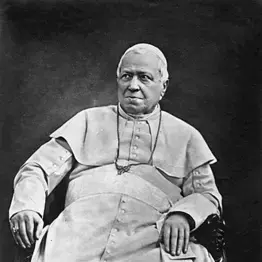
Pope (1846–1878) and last sovereign of the Papal States
Pius IX began his reign with reforms and an amnesty but after 1848 became a firm opponent of liberalism, nationalism and socialism. His Syllabus of Errors and Quanta Cura condemned religious liberty, state control of schools, civil marriage and divorce, and he held the Papal States' temporal power until Italy took Rome in 1870.
Closest ideologies
Based on the 43 statements where Pius IX has a known position.
- Reactionary (90% match)
- Integralismo Lusitano (89% match)
- Carlism (87% match)
- Integralism (87% match)
- Traditionalism (Spain) (86% match)
Similar people
- Jair Bolsonaro (88% alike)
- Pete Hegseth (86% alike)
- Augustus (85% alike)
- Stephen Miller (85% alike)
- Pat Buchanan (84% alike)
Known positions
- Strongly: The most senior religious scholars should have the highest authority over the state and its laws.
- Strongly: A wife should not be able to end the marriage when her husband refuses.
- Strongly: One spouse may have more authority than the other within a marriage.
- Strongly: The right to govern traces back to God, even when people confer it on their leaders.
- Strongly: The national church is recognised in law above other religions.
- Strongly: Staying out of other countries' internal affairs should not be the default for foreign policy.
- Strongly: Which country a disputed territory belongs to may be settled without a vote of its inhabitants.
- Strongly: Owners' rights to their property should almost never be overridden, even for public goals.
- Strongly: Businesses need not belong to the people who work in them.
- Strongly: Industries such as energy, rail and utilities do not need to be publicly owned.
- Strongly: Large landed estates should not be compulsorily transferred to the people who farm them.
- Strongly: State schools may teach pupils a religious faith, for example through lessons in its beliefs and practice.
- Strongly: Inherited religious teachings may stay as handed down, without being rethought for present conditions.
- Strongly: Ending a marriage should not be possible without proving fault.
- Strongly: Democracy is not the best form of government when voters choose badly.
- Strongly: Some institutional ties between government and religion are acceptable.
- Strongly: Religious values and institutions should shape laws, schools and public life.
- Strongly: Being the law gives a rule a moral claim to be obeyed.
- Strongly: A country may keep a region that wants to leave.
- Strongly: Land claimed as the historic homeland should not be traded away, even for peace.
- Strongly: Where they conflict, religious faith should count for at least as much as evidence and reasoning.
- Strongly: Society relies for its well-being on longstanding family arrangements, such as a married mother and father raising their children.
- Strongly: Religious institutions should be independent of government direction in their internal affairs.
- Strongly: Some things are right or wrong for everyone, in every culture and era.
- Strongly: Equality of outcomes should not be society's goal.
- Strongly: State ownership should stop short of covering all land.
- Strongly: The great religions need not share a single underlying truth.
- Strongly: My country should not send weapons to foreign insurgents, whatever it thinks of the governments they fight.
- Strongly: Politics should support people's spiritual well-being.
- Strongly: The reassurance people draw from faith in the face of material hardship need not be founded on false hopes.
- Strongly: Some areas of life should remain outside state direction.
- Strongly: Society needs government of some kind.
- Strongly: Government should have other tasks besides protecting people from physical violence.
- Leans: The law may treat people differently according to such things as birth, sex, race and status.
- Leans: Having a shared national identity does not by itself entitle a people to its own self-governing state.
- Leans: Consent of the governed is not the only basis of legitimate political authority.
- Leans: A ruler's unconstitutional acts do not give people a right to resist.
- Leans: Real authority to command the military should rest with the head of state.
- Leans: A country has the right to stop a region becoming independent by using its military.
- Leans: A country should press its neighbour to give back land taken from it in an old war.
- Leans: Besides its directly elected parliament, a legislature should have a second chamber, such as a senate.
- Leans: Land that a state declares its own against its people's will is still illegally occupied by that state.