Political Ideology Atlas · All ideologies · Take the test
New Nationalism (Theodore Roosevelt)
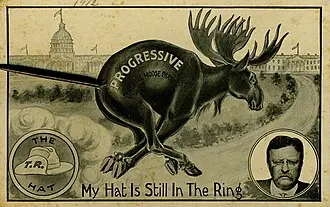
New Nationalism is the Progressive program of Theodore Roosevelt, drawing on Herbert Croly, that uses a strong federal government and executive to regulate large corporations, protect workers and put human welfare ahead of property rights. It accepts industrial concentration but wants it supervised by expert commissions, with democratic reforms such as primaries, initiative, referendum and recall to keep government answerable to the people rather than to business and party bosses.
What it stands for
- Those who inherit a large fortune should hand over a big share of it in tax.
- A business owner can earn a profit without taking unfair advantage of employees.
- Full-time work at the legal wage floor should pay enough to meet basic living costs.
- The state has no single leading function, or its leading function is something other than preserving the ruling class's power.
- Direct action does not have to take the place of elections and parliament as the way to achieve political change.
- The world's most powerful countries can avoid going to war with one another under capitalism.
Key works
- The New Nationalism, Theodore Roosevelt
- The Promise of American Life, Herbert Croly
- Progressive Party Platform of 1912, Progressive Party
Closest ideologies
- Pan-Americanism (89% match)
- Nordic model (89% match)
- Zionism (88% match)
- Czechoslovakism (88% match)
- Browderism (87% match)
People closest to it
- Warren G. Harding (89% alike)
- Shinzō Abe (89% alike)
- Theresa May (89% alike)
- Robert F. Kennedy (88% alike)
- James A. Garfield (88% alike)
Key positions
- Strongly: Those who inherit a large fortune should hand over a big share of it in tax.
- Strongly: A business owner can earn a profit without taking unfair advantage of employees.
- Strongly: Full-time work at the legal wage floor should pay enough to meet basic living costs.
- Strongly: The state has no single leading function, or its leading function is something other than preserving the ruling class's power.
- Strongly: Direct action does not have to take the place of elections and parliament as the way to achieve political change.
- Strongly: The world's most powerful countries can avoid going to war with one another under capitalism.
- Strongly: A country can miss out on lasting gains when barriers to international commerce come down.
- Strongly: Politics should prioritise a single common good identified by reasoning over compromises among organised interests.
- Strongly: Government should impose strict rules on how corporations operate.
- Strongly: An electorate should choose the head of state, either directly or through elected representatives.
- Strongly: Political representation should not come through social bodies such as families, local communities and occupational associations instead of political parties.
- Strongly: Workers' pay should be settled in collective bargaining between their union and their employer.
- Strongly: Even a purely ceremonial head of state should not hold the position by birth.
- Strongly: Workers are better off for having labor unions.
- Strongly: Workers do not need a disciplined revolutionary party to lead them.
- Strongly: Whatever their circumstances, everyone should be able to count on the state for enough to live decently, through benefits, pensions or public services.
- Strongly: People should have a way to vote an officeholder out between regular elections.
- Strongly: Laws should not be required to follow religious texts.
- Strongly: Owning things privately is justified only if it benefits society as a whole.
- Strongly: There is no deliberate plan behind immigration aimed at replacing the native population.
- Strongly: Very large concentrations of wealth threaten a free society.
- Strongly: Income-tax percentages may differ between income levels.
- Strongly: The armed forces may be controlled by someone other than the governing party's leadership.
- Strongly: In the long run people should still produce and share using money.
- Strongly: Work may stay divided into separate specialized jobs held by different people.
- Strongly: Income from useful work should be rewarded ahead of income from merely owning property.
- Strongly: News media should decide for themselves what they publish, whoever holds power.
- Strongly: An armed minority's actions are incapable of bringing about the conditions for a broader revolutionary uprising.
- Strongly: A workers' state does not need to suppress the old ruling class, even for a time.
- Strongly: Rapid economic development does not justify temporary restrictions on political freedom.
- Strongly: No state may force a minority out of the country, however hostile it judges that minority to be.
- Strongly: We have a duty to leave the planet in good condition for those who come after us.
- Strongly: Poor countries should retain economic ties with rich countries.
- Strongly: Governments should give no subsidies, licences or protections that favour firms close to them.
- Strongly: Some decisions should bind people who have not consented to them.
- Strongly: When companies press officials for policies they want, they gain more sway over public decisions than they should have.
- Strongly: Some areas of life should remain outside state direction.
- Strongly: Society needs government of some kind.
- Strongly: Women should be able to vote and stand for office on the same terms as men.
- Strongly: Countries should keep their armed forces.
- Strongly: The state should not be managed the way a well-run business is.
- Strongly: The holder of the highest state office need not be treated as holy.
- Strongly: Collecting taxes does not in itself amount to stealing people's money.
- Strongly: At least one other factor does as much to keep people in poverty as population growth does.
- Strongly: Political authority need not rest on oaths of loyalty sworn to a lord.
- Strongly: Government should have other tasks besides protecting people from physical violence.
- Strongly: Courts need not be handed over to private businesses.
- Strongly: Public offices may be filled by methods other than drawing lots.
- Strongly: Renting out housing should be permitted in at least some circumstances.
- Strongly: Final authority over a state's laws need not belong to its most senior religious scholars.
- Strongly: Women may go out in public without any legal duty to cover fully.
- Strongly: Farmers should have the legal freedom to leave the estates they work.
- Leans: Once the national majority has decided, public institutions, including courts and independent bodies, should not limit its decision.
- Leans: Women are able to achieve full equality within the existing economic system.
- Leans: Civil servants should be recruited according to their performance in competitive examinations.
- Leans: Public institutions do not need to help minority languages be used in public life.
- Leans: Many political decisions should rest with national or wider authorities, even where a smaller community could handle them.
- Leans: Newcomers should adopt the host nation's culture in place of their original culture.
- Leans: Taxes on imports should shield domestic producers from foreign competition.
- Leans: Industries such as energy, rail and utilities do not need to be publicly owned.
- Leans: Major laws should be decided by citizens voting on them themselves.
- Leans: New oil and gas wells and coal mines should be permitted.
- Leans: A country has the right to stop a region becoming independent by using its military.
- Leans: Cultural life inside a state should not be placed under the control of each national minority.
- Leans: Political power may be concentrated in one body.
- Leans: Private businesses and markets should run most of the economy, while the government supports people who cannot meet their basic needs.
- Leans: Government should not be bound by a written bill of rights protected against easy amendment by ordinary majorities.
- Leans: Political freedom is able to last in a society that withholds those economic freedoms.
- Leans: Businesses should be legally barred from agreements with competitors to suppress competition, such as fixing prices.
- Leans: In the society we should aim for, a person's share of goods may depend on things besides their needs.
- Leans: Children of citizens are not the only ones who should be citizens at birth.
- Leans: People able to work should get welfare benefits only in return for some work, such as a job or a work scheme.
- Leans: High earners and the very rich should pay tax at a much higher rate than everyone else.
- Leans: Creating new money should be reserved to public institutions, excluding private banks' creation of money through lending.
- Leans: Employers and workers should treat each other as partners whose cooperation comes before conflict, even where their interests differ.
- Leans: People who take land or other resources from nature for themselves owe the public a share of their value.
- Leans: A country may keep a region that wants to leave.
- Leans: Owners' rights to their property need not be protected against being overridden for public goals.
- Leans: Countries should accept binding international arbitration of their disputes.
- Leans: Each country should hold ultimate authority over its natural resources, without foreign interests controlling them.
- Leans: Private owners' choice of whom they deal with should be subject to some restrictions.
- Leans: Government should rely at least as much on legal enforcement as on its rulers' moral example.
- Leans: The government should keep some form of income tax.
- Leans: Keeping a nation's inherited culture alive, including its language, customs and traditions, matters.
- Leans: Nobody should hold a special rank by birth, such as a noble title, a hereditary crown or a caste position, or the special rights attached to one.
- Leans: Society relies for its well-being on longstanding family arrangements, such as a married mother and father raising their children.
- Leans: A national development strategy should not accept some regions growing wealthy ahead of the rest.
- Leans: Schools should cultivate patriotic feeling: loyalty to and pride in the nation, expressed for example through respect for its flag and anthem.
- Leans: A mother country and its colonies may trade with the outside world.
- Leans: A person loses freedom from being at another person's mercy, even if that power is never exercised.
- Leans: The state should not give all adults a regular payment unconditionally.
- Leans: State pensions funded by current workers' contributions should stay in place rather than be replaced by privately managed individual accounts.
- Leans: The state may restrict what adults do for reasons other than preventing harm to others.
- Leans: Most people in political office look after themselves first and the public second.
- Leans: The state should guarantee health care to everyone, whether it runs the services itself or pays for them.
- Leans: Rulers have a right to rule only because the people they rule have agreed to it.
- Leans: Equality of outcomes should not be society's goal.
- Leans: Being allowed to make a choice only counts as freedom if you have the resources to act on it.
- Leans: Meeting poor people's needs should be the first consideration in public policy.
- Leans: The law should treat everyone as an equal, whatever their birth, sex, race or status.
- Leans: State ownership should stop short of covering all land.