Political Ideology Atlas · All ideologies · Take the test
Muslim nationalism in South Asia
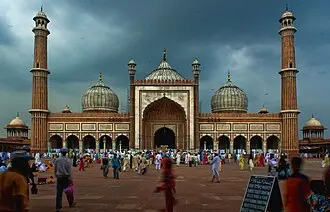
Muslim nationalism in South Asia holds that the Muslims of British India formed a nation distinct from Hindus in religion, culture and history, entitled to political safeguards and ultimately to homelands and a state of their own. It rejects Hindu-majority democracy without communal guarantees, and treats Islam as a shaping force in public life, with adherents ranging from modernists like Jinnah to traditionalist and idealist advocates of an Islamic order.
What it stands for
- Voters of each religious community should choose their representatives in elections held separately from other communities.
- Belonging to the nation goes with sharing its religion.
- The right to govern traces back to God, even when people confer it on their leaders.
- Each main community should have a guaranteed place in government, even against a numerical majority.
- Cultural life inside a state should not be placed under the control of each national minority.
- Marriage, inheritance and family law may differ between religious communities.
Closest ideologies
- Zionism (92% match)
- Pan-Americanism (92% match)
- Poporanism (92% match)
- Religious democracy (91% match)
- Sahrawi nationalism (90% match)
People closest to it
- Imran Khan (94% alike)
- Mahmoud Ahmadinejad (93% alike)
- Muhammad Iqbal (93% alike)
- Hassan Sheikh Mohamud (92% alike)
- Naveen Jindal (91% alike)
Key positions
- Strongly: Voters of each religious community should choose their representatives in elections held separately from other communities.
- Strongly: Belonging to the nation goes with sharing its religion.
- Strongly: The right to govern traces back to God, even when people confer it on their leaders.
- Strongly: Each main community should have a guaranteed place in government, even against a numerical majority.
- Strongly: Cultural life inside a state should not be placed under the control of each national minority.
- Strongly: Marriage, inheritance and family law may differ between religious communities.
- Strongly: Sharing a language is not sufficient for people to constitute one nation.
- Strongly: Religious values and institutions should shape laws, schools and public life.
- Strongly: Where they conflict, religious faith should count for at least as much as evidence and reasoning.
- Strongly: The people living in a disputed territory should choose by voting which country it joins.
- Strongly: A people with a shared national identity is entitled to its own self-governing state.
- Strongly: Public institutions should have the power to constrain a national majority's decisions in a liberal democracy.
- Strongly: Politics should support people's spiritual well-being.
- Strongly: Groups have rights of their own.
- Strongly: The reassurance people draw from faith in the face of material hardship need not be founded on false hopes.
- Strongly: Keeping a nation's inherited culture alive, including its language, customs and traditions, matters.
- Strongly: Society needs government of some kind.
- Strongly: The ruler should be subject to the country's laws.
- Strongly: Taking part in politics is at least as good a way to live as living privately away from public affairs.
- Strongly: Voting should not be limited to members of one ethnic group.
- Strongly: State schools need not steer pupils away from belief in God.
- Leans: Taking pride in one's racial group is not justified.
- Leans: Laws should follow religious texts.
- Leans: Democracy is best even when voters make poor choices.
- Leans: Government should be bound by written guarantees of basic rights protected against easy amendment by ordinary majorities.
- Leans: Inherited religious teachings should be understood anew in light of present conditions.
- Leans: Final authority over a state's laws need not belong to its most senior religious scholars.
- Leans: An electorate should choose the head of state, either directly or through elected representatives.
- Leans: A nation can be made up of several ethnic groups with none forming most of its people.
- Leans: People need not organize along racial lines to stand up for the concerns of their group.
- Leans: A people should have one region of its own rather than being split across several.
- Leans: No party's ideology should give it an exclusive right to lead the state.
- Leans: Rulers have a right to rule only because the people they rule have agreed to it.
- Leans: School history should mostly tell the story of the student's own nation.
- Leans: Political institutions developed in the West are not a suitable model for every civilization.
- Leans: The law should treat everyone as an equal, whatever their birth, sex, race or status.