Political Ideology Atlas · All people · Take the test
South & Southeast Asia · born 1928, historical
Zulfikar Ali Bhutto
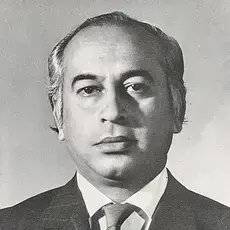
President (1971–1973) and prime minister (1973–1977) of Pakistan
Bhutto led Pakistan after the secession of Bangladesh. His government nationalised major industries and banks and redistributed agricultural land. He led the negotiations that produced the 1973 parliamentary constitution and signed the Simla Agreement with India.
Closest ideologies
Based on the 63 statements where Zulfikar Ali Bhutto has a known position.
- Arab socialism (89% match)
- Patria Grande (89% match)
- German nationalism (88% match)
- Eurasianism (87% match)
- Right-wing populism (87% match)
Similar people
- Gamal Abdel Nasser (90% alike)
- Joseph Smith (90% alike)
- Mahathir Mohamad (89% alike)
- William Lyon Mackenzie King (88% alike)
- Richard Nixon (88% alike)
Known positions
- Strongly: Laws should follow religious texts.
- Strongly: My country should possess its own nuclear arsenal with independent authority over its use.
- Strongly: The right to govern traces back to God, even when people confer it on their leaders.
- Strongly: A national emergency sometimes justifies temporarily withdrawing normal legal safeguards against people the government regards as internal enemies, such as protections against detention without trial.
- Strongly: The state may give legal precedence to one stream of a religion over the others.
- Strongly: An assembly elected by the people for that purpose should draft the constitution.
- Strongly: State schools may teach pupils a religious faith, for example through lessons in its beliefs and practice.
- Strongly: Public authorities should help get new facilities built to generate electricity from nuclear energy.
- Strongly: Besides its directly elected parliament, a legislature should have a second chamber, such as a senate.
- Strongly: The farmers who work large estates should take ownership from the landowners, with the transfer compulsory if owners refuse.
- Strongly: The government should steer investment into industries it sees as key to the country's future.
- Strongly: Some institutional ties between government and religion are acceptable.
- Strongly: Industries such as energy, rail and utilities should be owned by the state or public bodies, not private companies.
- Strongly: Society may be changed in large, rapid steps.
- Strongly: Religious values and institutions should shape laws, schools and public life.
- Strongly: Government should take sides on how people live, backing the ways of life it judges good.
- Strongly: An electorate should choose the head of state, either directly or through elected representatives.
- Strongly: Owners' rights to their property need not be protected against being overridden for public goals.
- Strongly: The people living in a disputed territory should choose by voting which country it joins.
- Strongly: The head of state should not be elected directly by the voters.
- Strongly: There should be a central bank.
- Strongly: State ownership should stop short of covering all land.
- Strongly: Political power may rest on something other than workplace-elected councils.
- Strongly: Protecting the constitution should be left to civilian institutions, not the armed forces.
- Strongly: Trade, finance and debt rules should be changed to give poorer countries a fairer share.
- Strongly: Police forces should continue to exist.
- Strongly: Society needs government of some kind.
- Strongly: Women should be able to vote and stand for office on the same terms as men.
- Strongly: Countries should keep their armed forces.
- Strongly: Voting should not be limited to members of one ethnic group.
- Strongly: Public spaces such as schools and facilities should not be separated by race under the law.
- Strongly: Government should have other tasks besides protecting people from physical violence.
- Strongly: Courts need not be handed over to private businesses.
- Strongly: State schools need not steer pupils away from belief in God.
- Strongly: People without property should also have the right to vote.
- Leans: The law may treat people differently according to such things as birth, sex, race and status.
- Leans: The government should stop its political opponents from organising, speaking or competing for power.
- Leans: Charging interest on loans is banned by law.
- Leans: Population growth should be deliberately held down.
- Leans: My country may join a military alliance led by one of the great powers.
- Leans: Governments should limit how money and investment can be moved across borders.
- Leans: A country has the right to stop a region becoming independent by using its military.
- Leans: A country should press its neighbour to give back land taken from it in an old war.
- Leans: Farmers should get price floors, state buying or cheap credit to keep them secure.
- Leans: Sex work between consenting adults should be illegal.
- Leans: Government should be bound by written guarantees of basic rights protected against easy amendment by ordinary majorities.
- Leans: Property should belong to many people in small holdings.
- Leans: A president should be limited in how many times he or she may stand for re-election.
- Leans: Final authority over a state's laws need not belong to its most senior religious scholars.
- Leans: Direct action does not have to take the place of elections and parliament as the way to achieve political change.
- Leans: Real command of the military may rest with someone other than the head of state.
- Leans: Government should impose strict rules on how corporations operate.
- Leans: Employees should have voting rights in the management of large companies.
- Leans: A country may keep a region that wants to leave.
- Leans: Keeping a nation's inherited culture alive, including its language, customs and traditions, matters.
- Leans: Political independence means little unless the economic and property system is also transformed.
- Leans: Public institutions should help minority languages be used in public life, for example through teaching or services in those languages.
- Leans: An elected legislature must approve the government's budget before the government spends public money.
- Leans: State pensions funded by current workers' contributions should stay in place rather than be replaced by privately managed individual accounts.
- Leans: Workers are better off for having labor unions.
- Leans: Individual farms should not give way to joint cultivation by groups of farmers.
- Leans: Meeting poor people's needs should be the first consideration in public policy.