Political Ideology Atlas · All people · Take the test
South & Southeast Asia · born 1968
Tarique Rahman
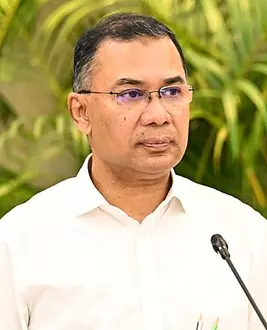
Prime minister of Bangladesh (2026–); BNP chairman
Rahman advocates multiparty government with constitutional checks, private investment and expanded social protection. His national-interest foreign policy accompanies support for multilateral cooperation; religious constitutional commitments coexist with an expressly inclusive conception of citizenship. Promises to protect dissent sit uneasily with restrictions retained by his government.
Closest ideologies
Based on the 51 statements where Tarique Rahman has a known position.
- Sahrawi nationalism (89% match)
- Producerism (88% match)
- Pan-Americanism (88% match)
- Nordic Social Democracy (87% match)
- Progressivism (87% match)
Similar people
- Shabana Mahmood (91% alike)
- John Quincy Adams (90% alike)
- Robert F. Kennedy (89% alike)
- Rajiv Gandhi (89% alike)
- Soong May-ling (89% alike)
Known positions
- Strongly: International criminal courts should try political leaders responsible for atrocities such as genocide, crimes against humanity and war crimes.
- Strongly: Elected politicians should serve only a small number of terms.
- Strongly: Government bodies should be specifically responsible for advancing gender equality.
- Strongly: Publicly funded services such as hospitals and schools should be run by private companies and charities as well as the state.
- Strongly: Private businesses and markets should run most of the economy, while the government supports people who cannot meet their basic needs.
- Strongly: Governments should answer in law for past abuses by their security forces, including unlawful killings.
- Strongly: Outside governments have no entitlement to interfere in another country's internal affairs for any purpose.
- Strongly: Businesses should be legally barred from agreements with competitors to suppress competition, such as fixing prices.
- Strongly: Besides its directly elected parliament, a legislature should have a second chamber, such as a senate.
- Strongly: Countries should maintain only the weapons needed for national safety.
- Strongly: Political power should be split among separate branches and levels that can each limit the others.
- Strongly: Farmers should get price floors, state buying or cheap credit to keep them secure.
- Strongly: When national priorities conflict with working together internationally, my country should choose its own priorities.
- Strongly: Political decisions should rest with the smallest local community able to handle them, with wider authorities handling matters that need a wider reach.
- Strongly: Democracy is best even when voters make poor choices.
- Strongly: Climate change calls for drastic action by governments.
- Strongly: Workers' pay should be settled in collective bargaining between their union and their employer.
- Strongly: Workers are better off for having labor unions.
- Strongly: A nation does not need one main ethnic group: it can be made up of people of many ancestries.
- Strongly: Meeting poor people's needs should be the first consideration in public policy.
- Strongly: The state should guarantee health care to everyone, whether it runs the services itself or pays for them.
- Strongly: Restoring a lost social order does not matter more than pursuing progress.
- Strongly: Rulers have a right to rule only because the people they rule have agreed to it.
- Strongly: Grown children owe care to parents who need it.
- Strongly: Whatever their circumstances, everyone should be able to count on the state for enough to live decently, through benefits, pensions or public services.
- Strongly: Rapid economic development does not justify temporary restrictions on political freedom.
- Strongly: Political authority does not ultimately come from God.
- Strongly: Governments should give no subsidies, licences or protections that favour firms close to them.
- Strongly: The law should treat everyone as an equal, whatever their birth, sex, race or status.
- Strongly: Belonging to the nation does not go with sharing its religion.
- Strongly: No party's ideology should give it an exclusive right to lead the state.
- Strongly: Keeping a nation's inherited culture alive, including its language, customs and traditions, matters.
- Strongly: The armed forces may be controlled by someone other than the governing party's leadership.
- Strongly: Countries should keep their armed forces.
- Strongly: Suspected drug dealers should never be put to death without a trial.
- Leans: Fewer tariffs and trade barriers make all countries better off over time.
- Leans: A poor country should rely on foreign money at least as much as on its own resources.
- Leans: New oil and gas wells and coal mines should be permitted.
- Leans: Government should support building nuclear power plants.
- Leans: Religious values and institutions should shape laws, schools and public life.
- Leans: Some institutional ties between government and religion are acceptable.
- Leans: The government should steer investment into industries it sees as key to the country's future.
- Leans: People who became refugees during a conflict should be permitted to return to the homes they themselves left.
- Leans: Ethnic diversity does not weaken a society's ability to hold together.
- Leans: Inventions and creative works should remain legally ownable, as under patents and copyrights.
- Leans: Trade, finance and debt rules should be changed to give poorer countries a fairer share.
- Leans: News media should decide for themselves what they publish, whoever holds power.
- Leans: A mother country and its colonies may trade with the outside world.
- Leans: A government needs more than fair elections to be democratic.