Political Ideology Atlas · All people · Take the test
Europe · born -428, historical
Plato
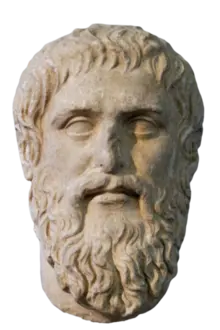
Athenian philosopher (c. 428–348 BC), founder of the Academy
Plato's political dialogues argue that a city should be ruled by those with knowledge of the Good, organized by function and censored to form virtue. The Republic proposes philosopher-rulers with communal property for the guardians; the Laws, later, proposes a mixed constitution under rule of law with fixed property lots and state-enforced religion. Democracy is treated as a deficient regime.
Closest ideologies
Based on the 69 statements where Plato has a known position.
- Platonism (90% match)
- Fourth Political Theory (86% match)
- Person Dignity Theory (85% match)
- Khomeinism (84% match)
- German nationalism (84% match)
Similar people
- Bashar al-Assad (86% alike)
- Wang Jingwei (85% alike)
- Joseph Smith (85% alike)
- Mahathir Mohamad (85% alike)
- John Ruskin (84% alike)
Known positions
- Strongly: Public policy, such as sterilization or incentives, should reduce the passing on of inherited disabilities.
- Strongly: The state should punish people who publicly insult what a religion holds sacred.
- Strongly: Charging interest on loans is banned by law.
- Strongly: The law may treat people differently according to such things as birth, sex, race and status.
- Strongly: Art, poetry and stories that harm people's moral character should be censored.
- Strongly: Some people are better suited by nature to govern.
- Strongly: Specialists should have more weight in decisions than public opinion.
- Strongly: The best government combines a governing role for a few with a governing role for the wider population.
- Strongly: Democracy is not the best form of government when voters choose badly.
- Strongly: Collective goals can justify treating a person merely as a tool.
- Strongly: Religious values and institutions should shape laws, schools and public life.
- Strongly: Politics should prioritise a single common good identified by reasoning over compromises among organised interests.
- Strongly: The worst crimes can be punished by death.
- Strongly: Some institutional ties between government and religion are acceptable.
- Strongly: The government should be able to require citizens to serve in the military.
- Strongly: What you owe your community matters more than your personal rights.
- Strongly: Some knowledge is neutral.
- Strongly: Some things are right or wrong for everyone, in every culture and era.
- Strongly: People who give their lives for the nation deserve to be remembered as martyrs, with reverence beyond ordinary thanks.
- Strongly: Constantly seeking additional possessions is harmful overall, despite any benefits it brings.
- Strongly: The state may restrict what adults do for reasons other than preventing harm to others.
- Strongly: Being the law gives a rule a moral claim to be obeyed.
- Strongly: Private ownership is legitimate only insofar as it benefits society.
- Strongly: Politics should support people's spiritual well-being.
- Strongly: Grown children owe care to parents who need it.
- Strongly: Religion does not offer illusory comfort for material suffering.
- Strongly: Work may stay divided into separate specialized jobs held by different people.
- Strongly: Society needs government of some kind.
- Strongly: State schools need not steer pupils away from belief in God.
- Leans: Every part of life should be subject to state direction.
- Leans: Same-sex relations between consenting adults should be punishable by law.
- Leans: God is the ultimate source of the right to exercise political authority.
- Leans: Population growth should be deliberately held down.
- Leans: Consent of the governed is not the only basis of legitimate political authority.
- Leans: Housework and childcare should be provided as public services in place of being done within families.
- Leans: Civil servants should be recruited according to their performance in competitive examinations.
- Leans: Changes to society should be introduced a little at a time.
- Leans: Women can legally choose to end most pregnancies.
- Leans: Property should belong to many people in small holdings.
- Leans: Political power should be split among separate branches and levels that can each limit the others.
- Leans: Prisons should mainly help offenders rejoin society.
- Leans: Living in the countryside does more for a person's moral wellbeing than living in a city.
- Leans: High earners and the very rich should pay tax at a much higher rate than everyone else.
- Leans: People should want as few material things as possible.
- Leans: Major laws should not be decided by direct votes of citizens.
- Leans: Free trade does not benefit everyone in the long run.
- Leans: Women and men should face identical draft obligations, including no obligations for either group when the draft is abolished.
- Leans: Owners' rights to their property need not be protected against being overridden for public goals.
- Leans: Employers and workers should treat each other as partners whose cooperation comes before conflict, even where their interests differ.
- Leans: Officials decide what gets made and who gets it at least as well as prices and competition do.
- Leans: The ruler should be subject to the country's laws.
- Leans: Public offices may be filled by methods other than drawing lots.
- Leans: Schools should cultivate patriotic feeling: loyalty to and pride in the nation, expressed for example through respect for its flag and anthem.
- Leans: Rulers must act under lasting, publicly known laws administered by recognised courts.
- Leans: Women should be able to vote and stand for office on the same terms as men.
- Leans: Society need not promote ways of living that differ from custom.
- Leans: The law should not assign different roles in public life on the basis of sex.
- Leans: Very large concentrations of wealth threaten a free society.
- Leans: Countries may keep controls on who enters and settles, even in the long run.
- Leans: War does not strengthen a nation's character.
- Leans: Looking after your own interests is not a moral good in itself.
- Leans: Being powerful does not mean a country should bring more land within its borders.
- Leans: A people's connection to its ancestral land is spiritual, beyond practical interests or ordinary affection.
- Leans: Someone who actually governs a state should not hand that power on to their own child.