Political Ideology Atlas · All people · Take the test
Middle East & North Africa · born 1960
Reza Pahlavi
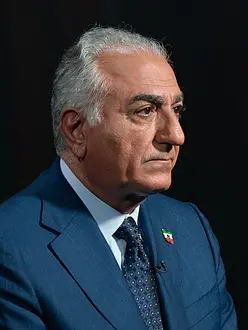
Exiled former crown prince of Iran and opposition leader; head of the House of Pahlavi; leader of the Iranian transition movement (Lion and Sun Revolution)
Pahlavi advocates replacing the Islamic Republic with a secular, democratic Iran based on four principles: territorial integrity, separation of religion and state, individual liberties and equality of all citizens, and a free choice of the form of government (republic or constitutional monarchy) by referendum after a constituent assembly. His economic program favors markets, private property, an independent central bank and integration into the global economy, and he supports maximum pressure and, since 2026, military strikes on the regime's repressive apparatus.
Closest ideologies
Based on the 68 statements where Reza Pahlavi has a known position.
- Liberal internationalism (91% match)
- Democracy (91% match)
- Pro-Europeanism (91% match)
- Revisionism (90% match)
- Lulism (90% match)
Similar people
- Arnold Schwarzenegger (93% alike)
- Nandan Nilekani (92% alike)
- Andy Burnham (90% alike)
- Barack Obama (90% alike)
- Benazir Bhutto (90% alike)
Known positions
- Strongly: Elected governments should leave central banks free to make monetary-policy decisions within their legal mandates.
- Strongly: Owners' rights to their property should almost never be overridden, even for public goals.
- Strongly: Jews, as a people, are entitled to a country of their own in the Land of Israel.
- Strongly: An assembly elected by the people for that purpose should draft the constitution.
- Strongly: Force is for self-defence alone.
- Strongly: Governments should answer in law for past abuses by their security forces, including unlawful killings.
- Strongly: Government should maintain a strict institutional separation from religion.
- Strongly: The state should be barred from executing people convicted of the gravest crimes, such as terrorism.
- Strongly: Government should be bound by written guarantees of basic rights protected against easy amendment by ordinary majorities.
- Strongly: Political power should be split among separate branches and levels that can each limit the others.
- Strongly: Foreign powers sometimes have a right to intervene in a country's internal affairs.
- Strongly: Military intervention abroad is sometimes necessary to protect human rights.
- Strongly: Democracy is best even when voters make poor choices.
- Strongly: The law should impose no restrictions on strikes.
- Strongly: Today's nation is the same people as its ancient and medieval forebears.
- Strongly: Ethnic diversity does not weaken a society's ability to hold together.
- Strongly: A country may keep a region that wants to leave.
- Strongly: My country can do without nuclear weapons that it alone controls.
- Strongly: Rulers have a right to rule only because the people they rule have agreed to it.
- Strongly: The law should not assign different roles in public life on the basis of sex.
- Strongly: An economy directed by a central plan is not capable of working better than one directed by market exchange.
- Strongly: Economic growth should not be limited for the sake of the environment.
- Strongly: Being powerful does not mean a country should bring more land within its borders.
- Strongly: The government should let its political opponents organise, speak and compete for power.
- Strongly: Protecting the constitution should be left to civilian institutions, not the armed forces.
- Strongly: Political authority does not ultimately come from God.
- Strongly: People should be free to own land privately.
- Strongly: The law should treat everyone as an equal, whatever their birth, sex, race or status.
- Strongly: Belonging to the nation does not go with sharing its religion.
- Strongly: Laws should not be required to follow religious texts.
- Strongly: At least some revolutions have been justified.
- Strongly: No party's ideology should give it an exclusive right to lead the state.
- Strongly: Keeping a nation's inherited culture alive, including its language, customs and traditions, matters.
- Strongly: The armed forces may be controlled by someone other than the governing party's leadership.
- Strongly: Governments should have no right to shut down internet access for public-order reasons.
- Strongly: Members of other ethnic groups should be free to stay in the country.
- Strongly: Publicly insulting a religion's sacred beliefs should be left outside the criminal law.
- Strongly: Some areas of life should remain outside state direction.
- Strongly: Women should be able to vote and stand for office on the same terms as men.
- Strongly: Society needs government of some kind.
- Strongly: Countries should keep their armed forces.
- Strongly: The ruler should be subject to the country's laws.
- Strongly: Women may go out in public without any legal duty to cover fully.
- Strongly: Courts need not be handed over to private businesses.
- Strongly: Final authority over a state's laws need not belong to its most senior religious scholars.
- Strongly: Farmers should have the legal freedom to leave the estates they work.
- Leans: International criminal courts should try political leaders responsible for atrocities such as genocide, crimes against humanity and war crimes.
- Leans: Prices and competition generally decide better than officials what gets made and who gets it.
- Leans: Fewer tariffs and trade barriers make all countries better off over time.
- Leans: The farmers who work large estates should take ownership from the landowners, with the transfer compulsory if owners refuse.
- Leans: Industries such as energy, rail and utilities do not need to be publicly owned.
- Leans: Only the state's armed forces and police should have permission to carry weapons.
- Leans: Businesses should be legally barred from agreements with competitors to suppress competition, such as fixing prices.
- Leans: State schools should not teach religion.
- Leans: Trade unions should control their own affairs without state direction.
- Leans: Allies are bound to defend one another against armed attack.
- Leans: The government should be able to require citizens to serve in the military.
- Leans: Workers' pay should be settled in collective bargaining between their union and their employer.
- Leans: Parties and offices should cut across religious lines.
- Leans: Public institutions should help minority languages be used in public life, for example through teaching or services in those languages.
- Leans: Workers are better off for having labor unions.
- Leans: National policy should give priority to preventing outside powers from splitting the country territorially.
- Leans: Political violence is sometimes justified.
- Leans: Governments should give no subsidies, licences or protections that favour firms close to them.