Political Ideology Atlas · All people · Take the test
Russia & Central Asia · born 1878, historical
Joseph Stalin
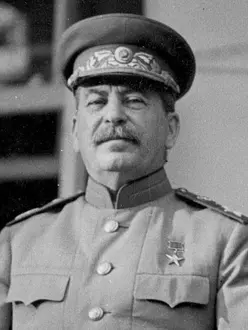
Soviet leader and Communist Party general secretary (1922–1953)
Stalin led the Soviet Communist Party from the 1920s until his death in 1953, arguing for socialism in one country, the dictatorship of the proletariat and a single ruling party. In power he collectivized agriculture, ran the economy by a state plan, wrote state ownership, social rights and universal suffrage into the 1936 Constitution, and ruled through mass repression, deportations of whole nationalities, censorship and the Gulag; his social policy banned abortion, recriminalised male homosexuality and promoted large families.
Closest ideologies
Based on the 136 statements where Joseph Stalin has a known position.
- Stalinism (89% match)
- Soviet patriotism (87% match)
- Authoritarian socialism (84% match)
- State Socialism (84% match)
- Real socialism (83% match)
Similar people
- Kim Jong-un (83% alike)
- Nicolae Ceaușescu (81% alike)
- Kim Il-sung (79% alike)
- Deng Xiaoping (77% alike)
- Subhas Chandra Bose (77% alike)
Known positions
- Strongly: Education provided by the state should encourage people to reject belief in God.
- Strongly: A workers' state must suppress the old ruling class for a time.
- Strongly: Every part of life should be subject to state direction.
- Strongly: Eventually people should produce and share without money.
- Strongly: A state whose economy is publicly owned and planned should be defended against a return to capitalism even if a bureaucracy rules it.
- Strongly: Same-sex relations between consenting adults should be punishable by law.
- Strongly: One ideologically correct party should hold state leadership without competing parties having a right to replace it.
- Strongly: The people in power should decide what the country's news media publish.
- Strongly: Religion gives people a false consolation for hardship in their material lives.
- Strongly: Workers require political leadership from a tightly organised revolutionary party.
- Strongly: Farming should be organized as joint cultivation by groups of farmers instead of separate individual farm operations.
- Strongly: All land should be owned by the state.
- Strongly: A socialist state with hostile countries all around it should work to make its state power stronger.
- Strongly: The government should stop its political opponents from organising, speaking or competing for power.
- Strongly: A powerful country should bring more land within its borders.
- Strongly: An economy whose production is directed by a central plan is capable of working better than an economy directed by market exchange.
- Strongly: History is mainly driven by conflict between economic classes.
- Strongly: Political change should replace the existing administrative and coercive institutions with new forms of organization, rather than put new leaders in charge of the old apparatus.
- Strongly: Historical change comes mainly from changes in how society produces and exchanges goods.
- Strongly: My country should possess its own nuclear arsenal with independent authority over its use.
- Strongly: It is acceptable to praise a national leader openly as the one who stands for the whole nation.
- Strongly: Rulers are not bound to act only under lasting, publicly known laws administered by recognised courts.
- Strongly: Where they conflict, evidence and reasoning should count for more than faith, God, revelation or scripture.
- Strongly: Wars between great powers are an unavoidable consequence of capitalism.
- Strongly: Owners' profit is value taken from workers' labor.
- Strongly: The government should have authority over religious institutions' internal affairs.
- Strongly: In the society we should aim for, a person's needs should determine their share of goods.
- Strongly: A nation's identity does not run in unbroken continuity from its ancient origins to the present.
- Strongly: Cooperation between employers and workers should not come before conflict where their interests differ.
- Strongly: Speech that attacks groups for who they are can be punished by law.
- Strongly: The system in which people work for wages for an employer should be ended.
- Strongly: A national emergency sometimes justifies temporarily withdrawing normal legal safeguards against people the government regards as internal enemies, such as protections against detention without trial.
- Strongly: Society should push new technology forward faster, even where it overturns established institutions.
- Strongly: A country should press its neighbour to give back land taken from it in an old war.
- Strongly: Democracy is not the best form of government when voters choose badly.
- Strongly: Governments should be able to keep some international agreements secret.
- Strongly: Government should maintain a strict institutional separation from religion.
- Strongly: New oil and gas wells and coal mines should be permitted.
- Strongly: The state should offer public work to anyone who wants a job and cannot find one.
- Strongly: Religious values and institutions should not have a major part in shaping laws, schools and public life.
- Strongly: Besides its directly elected parliament, a legislature should have a second chamber, such as a senate.
- Strongly: State schools should not teach religion.
- Strongly: Property need not be spread among many small owners.
- Strongly: Trade unions may be subject to state direction of their affairs.
- Strongly: A general collapse of capitalism is unavoidable.
- Strongly: What things are worth comes from the work put into them.
- Strongly: Workers should not have democratic voting rights in the management of large companies.
- Strongly: A country with nuclear weapons should keep them for as long as its rivals retain theirs.
- Strongly: Production should be organised to provide what people need, instead of being organised around what yields a profit.
- Strongly: The worst crimes can be punished by death.
- Strongly: Ending a marriage should not be possible without proving fault.
- Strongly: Abortion should be illegal in most cases.
- Strongly: The global economic system keeps poorer countries poor by directing their wealth toward richer countries.
- Strongly: Areas where an ethnic minority makes up most of the population should be able to run many of their own affairs within the state.
- Strongly: Industries such as energy, rail and utilities should be owned by the state or public bodies, not private companies.
- Strongly: People able to work should get welfare benefits only in return for some work, such as a job or a work scheme.
- Strongly: Foreign powers sometimes have a right to intervene in a country's internal affairs.
- Strongly: The Soviet economy was not capitalism under state ownership with the state in place of private capitalists.
- Strongly: The state should give families money to have more children, such as through payments and tax breaks.
- Strongly: Officeholders at higher levels may be chosen by means other than delegates picked by lower councils.
- Strongly: Defeating communism should not take priority over coexistence with it.
- Strongly: The government should be able to require citizens to serve in the military.
- Strongly: Cultural life inside a state should not be placed under the control of each national minority.
- Strongly: A government should outlaw political parties that aim to do away with its constitutional order.
- Strongly: Armed forces may sometimes be used for purposes beyond defending the country against attack.
- Strongly: The law should limit the making or sale of pornography.
- Strongly: The government should steer investment into industries it sees as key to the country's future.
- Strongly: After members debate and adopt a party decision, every member should have to help implement it, including those who opposed it.
- Strongly: Students should pay no tuition to attend public higher education institutions.
- Strongly: Socialism cannot be reached just by winning elections and governing through parliament.
- Strongly: Society may be changed in large, rapid steps.
- Strongly: Workers' solidarity with workers in other countries should count at least as much as solidarity with their own nation.
- Strongly: Public institutions should help minority languages be used in public life, for example through teaching or services in those languages.
- Strongly: Voters should be able to remove elected officials before their terms end.
- Strongly: The state should not make one language the only common language of government, schooling and public life at the cost of limiting others.
- Strongly: Owners' rights to their property need not be protected against being overridden for public goals.
- Strongly: The head of state should not be elected directly by the voters.
- Strongly: Social duty should not take the place of material rewards as the main reason people work.
- Strongly: Basic local services, such as water, hospitals and local transport, should be publicly owned and run.
- Strongly: Officials decide what gets made and who gets it at least as well as prices and competition do.
- Strongly: Politics is not best understood as a contest between spiritual good and evil.
- Strongly: There should be no regular state payment that every adult gets whether or not they work.
- Strongly: A healthy society depends on the traditional family, such as a married mother and father raising their children.
- Strongly: Being free requires having the practical resources to act on one's choices, such as an adequate livelihood.
- Strongly: The nation's cause and the cause of its ordinary working people are one and the same.
- Strongly: The state should guarantee health care to everyone, whether it runs the services itself or pays for them.
- Strongly: Equality of outcomes should not be society's goal.
- Strongly: Restoring a lost social order does not matter more than pursuing progress.
- Strongly: Population growth may be left to run its course.
- Strongly: Land does not belong to whoever first puts it to use.
- Strongly: Economic growth should not be limited for the sake of the environment.
- Strongly: Political violence is sometimes justified.
- Strongly: Income from useful work should be rewarded ahead of income from merely owning property.
- Strongly: In an economy with common ownership of productive assets, people should still own their personal belongings.
- Strongly: Laws should not be required to follow religious texts.
- Strongly: Local community ownership of the means of production should not replace private or state ownership.
- Strongly: At least some revolutions have been justified.
- Strongly: Small, informal, trust-based groups should not take the place of lasting parties, unions and federations in political action.
- Strongly: Industrial society has done at least as much good as harm to humanity.
- Strongly: Population growth does not mainly drive lasting poverty.
- Strongly: Publicly insulting a religion's sacred beliefs should be left outside the criminal law.
- Strongly: Each country should hold ultimate authority over its natural resources, without foreign interests controlling them.
- Strongly: Marriage should retain legal recognition.
- Strongly: Women should be able to vote and stand for office on the same terms as men.
- Strongly: Society needs government of some kind.
- Strongly: Government should have other tasks besides protecting people from physical violence.
- Strongly: Voting should not be limited to members of one ethnic group.
- Strongly: People without property should also have the right to vote.
- Strongly: Public spaces such as schools and facilities should not be separated by race under the law.
- Leans: A socialist system led by a communist party is able to include a market economy.
- Leans: Work should no longer be divided into separate specialized jobs held by different people.
- Leans: Political power should rest on councils elected in workplaces in place of parliaments.
- Leans: Conflicts between social classes persist after a society becomes socialist.
- Leans: The UN should have authority to compel member states to comply with its decisions.
- Leans: People should lose their right to a plot of land when they no longer use it.
- Leans: International criminal courts should try political leaders responsible for atrocities such as genocide, crimes against humanity and war crimes.
- Leans: Communist parties should not necessarily determine their strategies independently of foreign parties.
- Leans: Nature does not have value in itself, apart from its usefulness to humans.
- Leans: Fewer tariffs and trade barriers make all countries better off over time.
- Leans: Whether citizens may see government information can be left to the government to decide.
- Leans: Many political decisions should rest with national or wider authorities, even where a smaller community could handle them.
- Leans: A country has the right to stop a region becoming independent by using its military.
- Leans: Speaking a common language is sufficient for people to constitute one nation.
- Leans: Political power may be concentrated in one body.
- Leans: Businesses should belong to the people who work in them, for example as cooperatives.
- Leans: Countries should maintain only the weapons needed for national safety.
- Leans: Automation should be directed towards making the time people need to spend working as short as feasible.
- Leans: Advancing gender equality need not be the specific job of any government body.
- Leans: Some cultures are superior to others.
- Leans: A wife should be able to end the marriage even when her husband refuses.
- Leans: Keeping a nation's inherited culture alive, including its language, customs and traditions, matters.