Political Ideology Atlas · All people · Take the test
Europe · born 1938
Juan Carlos I of Spain
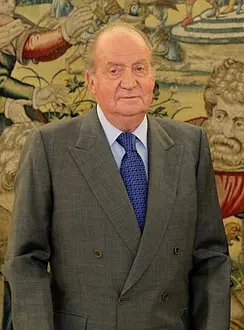
King of Spain (1975–2014)
Juan Carlos I presented himself as a constitutional monarch above party, guardian of national unity within regional diversity and of the 1978 Constitution. His own messages stress consensus, a welfare state, European integration, development cooperation and firm rejection of terrorism and coups, while saying little on moral or economic doctrine.
Closest ideologies
Based on the 49 statements where Juan Carlos I of Spain has a known position.
- Nordic Social Democracy (91% match)
- Cultural Zionism (90% match)
- Pan-Americanism (90% match)
- Communitarianism (90% match)
- Social Liberalism (90% match)
Similar people
- Harald V of Norway (93% alike)
- Robert F. Kennedy (92% alike)
- Shabana Mahmood (90% alike)
- Angela Merkel (90% alike)
- Tulsi Gabbard (90% alike)
Known positions
- Strongly: Violence is never an acceptable way to pursue political goals.
- Strongly: The UN should have authority to compel member states to comply with its decisions.
- Strongly: It is acceptable for a monarch who inherits the throne to be the country's symbolic head while others govern.
- Strongly: The head of state should not have to be chosen by election.
- Strongly: Changes to society should be introduced a little at a time.
- Strongly: The nation's figurehead should be non-partisan and belong to everyone.
- Strongly: Democracy is best even when voters make poor choices.
- Strongly: The head of state should not be elected directly by the voters.
- Strongly: Being free requires having the practical resources to act on one's choices, such as an adequate livelihood.
- Strongly: Rulers have a right to rule only because the people they rule have agreed to it.
- Strongly: The law should not assign different roles in public life on the basis of sex.
- Strongly: The government should let its political opponents organise, speak and compete for power.
- Strongly: Protecting the constitution should be left to civilian institutions, not the armed forces.
- Strongly: The law should treat everyone as an equal, whatever their birth, sex, race or status.
- Strongly: No party's ideology should give it an exclusive right to lead the state.
- Strongly: Keeping a nation's inherited culture alive, including its language, customs and traditions, matters.
- Leans: Most people in political office look after the public at least as much as themselves.
- Leans: Special ranks held by birth, such as noble titles and hereditary crowns, may continue to exist.
- Leans: Countries should hand part of their decision-making power to a union of nations, such as the European Union.
- Leans: A former empire may keep a special relationship with its old territories.
- Leans: The representative legislature should have the final say on legislation.
- Leans: Private businesses and markets should run most of the economy, while the government supports people who cannot meet their basic needs.
- Leans: Only the state's armed forces and police should have permission to carry weapons.
- Leans: Working together internationally should count at least as much as my country's own priorities.
- Leans: Distance and nationality do not weaken the duty of the rich to help the poor abroad.
- Leans: Political power should be split among separate branches and levels that can each limit the others.
- Leans: Military intervention abroad is sometimes necessary to protect human rights.
- Leans: Political decisions should rest with the smallest local community able to handle them, with wider authorities handling matters that need a wider reach.
- Leans: Governments should not borrow heavily, spending much more than they collect in taxes, to boost the economy.
- Leans: A country may join permanent military alliances.
- Leans: Recreational drugs should be illegal for adults.
- Leans: Climate change calls for drastic action by governments.
- Leans: Government should impose strict rules on how corporations operate.
- Leans: Public institutions should help minority languages be used in public life, for example through teaching or services in those languages.
- Leans: Ordinary legal protections, such as the right not to be held without trial, should stay in force even in a national emergency.
- Leans: A country can get through deadlock among its institutions without a leader who overrides them.
- Leans: The state should not make one language the only common language of government, schooling and public life at the cost of limiting others.
- Leans: Government should have other tasks besides protecting people from physical violence.
- Leans: Ethnic diversity does not weaken a society's ability to hold together.
- Leans: The ruler should be subject to the country's laws.
- Leans: Society needs government of some kind.
- Leans: A healthy society depends on the traditional family, such as a married mother and father raising their children.
- Leans: A country may keep a region that wants to leave.
- Leans: A nation does not need one main ethnic group: it can be made up of people of many ancestries.
- Leans: Meeting poor people's needs should be the first consideration in public policy.
- Leans: Restoring a lost social order does not matter more than pursuing progress.
- Leans: Whatever their circumstances, everyone should be able to count on the state for enough to live decently, through benefits, pensions or public services.
- Leans: A people with a shared national identity is entitled to its own self-governing state.