Political Ideology Atlas · All people · Take the test
South & Southeast Asia · born 1924, historical
Atal Bihari Vajpayee
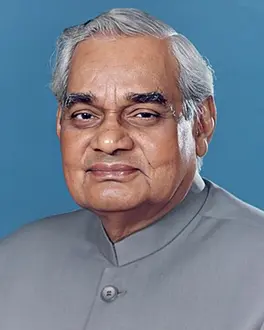
Prime Minister of India (1996, 1998-2004); founding BJP president (1980); External Affairs Minister (1977-79)
Vajpayee was a Hindu-nationalist parliamentarian who combined cultural nationalism with a conciliatory, coalition-minded style. As prime minister he tested nuclear weapons, pursued talks with Pakistan, privatised public enterprises and kept contentious BJP aims (Ram temple, Article 370, a uniform civil code) out of the coalition agenda. He opposed the Emergency, defended parliamentary democracy and secularism as he defined them, and was criticised for his handling of the 2002 Gujarat violence.
Closest ideologies
Based on the 50 statements where Atal Bihari Vajpayee has a known position.
- Pan-Americanism (93% match)
- Sahrawi nationalism (92% match)
- Communitarianism (91% match)
- Nordic Social Democracy (91% match)
- Poporanism (90% match)
Similar people
- John Quincy Adams (94% alike)
- Shabana Mahmood (93% alike)
- Robert F. Kennedy (91% alike)
- Soong May-ling (91% alike)
- Péter Magyar (90% alike)
Known positions
- Strongly: My country should possess its own nuclear arsenal with independent authority over its use.
- Strongly: Democracy is best even when voters make poor choices.
- Strongly: A country can get through deadlock among its institutions without a leader who overrides them.
- Strongly: A country may keep a region that wants to leave.
- Strongly: Economic growth should not be limited for the sake of the environment.
- Strongly: Being powerful does not mean a country should bring more land within its borders.
- Strongly: Rapid economic development does not justify temporary restrictions on political freedom.
- Strongly: A mother country and its colonies may trade with the outside world.
- Strongly: The law should treat everyone as an equal, whatever their birth, sex, race or status.
- Strongly: Keeping a nation's inherited culture alive, including its language, customs and traditions, matters.
- Strongly: Some areas of life should remain outside state direction.
- Strongly: No society has the right to rule another for its supposed improvement, however advanced it is.
- Strongly: Public spaces such as schools and facilities should not be separated by race under the law.
- Strongly: Museums, libraries and other inherited culture should not be destroyed, even when they stand in the way of new creation.
- Leans: Violence is never an acceptable way to pursue political goals.
- Leans: The UN should have authority to compel member states to comply with its decisions.
- Leans: Binding composition rules should ensure that public bodies have approximately equal numbers of women and men.
- Leans: My country's military strength should exceed that of its rivals.
- Leans: Industries such as energy, rail and utilities do not need to be publicly owned.
- Leans: A country has the right to stop a region becoming independent by using its military.
- Leans: New oil and gas wells and coal mines should be permitted.
- Leans: Employees should have voting rights in the management of large companies.
- Leans: Distance and nationality do not weaken the duty of the rich to help the poor abroad.
- Leans: Taxes on imports should shield domestic producers from foreign competition.
- Leans: Government should support building nuclear power plants.
- Leans: Property should belong to many people in small holdings.
- Leans: Political power should be split among separate branches and levels that can each limit the others.
- Leans: When national priorities conflict with working together internationally, my country should choose its own priorities.
- Leans: Political decisions should rest with the smallest local community able to handle them, with wider authorities handling matters that need a wider reach.
- Leans: Governments should not borrow heavily, spending much more than they collect in taxes, to boost the economy.
- Leans: The government should steer investment into industries it sees as key to the country's future.
- Leans: Ordinary legal protections, such as the right not to be held without trial, should stay in force even in a national emergency.
- Leans: People who became refugees during a conflict should be permitted to return to the homes they themselves left.
- Leans: Nature matters for its own sake, not only because it is useful to people.
- Leans: Employers and workers should treat each other as partners whose cooperation comes before conflict, even where their interests differ.
- Leans: A nation does not need one main ethnic group: it can be made up of people of many ancestries.
- Leans: Meeting poor people's needs should be the first consideration in public policy.
- Leans: Whatever their circumstances, everyone should be able to count on the state for enough to live decently, through benefits, pensions or public services.
- Leans: A people with a shared national identity is entitled to its own self-governing state.
- Leans: Laws should not be required to follow religious texts.
- Leans: Poor countries should retain economic ties with rich countries.