Political Ideology Atlas · All ideologies · Take the test
New Nationalism
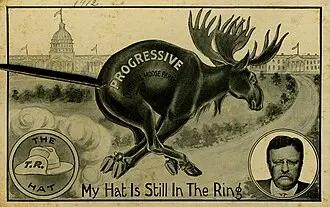
New Nationalism is the Progressive program of Theodore Roosevelt, drawing on Herbert Croly, that uses a strong federal government and executive to regulate large corporations, protect workers and put human welfare ahead of property rights. It accepts industrial concentration but wants it supervised by expert commissions, with democratic reforms such as primaries, initiative, referendum and recall to keep government answerable to the people rather than to business and party bosses.
What it stands for
- Those who inherit a large fortune should hand over a big share of it in tax.
- Capitalism is not bound to suffer a general collapse.
- Foreign powers sometimes have a right to intervene in a country's internal affairs.
- Officeholders at higher levels may be chosen by means other than delegates picked by lower councils.
- Democracy is best even when voters make poor choices.
- Government should impose strict rules on how corporations operate.
Key figures
- Theodore Roosevelt: Former president who set out the programme at Osawatomie in 1910 and ran on it in 1912
- Herbert Croly: Author of The Promise of American Life, which supplied the New Nationalism's ideas
Closest ideologies
- Gaullism (89% match)
- Kemalism (87% match)
- American nationalism (86% match)
- Sovereign democracy (86% match)
- Venizelism (86% match)
People closest to it
- James A. Garfield (89% alike)
- Ulysses S. Grant (88% alike)
- William McKinley (88% alike)
- George Washington (88% alike)
- Shinzō Abe (88% alike)
Key positions
- Strongly: Those who inherit a large fortune should hand over a big share of it in tax.
- Strongly: Capitalism is not bound to suffer a general collapse.
- Strongly: Foreign powers sometimes have a right to intervene in a country's internal affairs.
- Strongly: Officeholders at higher levels may be chosen by means other than delegates picked by lower councils.
- Strongly: Democracy is best even when voters make poor choices.
- Strongly: Government should impose strict rules on how corporations operate.
- Strongly: Free trade does not benefit everyone in the long run.
- Strongly: Voters should be able to remove elected officials before their terms end.
- Strongly: Defense should not rest with armed ordinary citizens in place of a standing force.
- Strongly: Direct action does not have to take the place of elections and parliament as the way to achieve political change.
- Strongly: Employers and workers should treat each other as partners whose cooperation comes before conflict, even where their interests differ.
- Strongly: An electorate should choose the head of state, either directly or through elected representatives.
- Strongly: Profit made from owning businesses does not come from exploiting the workers who produce it.
- Strongly: Capitalism does not inevitably cause wars between great powers.
- Strongly: The people who own the economy and hold power are not the ones the state mainly serves.
- Strongly: A country may keep a region that wants to leave.
- Strongly: A country may keep all its decisions in its own hands rather than pooling them with other nations.
- Strongly: Political representation should not come through social bodies such as families, local communities and occupational associations instead of political parties.
- Strongly: People may live and work outside communities that own their property together.
- Strongly: Restoring a lost social order does not matter more than pursuing progress.
- Strongly: Local communities should not tie their joint councils to merely carrying out what local assemblies decide.
- Strongly: Rulers have a right to rule only because the people they rule have agreed to it.
- Strongly: The existing governing institutions should be retained, even if their personnel, policies or procedures change.
- Strongly: Even a purely ceremonial head of state should not hold the position by birth.
- Strongly: Other forces move history at least as much as conflict between classes does.
- Strongly: Income-tax percentages may differ between income levels.
- Strongly: Private ownership is legitimate only insofar as it benefits society.
- Strongly: Very large concentrations of wealth threaten a free society.
- Strongly: Class struggle does not continue under socialism.
- Strongly: Whatever their circumstances, everyone should be able to count on the state for enough to live decently, through benefits, pensions or public services.
- Strongly: Income from useful work should be rewarded ahead of income from merely owning property.
- Strongly: The government should let its political opponents organise, speak and compete for power.
- Strongly: Rapid economic development does not justify temporary restrictions on political freedom.
- Strongly: Political authority does not ultimately come from God.
- Strongly: Businesses gain too much influence over government policy from their lobbying.
- Strongly: Governments should give no subsidies, licences or protections that favour firms close to them.
- Strongly: Individual farms should not give way to joint cultivation by groups of farmers.
- Strongly: Poor countries should retain economic ties with rich countries.
- Strongly: Being the first to use force can be right, depending on what it is meant to achieve.
- Strongly: An armed minority's actions are incapable of bringing about the conditions for a broader revolutionary uprising.
- Strongly: Workers do not need a disciplined revolutionary party to lead them.
- Strongly: Laws should not be required to follow religious texts.
- Strongly: News media should decide for themselves what they publish, whoever holds power.
- Strongly: No party's ideology should give it an exclusive right to lead the state.
- Strongly: We have a duty to leave the planet in good condition for those who come after us.
- Strongly: Small, informal, trust-based groups should not take the place of lasting parties, unions and federations in political action.
- Strongly: In a war between great powers, workers need not seek their own government's defeat.
- Strongly: The armed forces may be controlled by someone other than the governing party's leadership.
- Strongly: Central banks should keep a role in controlling the money supply.
- Strongly: Industrial society has done at least as much good as harm to humanity.
- Strongly: Work may stay divided into separate specialized jobs held by different people.
- Strongly: Population growth does not mainly drive lasting poverty.
- Strongly: There is no deliberate plan behind immigration aimed at replacing the native population.
- Strongly: In the long run people should still produce and share using money.
- Strongly: No state may force a minority out of the country, however hostile it judges that minority to be.
- Strongly: Some areas of life should remain outside state direction.
- Strongly: Women should be able to vote and stand for office on the same terms as men.
- Strongly: The vote keeps a government in check at least as well as being able to leave the country does.
- Strongly: Some decisions should bind people who have not consented to them.
- Strongly: A workers' state does not need to suppress the old ruling class, even for a time.
- Strongly: Public offices may be filled by methods other than drawing lots.
- Strongly: Society needs government of some kind.
- Strongly: Countries should keep their armed forces.
- Strongly: The slaughter of cattle should be legal.
- Strongly: The ruler should be subject to the country's laws.
- Strongly: The state should not be managed the way a well-run business is.
- Strongly: Government should have other tasks besides protecting people from physical violence.
- Strongly: Collecting taxes does not in itself amount to stealing people's money.
- Strongly: Renting out housing should be permitted in at least some circumstances.
- Strongly: Political authority need not rest on oaths of loyalty sworn to a lord.
- Strongly: The holder of the highest state office need not be treated as holy.
- Strongly: Taking part in politics is at least as good a way to live as living privately away from public affairs.
- Strongly: Women may go out in public without any legal duty to cover fully.
- Strongly: Courts need not be handed over to private businesses.
- Strongly: Final authority over a state's laws need not belong to its most senior religious scholars.
- Strongly: Farmers should have the legal freedom to leave the estates they work.
- Leans: Once the national majority has decided, public institutions, including courts and independent bodies, should not limit its decision.
- Leans: At its core, politics is a struggle between spiritual good and evil.
- Leans: When people's freedom to do something harms the environment, the law should limit that freedom.
- Leans: Voters themselves should elect the head of state, without an intermediary body selecting the officeholder.
- Leans: Public institutions do not need to help minority languages be used in public life.
- Leans: Newcomers should adopt the host nation's culture in place of their original culture.
- Leans: Workers' solidarity with their own nation should take priority over solidarity with workers across borders.
- Leans: After members debate and adopt a party decision, those who opposed it should not have to help implement it.
- Leans: Major laws should be decided by citizens voting on them themselves.
- Leans: Real authority to command the military should rest with the head of state.
- Leans: A region joining a larger state may be required to adopt that state's economic system.
- Leans: The country may allow more immigration than strict limits would permit.
- Leans: Private businesses and markets should run most of the economy, while the government supports people who cannot meet their basic needs.
- Leans: Judge policies by what they achieve, independently of whether they match an ideology.
- Leans: Many political decisions should rest with national or wider authorities, even where a smaller community could handle them.
- Leans: Countries that feel dominated by Western powers may handle their relations with them separately.
- Leans: My country's military strength should exceed that of its rivals.
- Leans: Industries such as energy, rail and utilities do not need to be publicly owned.
- Leans: Most goods need not be produced close to their place of consumption.
- Leans: Laws, institutions and customs today do not systematically favor men over women.
- Leans: Transfers of wealth to richer countries do not explain poor countries' continuing poverty.
- Leans: Production should not be reorganised around what people need in place of what yields a profit.
- Leans: Taxes on imports should shield domestic producers from foreign competition.
- Leans: The ruling class does not stay in power mainly through people going along with its ideas.
- Leans: Armaments need not be limited to the minimum needed for national safety.
- Leans: Rich people have an obligation to help those worse off than they are.
- Leans: Businesses need not belong to the people who work in them.
- Leans: Property should belong to many people in small holdings.
- Leans: Environmental agencies should still regulate pollution, not leave it to compensation lawsuits for proven damage.
- Leans: Women's equality can be fully achieved without transforming the economic system.
- Leans: Mass entertainment does not generally discourage people from challenging the existing social order.
- Leans: Elected officials may receive a salary above what an average worker earns.
- Leans: Workers should not have democratic voting rights in the management of large companies.
- Leans: Politics should prioritise a single common good identified by reasoning over compromises among organised interests.
- Leans: When national priorities conflict with working together internationally, my country should choose its own priorities.
- Leans: High earners and the very rich should pay tax at a much higher rate than everyone else.
- Leans: Full-time work at the legal wage floor should pay enough to meet basic living costs.
- Leans: Children of citizens are not the only ones who should be citizens at birth.
- Leans: Elected officials have at least as much real power as the people who run the press, universities and other cultural institutions.
- Leans: People able to work should get welfare benefits only in return for some work, such as a job or a work scheme.
- Leans: A president should be limited in how many times he or she may stand for re-election.
- Leans: Large landed estates should not be compulsorily transferred to the people who farm them.
- Leans: Belonging to the nation ties a person's life to a sacred community that goes on after their death.
- Leans: Cultural life inside a state should not be placed under the control of each national minority.
- Leans: Armed forces may sometimes be used for purposes beyond defending the country against attack.
- Leans: Marriage, inheritance and family law should be the same for everyone, not set by each religious community.
- Leans: Whoever uses land or resources owes the rest of society a share of their value.
- Leans: Capitalism built the productive power and wealth that later and better societies rest on.
- Leans: A head of state may take a side in party politics.
- Leans: What you owe your community matters more than your personal rights.
- Leans: Ideas of what men and women are like do not come mostly from culture.
- Leans: Workers' pay should be settled in collective bargaining between their union and their employer.
- Leans: Public spaces such as schools and facilities should not be separated by race under the law.
- Leans: Political freedom can last without economic freedom.
- Leans: A region need not keep most of the tax money it raises for itself.
- Leans: Countries within one civilization may remain politically separate.
- Leans: University-educated people are not especially out of touch with the realities of ordinary life.
- Leans: Some things are right or wrong for everyone, in every culture and era.
- Leans: Most of government should be funded by taxes other than a tax on the value of land.
- Leans: Owners' rights to their property need not be protected against being overridden for public goals.
- Leans: In the society we should aim for, a person's share of goods may depend on things besides their needs.
- Leans: Government should rely at least as much on legal enforcement as on its rulers' moral example.
- Leans: Officials decide what gets made and who gets it at least as well as prices and competition do.
- Leans: Workers are better off for having labor unions.
- Leans: Peoples who share an ethnic heritage, such as the Slavic peoples, should not come together in one state.
- Leans: There should be no regular state payment that every adult gets whether or not they work.
- Leans: A healthy society depends on the traditional family, such as a married mother and father raising their children.
- Leans: Rules need not set equal numbers of women and men on public bodies.
- Leans: The general public should have at least as much say in policy as experts.
- Leans: Schools should cultivate patriotic feeling: loyalty to and pride in the nation, expressed for example through respect for its flag and anthem.
- Leans: Private charity does not help people in poverty better than government programs do.
- Leans: The nation's cause and the cause of its ordinary working people are one and the same.
- Leans: Nobody should hold a special rank by birth, such as a noble title, a hereditary crown or a caste position, or the special rights attached to one.
- Leans: A nation does not need one main ethnic group: it can be made up of people of many ancestries.
- Leans: Wages need not be set through negotiating bodies that the state officially recognizes.
- Leans: Meeting poor people's needs should be the first consideration in public policy.
- Leans: Publicly honouring a national leader as the personification of the nation is not acceptable.
- Leans: Historical change does not come mainly from changes in how society produces and exchanges goods.
- Leans: No one is better suited by nature to govern than anyone else.
- Leans: The state should guarantee health care to everyone, whether it runs the services itself or pays for them.
- Leans: The state may restrict what adults do for reasons other than preventing harm to others.
- Leans: Lasting socialism in one country does not require socialist revolutions abroad.
- Leans: The presence of people of its nationality does not give a state a rightful claim to land beyond its borders.
- Leans: Equality of outcomes should not be society's goal.
- Leans: Population growth may be left to run its course.
- Leans: Art should not be censored for its effect on people's moral character.
- Leans: Most people in political office look after themselves first and the public second.
- Leans: Politics should support people's spiritual well-being.
- Leans: Keeping a nation's inherited culture alive, including its language, customs and traditions, matters.
- Leans: An economy directed by a central plan is not capable of working better than one directed by market exchange.
- Leans: Economic growth should not be limited for the sake of the environment.
- Leans: Looking after your own interests is not a moral good in itself.
- Leans: Local community ownership of the means of production should not replace private or state ownership.
- Leans: Protecting the constitution should be left to civilian institutions, not the armed forces.
- Leans: A national development strategy should not accept some regions growing wealthy ahead of the rest.
- Leans: Naturalized citizens may hold public office as well as people born in the country.
- Leans: A mother country and its colonies may trade with the outside world.
- Leans: Elected governments need not leave monetary policy to central banks acting on their own.
- Leans: State pensions funded by current workers' contributions should stay in place rather than be replaced by privately managed individual accounts.
- Leans: Groups have rights of their own.
- Leans: The law should treat everyone as an equal, whatever their birth, sex, race or status.