Political Ideology Atlas · All people · Take the test
Europe · born 1863, historical
Gabriele D'Annunzio
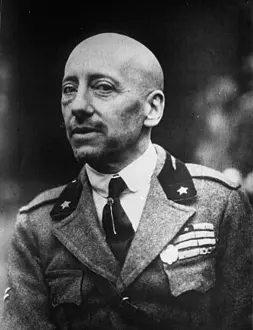
Italian poet, soldier and Comandante of the Regency of Carnaro at Fiume (1919-1920)
D'Annunzio was a poet turned ultranationalist who campaigned for Italy's entry into the First World War and in 1919 seized Fiume with veterans, ruling it as a charismatic Comandante. The Charter of Carnaro he promulgated, drafted with the syndicalist De Ambris, combined universal suffrage, women's equality, recall and referendums with corporatist bodies and a social view of property. His later years were spent at Lake Garda, apart from Mussolini's government.
Closest ideologies
Based on the 35 statements where Gabriele D'Annunzio has a known position.
- Pan-Arabism (89% match)
- Arab socialism (88% match)
- Arab nationalism (88% match)
- National Bolshevism (NazBol) (86% match)
- Ba'athism (86% match)
Similar people
- Marcus Garvey (87% alike)
- Sun Yat-sen (86% alike)
- Joseph Smith (86% alike)
- Ibrahim Traoré (86% alike)
- Wang Jingwei (85% alike)
Known positions
- Strongly: A powerful country should bring more land within its borders.
- Strongly: War develops virtues in a nation, such as courage and discipline.
- Strongly: The presence of people belonging to the same nation gives a state a legitimate territorial claim outside its borders.
- Strongly: Defense should rest with armed ordinary citizens, not a standing force.
- Strongly: The country would benefit from a strong leader with the power to act despite deadlock among its political institutions.
- Strongly: A party with a fifth of the votes should get about a fifth of the seats.
- Strongly: The nation has decayed and must be reborn.
- Strongly: Countries that feel dominated by Western powers should band together to resist them.
- Strongly: The government should be able to require citizens to serve in the military.
- Strongly: Public institutions should help minority languages be used in public life, for example through teaching or services in those languages.
- Strongly: Voters should be able to remove elected officials before their terms end.
- Strongly: Private ownership is legitimate only insofar as it benefits society.
- Strongly: Political violence is sometimes justified.
- Strongly: Keeping a nation's inherited culture alive, including its language, customs and traditions, matters.
- Strongly: Women should be able to vote and stand for office on the same terms as men.
- Strongly: Countries should keep their armed forces.
- Leans: It is acceptable to praise a national leader openly as the one who stands for the whole nation.
- Leans: Officially recognized bodies representing employers and workers should negotiate wages together.
- Leans: People seeking political change should act directly—for example, with strikes, boycotts or occupations—instead of pursuing change through elections and parliaments.
- Leans: Major laws should be decided by citizens voting on them themselves.
- Leans: Government should maintain a strict institutional separation from religion.
- Leans: Businesses should belong to the people who work in them, for example as cooperatives.
- Leans: When national priorities conflict with working together internationally, my country should choose its own priorities.
- Leans: Industries such as energy, rail and utilities should be owned by the state or public bodies, not private companies.
- Leans: Museums, libraries and other inherited culture should not be destroyed, even when they stand in the way of new creation.
- Leans: Belonging to the nation ties a person's life to a sacred community that goes on after their death.
- Leans: Owners' rights to their property need not be protected against being overridden for public goals.
- Leans: Employers and workers should treat each other as partners whose cooperation comes before conflict, even where their interests differ.
- Leans: People should have a direct role in making decisions where they work, live and study, rather than having those decisions made entirely for them.
- Leans: Schools should cultivate patriotic feeling: loyalty to and pride in the nation, expressed for example through respect for its flag and anthem.
- Leans: At least some revolutions have been justified.
- Leans: A people with a shared national identity is entitled to its own self-governing state.
- Leans: The law should treat everyone as an equal, whatever their birth, sex, race or status.