Political Ideology Atlas · All people · Take the test
South & Southeast Asia · born 1891, historical
B. R. Ambedkar
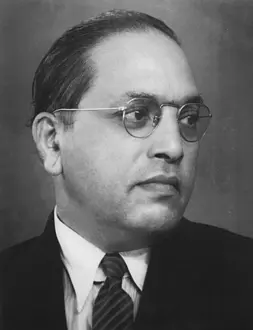
Jurist, social reformer and chair of the Constitution Drafting Committee (1947-1950); Labour Member of the Viceroy's Executive Council (1942-1946); India's first Law Minister (1947-1951)
Jurist and leader of the movement against untouchability, who argued for the annihilation of caste, a secular constitution with entrenched rights and guaranteed representation for disadvantaged communities, and, in 1947, State socialism written into the constitution under parliamentary democracy. From 1951 he dropped any fixed economic pattern for pragmatic, production-first policies, rejected communist dictatorship and violent revolution, opposed Nehru's non-alignment in favour of the free democracies, and in 1956 converted to Buddhism.
Closest ideologies
Based on the 134 statements where B. R. Ambedkar has a known position.
- Liberalism in the United States (91% match)
- Progressivism (88% match)
- Clintonism (88% match)
- New Democracy (87% match)
- Revisionism (87% match)
Similar people
- Frederick Douglass (90% alike)
- Harold Wilson (90% alike)
- Jawaharlal Nehru (89% alike)
- Howard Dean (89% alike)
- Rajiv Gandhi (88% alike)
Known positions
- Strongly: Population growth should be deliberately held down.
- Strongly: A society holds together less well when its members belong to different ethnic groups.
- Strongly: The government should have authority over religious institutions' internal affairs.
- Strongly: Each main community should have a guaranteed place in government, even against a numerical majority.
- Strongly: A country can move toward socialism by winning elections and governing through parliament.
- Strongly: Workers should form a party of their own, separate from the parties already in place.
- Strongly: Judge policies by what they achieve, independently of whether they match an ideology.
- Strongly: My country may join a military alliance led by one of the great powers.
- Strongly: Many political decisions should rest with national or wider authorities, even where a smaller community could handle them.
- Strongly: The farmers who work large estates should take ownership from the landowners, with the transfer compulsory if owners refuse.
- Strongly: The political goal should be victory over communism ahead of accommodation with it.
- Strongly: People may want more than the fewest material things possible.
- Strongly: Government should maintain a strict institutional separation from religion.
- Strongly: The state should be barred from executing people convicted of the gravest crimes, such as terrorism.
- Strongly: Living in a city does at least as much for a person's moral wellbeing as living in the countryside.
- Strongly: Government should be bound by written guarantees of basic rights protected against easy amendment by ordinary majorities.
- Strongly: Inherited religious teachings should be understood anew in light of present conditions.
- Strongly: A country should seek ties with the United States at least as close as its ties with China.
- Strongly: When national priorities conflict with working together internationally, my country should choose its own priorities.
- Strongly: Government should serve people's good while respecting each person as more than an instrument of the state or community.
- Strongly: Marriage, inheritance and family law should be the same for everyone, not set by each religious community.
- Strongly: Automation should be directed towards making the time people need to spend working as short as feasible.
- Strongly: Religious minorities should not be exempt from general laws that burden their practice.
- Strongly: Direct action does not have to take the place of elections and parliament as the way to achieve political change.
- Strongly: Owners' rights to their property need not be protected against being overridden for public goals.
- Strongly: A wife should be able to end the marriage even when her husband refuses.
- Strongly: In law, a country's traditional national church should rank no higher than other religious bodies.
- Strongly: A country may keep a region that wants to leave.
- Strongly: Political independence means little unless the economic and property system is also transformed.
- Strongly: Nobody should hold a special rank by birth, such as a noble title, a hereditary crown or a caste position, or the special rights attached to one.
- Strongly: Public institutions should have the power to constrain a national majority's decisions in a liberal democracy.
- Strongly: Restoring a lost social order does not matter more than pursuing progress.
- Strongly: Rulers have a right to rule only because the people they rule have agreed to it.
- Strongly: The law should not assign different roles in public life on the basis of sex.
- Strongly: Very large concentrations of wealth threaten a free society.
- Strongly: Politics should support people's spiritual well-being.
- Strongly: The government should let its political opponents organise, speak and compete for power.
- Strongly: Political authority does not ultimately come from God.
- Strongly: Businesses gain too much influence over government policy from their lobbying.
- Strongly: Groups have rights of their own.
- Strongly: The law should treat everyone as an equal, whatever their birth, sex, race or status.
- Strongly: A government needs more than fair elections to be democratic.
- Strongly: Belonging to the nation does not go with sharing its religion.
- Strongly: Religion does not offer illusory comfort for material suffering.
- Strongly: Laws should not be required to follow religious texts.
- Strongly: No party's ideology should give it an exclusive right to lead the state.
- Strongly: Religious conversion should be free of legal restriction.
- Strongly: Industrial society has done at least as much good as harm to humanity.
- Strongly: Work may stay divided into separate specialized jobs held by different people.
- Strongly: Some areas of life should remain outside state direction.
- Strongly: Private owners' choice of whom they deal with should be subject to some restrictions.
- Strongly: Women should be able to vote and stand for office on the same terms as men.
- Strongly: A workers' state does not need to suppress the old ruling class, even for a time.
- Strongly: Society needs government of some kind.
- Strongly: Government should have other tasks besides protecting people from physical violence.
- Strongly: Belonging to a religious minority is no ground for shoppers to stay away from a shop.
- Strongly: Voting should not be limited to members of one ethnic group.
- Strongly: People without property should also have the right to vote.
- Strongly: Public spaces such as schools and facilities should not be separated by race under the law.
- Strongly: Final authority over a state's laws need not belong to its most senior religious scholars.
- Strongly: People must be free to leave their religion without legal penalty.
- Strongly: Humanity would gain nothing by going back to living off hunting and gathering.
- Strongly: Farmers should have the legal freedom to leave the estates they work.
- Leans: Keeping a nation's inherited culture alive, including its language, customs and traditions, is not important.
- Leans: Farming should be organized as joint cultivation by groups of farmers instead of separate individual farm operations.
- Leans: All land should be owned by the state.
- Leans: An economy whose production is directed by a central plan is capable of working better than an economy directed by market exchange.
- Leans: Society should aim for people to end up with broadly equal material conditions.
- Leans: People should lose their right to a plot of land when they no longer use it.
- Leans: Where they conflict, evidence and reasoning should count for more than faith, God, revelation or scripture.
- Leans: Owners' profit is value taken from workers' labor.
- Leans: Cooperation between employers and workers should not come before conflict where their interests differ.
- Leans: At least some basic necessities should be subject to consumption taxes.
- Leans: A nation should revive its culture first and build its state afterward.
- Leans: A national emergency sometimes justifies temporarily withdrawing normal legal safeguards against people the government regards as internal enemies, such as protections against detention without trial.
- Leans: Society should push new technology forward faster, even where it overturns established institutions.
- Leans: A poor country should rely on foreign money at least as much as on its own resources.
- Leans: Governments should actively help liberal democracy to spread in other countries.
- Leans: The national parliament stays the final authority and can take powers back from the regions.
- Leans: The nation's figurehead should be non-partisan and belong to everyone.
- Leans: Those who inherit a large fortune should hand over a big share of it in tax.
- Leans: Property need not be spread among many small owners.
- Leans: Countries should maintain only the weapons needed for national safety.
- Leans: Allies are bound to defend one another against armed attack.
- Leans: Political power should be split among separate branches and levels that can each limit the others.
- Leans: Elected officials may receive a salary above what an average worker earns.
- Leans: The directly elected parliament should be a legislature's only chamber.
- Leans: Society should follow a third course beyond capitalism and communism.
- Leans: Full-time work at the legal wage floor should pay enough to meet basic living costs.
- Leans: Laws, institutions and customs still favor men over women.
- Leans: Industries such as energy, rail and utilities should be owned by the state or public bodies, not private companies.
- Leans: Democracy is best even when voters make poor choices.
- Leans: Real command of the military may rest with someone other than the head of state.
- Leans: The government should steer investment into industries it sees as key to the country's future.
- Leans: A country may join permanent military alliances.
- Leans: Countries within one civilization may remain politically separate.
- Leans: State schools need not steer pupils away from belief in God.
- Leans: Workers' solidarity with workers in other countries should count at least as much as solidarity with their own nation.
- Leans: Seats may be allocated in ways that do not follow parties' shares of the vote closely.
- Leans: Government should impose strict rules on how corporations operate.
- Leans: A country can get through deadlock among its institutions without a leader who overrides them.
- Leans: Some things are right or wrong for everyone, in every culture and era.
- Leans: Land that a state declares its own against its people's will is still illegally occupied by that state.
- Leans: You can't reach a free, fair society by unfree or unfair means.
- Leans: A person loses freedom from being at another person's mercy, even if that power is never exercised.
- Leans: Killing another person can be right in self-defence or in defence of others.
- Leans: Voters of different religious communities may all vote in the same elections.
- Leans: Workers are better off for having labor unions.
- Leans: Countries should keep their armed forces.
- Leans: Being free requires having the practical resources to act on one's choices, such as an adequate livelihood.
- Leans: Political representation should not come through social bodies such as families, local communities and occupational associations instead of political parties.
- Leans: A state should take responsibility for the welfare of its national communities across neighbouring borders.
- Leans: Marriage should retain legal recognition.
- Leans: Meeting poor people's needs should be the first consideration in public policy.
- Leans: Publicly honouring a national leader as the personification of the nation is not acceptable.
- Leans: No state may force a minority out of the country, however hostile it judges that minority to be.
- Leans: Historical change does not come mainly from changes in how society produces and exchanges goods.
- Leans: Members of other ethnic groups should be free to stay in the country.
- Leans: Private ownership is legitimate only insofar as it benefits society.
- Leans: In a war between great powers, workers need not seek their own government's defeat.
- Leans: Daughters and widows should inherit and own land on the same terms as sons and husbands.
- Leans: News media should decide for themselves what they publish, whoever holds power.
- Leans: Political violence is sometimes justified.
- Leans: Soldiers and conscripts need not refuse to fight when their state goes to war.
- Leans: A people with a shared national identity is entitled to its own self-governing state.
- Leans: The state should not steer people of the majority group toward settling in regions where minorities predominate.
- Leans: The leader should not bypass political intermediaries in dealing with the people.
- Leans: Being the first to use force can be right, depending on what it is meant to achieve.