Political Ideology Atlas · All ideologies · Take the test
Nazi-Maoism
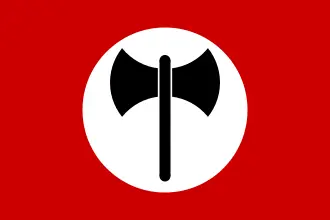
Nazi-Maoism is a small Italian, then European, current of the late 1960s and 1970s that tried to fuse far-right racial and elitist ideas with Maoist people's war and an anti-bourgeois, anti-Western stance. Its theorist Franco Freda sought a 'fascist dictatorship of the proletariat' that would destroy the bourgeois liberal system, abolish private property, and rebuild a totalitarian, hierarchical state under a philosopher-elite.
What it stands for
- A workers' state must suppress the old ruling class for a time.
- Every part of life should be subject to state direction.
- A minority group is working in secret to harm the nation.
- The law may treat people differently according to such things as birth, sex, race and status.
- Farming should be organized as joint cultivation by groups of farmers instead of separate individual farm operations.
- The government should stop its political opponents from organising, speaking or competing for power.
Key figures
- Franco Freda: Italian publisher and theorist whose writings were the group's main theoretical source.
Closest ideologies
- Volksgemeinschaft (87% match)
- Völkisch movement (84% match)
- Falangism (83% match)
- Technocracy movement (82% match)
- Ethnocacerism (82% match)
People closest to it
- Wilhelm Frick (85% alike)
- Idi Amin (84% alike)
- Reza Shah (82% alike)
- Jean-Jacques Dessalines (81% alike)
- Ibrahim Traoré (81% alike)
Key positions
- Strongly: A workers' state must suppress the old ruling class for a time.
- Strongly: Every part of life should be subject to state direction.
- Strongly: A minority group is working in secret to harm the nation.
- Strongly: The law may treat people differently according to such things as birth, sex, race and status.
- Strongly: Farming should be organized as joint cultivation by groups of farmers instead of separate individual farm operations.
- Strongly: The government should stop its political opponents from organising, speaking or competing for power.
- Strongly: War develops virtues in a nation, such as courage and discipline.
- Strongly: Members of every racial group should organise politically around interests specific to their group.
- Strongly: Political change should replace the existing administrative and coercive institutions with new forms of organization, rather than put new leaders in charge of the old apparatus.
- Strongly: Consent of the governed is not the only basis of legitimate political authority.
- Strongly: Some people are better suited by nature to govern.
- Strongly: Rulers are not bound to act only under lasting, publicly known laws administered by recognised courts.
- Strongly: People do not need a direct role in making decisions where they work, live and study.
- Strongly: The head of state should not have to be chosen by election.
- Strongly: People seeking political change should act directly—for example, with strikes, boycotts or occupations—instead of pursuing change through elections and parliaments.
- Strongly: The government may spend public money without first getting its budget approved by an elected legislature.
- Strongly: Unused arbitrary power over a person does not itself reduce that person's freedom.
- Strongly: No moral truths hold across all cultures.
- Strongly: Workers' solidarity with their own nation should take priority over solidarity with workers across borders.
- Strongly: Countries within one civilization should unite politically.
- Strongly: Dividing politics into left and right no longer makes sense.
- Strongly: Having a human nature in common is not what gives people their rights.
- Strongly: Society may deal with racial discrimination as it arises today without programs aimed at past wrongs.
- Strongly: Democracy is not the best form of government when voters choose badly.
- Strongly: Collective goals can justify treating a person merely as a tool.
- Strongly: People do not have full ownership of their own bodies.
- Strongly: Governments should sometimes withhold the records explaining their decisions.
- Strongly: Political power may be concentrated in one body.
- Strongly: Property need not be spread among many small owners.
- Strongly: Environmental agencies should still regulate pollution, not leave it to compensation lawsuits for proven damage.
- Strongly: Trade unions may be subject to state direction of their affairs.
- Strongly: Government should not be bound by a written bill of rights protected against easy amendment by ordinary majorities.
- Strongly: Council homes may stay in public hands without tenants having a right to buy them.
- Strongly: A general collapse of capitalism is unavoidable.
- Strongly: The nation has decayed and must be reborn.
- Strongly: Communist one-party states should not receive the same condemnation as fascist states.
- Strongly: Industries such as energy, rail and utilities should be owned by the state or public bodies, not private companies.
- Strongly: Countries that feel dominated by Western powers should band together to resist them.
- Strongly: Whether a policy fits an ideology should count independently of its results.
- Strongly: The economy should not combine mainly private markets with government support for people who cannot meet their basic needs.
- Strongly: What you owe your community matters more than your personal rights.
- Strongly: The government should steer investment into industries it sees as key to the country's future.
- Strongly: Tackling oppression does not require a combined approach to its overlapping forms, such as racism, sexism and class oppression.
- Strongly: A state of their own in the Land of Israel is not something Jews are owed as a people.
- Strongly: A democratic constitution need not be founded on an explicit rejection of fascism.
- Strongly: Political freedom can last without economic freedom.
- Strongly: Society may be changed in large, rapid steps.
- Strongly: Another body may have the final say over what the legislature passes.
- Strongly: Elected representatives may serve out their terms without voters being able to remove them early.
- Strongly: Some cultures are superior to others.
- Strongly: Owners' rights to their property need not be protected against being overridden for public goals.
- Strongly: The head of state should not be elected directly by the voters.
- Strongly: Officials decide what gets made and who gets it at least as well as prices and competition do.
- Strongly: It is not true that communities should be free to choose their own economic arrangements with no fixed blueprint for a free society's economy.
- Strongly: The people who own the economy and hold power are not the ones the state mainly serves.
- Strongly: A country may keep all its decisions in its own hands rather than pooling them with other nations.
- Strongly: Private charity does not help people in poverty better than government programs do.
- Strongly: It is legitimate to take pride in the racial group one belongs to.
- Strongly: Society need not promote ways of living that differ from custom.
- Strongly: The state may restrict what adults do for reasons other than preventing harm to others.
- Strongly: Local communities should not tie their joint councils to merely carrying out what local assemblies decide.
- Strongly: Most people in political office look after themselves first and the public second.
- Strongly: Land does not belong to whoever first puts it to use.
- Strongly: Private ownership is legitimate only insofar as it benefits society.
- Strongly: Member states should keep the final decision on whether to follow UN decisions.
- Strongly: Foreign armies should not be based on the country's territory.
- Strongly: Unequal results between racial groups do not by themselves make a policy discriminatory.
- Strongly: Political violence is sometimes justified.
- Strongly: A national development strategy should not accept some regions growing wealthy ahead of the rest.
- Strongly: A people's connection to its ancestral land is spiritual, beyond practical interests or ordinary affection.
- Strongly: Elected governments need not leave monetary policy to central banks acting on their own.
- Strongly: State pensions funded by current workers' contributions should stay in place rather than be replaced by privately managed individual accounts.
- Strongly: Groups have rights of their own.
- Strongly: Citizens should not be permitted to choose someone else to cast their votes in a policy area, with separate choices for different areas.
- Strongly: A government needs more than fair elections to be democratic.
- Strongly: Being the first to use force can be right, depending on what it is meant to achieve.
- Strongly: Laws should not be required to follow religious texts.
- Strongly: Local community ownership of the means of production should not replace private or state ownership.
- Strongly: Looking after your own interests is not a moral good in itself.
- Strongly: At least some revolutions have been justified.
- Strongly: Private owners' choice of whom they deal with should be subject to some restrictions.
- Strongly: The vote keeps a government in check at least as well as being able to leave the country does.
- Strongly: Public offices may be filled by methods other than drawing lots.
- Strongly: Society needs government of some kind.
- Strongly: Countries should keep their armed forces.
- Strongly: Government should have other tasks besides protecting people from physical violence.
- Strongly: Voters of different religious communities may all vote in the same elections.
- Strongly: Killing another person can be right in self-defence or in defence of others.
- Strongly: Taking part in politics is at least as good a way to live as living privately away from public affairs.
- Strongly: People without property should also have the right to vote.
- Strongly: Courts need not be handed over to private businesses.
- Strongly: Final authority over a state's laws need not belong to its most senior religious scholars.
- Strongly: Humanity would gain nothing by going back to living off hunting and gathering.
- Leans: Only members of one racial or ethnic group should have the right to vote.
- Leans: Public policy, such as sterilization or incentives, should reduce the passing on of inherited disabilities.
- Leans: The ruler should not be bound by the country's laws, including those made by that ruler and by earlier ones.
- Leans: A state may force a minority it sees as hostile to leave the country.
- Leans: The people in power should decide what the country's news media publish.
- Leans: An armed minority's actions are capable of bringing about conditions that enable a broader revolutionary uprising.
- Leans: Common ownership of production need not leave personal belongings private.
- Leans: Behind their different forms, the great religions point to one shared truth.
- Leans: History is mainly driven by conflict between economic classes.
- Leans: A nation should be mainly one ethnic people.
- Leans: Specialists should have more weight in decisions than public opinion.
- Leans: At its core, politics is a struggle between spiritual good and evil.
- Leans: A society holds together less well when its members belong to different ethnic groups.
- Leans: Government should depend more on leaders setting a good example than on enforcing laws with penalties.
- Leans: Cooperation between employers and workers should not come before conflict where their interests differ.
- Leans: A free, fair society can be reached through methods that fall short of being free and fair.
- Leans: The country would benefit from a strong leader with the power to act despite deadlock among its political institutions.
- Leans: A national emergency sometimes justifies temporarily withdrawing normal legal safeguards against people the government regards as internal enemies, such as protections against detention without trial.
- Leans: A country should not tie itself to other countries through lasting military alliances.
- Leans: A society can be socialist without the working class itself holding political power.
- Leans: Religious values and institutions should not have a major part in shaping laws, schools and public life.
- Leans: Settlers from abroad who displace a land's people and found a state there are carrying out colonialism.
- Leans: Prisons should focus at least as much on punishment as on rehabilitation.
- Leans: Businesses need not belong to the people who work in them.
- Leans: Workers should not have democratic voting rights in the management of large companies.
- Leans: Society should follow a third course beyond capitalism and communism.
- Leans: When national priorities conflict with working together internationally, my country should choose its own priorities.
- Leans: Museums, libraries and other inherited culture should not be destroyed, even when they stand in the way of new creation.
- Leans: Marriage, inheritance and family law should be the same for everyone, not set by each religious community.
- Leans: A head of state may take a side in party politics.
- Leans: Major laws should not be decided by direct votes of citizens.
- Leans: A constitution does not have to be drafted by an assembly elected for that purpose.
- Leans: The state should stop foreign buyers from taking over key national businesses.
- Leans: Seats may be allocated in ways that do not follow parties' shares of the vote closely.
- Leans: Religious minorities should not be exempt from general laws that burden their practice.
- Leans: A national church need not be ruled by its bishops.
- Leans: Whether a distribution of wealth is just does not depend only on how it came about.
- Leans: Renting out housing should be permitted in at least some circumstances.
- Leans: The best constitution does not combine rule by the few with rule by the many.
- Leans: People who give their lives for the nation deserve to be remembered as martyrs, with reverence beyond ordinary thanks.
- Leans: The nation's cause and the cause of its ordinary working people are one and the same.
- Leans: People may live and work outside communities that own their property together.
- Leans: Constantly seeking additional possessions is harmful overall, despite any benefits it brings.
- Leans: In the long run people should still produce and share using money.
- Leans: Lasting socialism in one country does not require socialist revolutions abroad.
- Leans: Equality of outcomes should not be society's goal.
- Leans: Central banks should keep a role in controlling the money supply.
- Leans: Public school science classes may teach evolution on its own.
- Leans: Small, informal, trust-based groups should not take the place of lasting parties, unions and federations in political action.
- Leans: World power should be distributed among several independent major powers, without one dominant power.
- Leans: Political power may rest on something other than workplace-elected councils.
- Leans: Income from useful work should be rewarded ahead of income from merely owning property.
- Leans: Belonging to the nation does not go with sharing its religion.