Political Ideology Atlas · All ideologies · Take the test
Civilizing mission
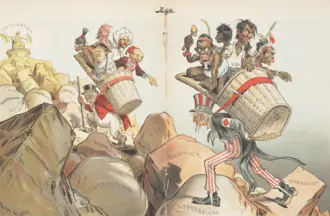
The civilizing mission holds that more advanced societies, above all those of Europe and later the United States, have a duty to rule and uplift less advanced peoples by spreading their education, law, religion, trade and technology. Rule is justified as temporary tutelage for the subjects' improvement, often alongside an explicit hierarchy of races or civilizations. Its two models are assimilation, remaking others in the colonizer's image, and a paternal protection of native society.
What it stands for
- Temporary rule by a more developed society is justified when it helps the ruled to progress.
- Spreading our political system abroad should be a special calling of our nation.
- A powerful country should bring more land within its borders.
- Colonial-era treaties still bind today, including ones that divided a people without asking them.
- A free, fair society can be reached through methods that fall short of being free and fair.
- Land that a state declares its own against its people's will is not illegally occupied by that state.
Key figures
- Jules Ferry: French premier who defended colonial expansion as the duty of superior races
- Rudyard Kipling: Author of 'The White Man's Burden', the best-known British expression of the idea
- John Stuart Mill: Liberal philosopher who defended tutelary rule over 'backward' societies
Closest ideologies
- Anglo-Saxonism (88% match)
- Cameralism (86% match)
- Authoritarian Capitalism (85% match)
- Enlightened absolutism (85% match)
- Bonapartism (84% match)
People closest to it
- Benjamin Netanyahu (87% alike)
- Alexander Hamilton (86% alike)
- Lindsey Graham (86% alike)
- Toussaint Louverture (85% alike)
- Kuan Yew Lee (85% alike)
Key positions
- Strongly: Temporary rule by a more developed society is justified when it helps the ruled to progress.
- Strongly: Spreading our political system abroad should be a special calling of our nation.
- Strongly: A powerful country should bring more land within its borders.
- Strongly: Colonial-era treaties still bind today, including ones that divided a people without asking them.
- Strongly: A free, fair society can be reached through methods that fall short of being free and fair.
- Strongly: Land that a state declares its own against its people's will is not illegally occupied by that state.
- Strongly: Decisions about indigenous peoples' traditional lands may rest with the wider state, not with those peoples.
- Strongly: Countries that feel dominated by Western powers may handle their relations with them separately.
- Strongly: Transfers of wealth to richer countries do not explain poor countries' continuing poverty.
- Strongly: Foreign powers sometimes have a right to intervene in a country's internal affairs.
- Strongly: Cultural life inside a state should not be placed under the control of each national minority.
- Strongly: Armed forces may sometimes be used for purposes beyond defending the country against attack.
- Strongly: Some knowledge is neutral.
- Strongly: Countries that had colonies should not have to compensate the countries they colonized.
- Strongly: Some cultures are superior to others.
- Strongly: Racial categories are not merely social constructs without a scientific basis.
- Strongly: Profit made from owning businesses does not come from exploiting the workers who produce it.
- Strongly: Capitalism does not inevitably cause wars between great powers.
- Strongly: The people who own the economy and hold power are not the ones the state mainly serves.
- Strongly: Other forces move history at least as much as conflict between classes does.
- Strongly: Unequal results between racial groups do not by themselves make a policy discriminatory.
- Strongly: Descendants of settlers need not be led politically by the country's original peoples.
- Strongly: Poor countries should retain economic ties with rich countries.
- Strongly: Being the first to use force can be right, depending on what it is meant to achieve.
- Strongly: An armed minority's actions are incapable of bringing about the conditions for a broader revolutionary uprising.
- Strongly: Lending money at interest should be legal.
- Strongly: Political power may rest on something other than workplace-elected councils.
- Strongly: There is no deliberate plan behind immigration aimed at replacing the native population.
- Strongly: In the long run people should still produce and share using money.
- Strongly: Some areas of life should remain outside state direction.
- Strongly: Some decisions should bind people who have not consented to them.
- Strongly: A workers' state does not need to suppress the old ruling class, even for a time.
- Strongly: Public offices may be filled by methods other than drawing lots.
- Strongly: Collecting taxes does not in itself amount to stealing people's money.
- Strongly: Renting out housing should be permitted in at least some circumstances.
- Strongly: Political authority need not rest on oaths of loyalty sworn to a lord.
- Strongly: People must be free to leave their religion without legal penalty.
- Strongly: Museums, libraries and other inherited culture should not be destroyed, even when they stand in the way of new creation.
- Strongly: Humanity would gain nothing by going back to living off hunting and gathering.
- Leans: Colonies should be run mainly to supply markets, materials and outlets for the ruling country.
- Leans: Only members of one racial or ethnic group should have the right to vote.
- Leans: Most of the average difference in ability between racial groups comes from genes.
- Leans: The law may treat people differently according to such things as birth, sex, race and status.
- Leans: Temporary limits on political freedom are justified to achieve rapid economic development.
- Leans: The government should stop its political opponents from organising, speaking or competing for power.
- Leans: Having a shared national identity does not by itself entitle a people to its own self-governing state.
- Leans: International economic rules should not be reshaped to favour developing countries.
- Leans: Consent of the governed is not the only basis of legitimate political authority.
- Leans: Some people are better suited by nature to govern.
- Leans: Political independence means a great deal even without economic transformation.
- Leans: Specialists should have more weight in decisions than public opinion.
- Leans: A former empire may keep a special relationship with its old territories.
- Leans: Prices and competition generally decide better than officials what gets made and who gets it.
- Leans: Government should depend more on leaders setting a good example than on enforcing laws with penalties.
- Leans: Civil servants should be recruited according to their performance in competitive examinations.
- Leans: Communist parties should not necessarily determine their strategies independently of foreign parties.
- Leans: The state should make one language the only common language of government, schooling and public life, limiting the use of others.
- Leans: Public institutions do not need to help minority languages be used in public life.
- Leans: Changes to society should be introduced a little at a time.
- Leans: Having a human nature in common is not what gives people their rights.
- Leans: A poor country should rely on foreign money at least as much as on its own resources.
- Leans: A state need not make a faded national language its official language again.
- Leans: Society may deal with racial discrimination as it arises today without programs aimed at past wrongs.
- Leans: Many political decisions should rest with national or wider authorities, even where a smaller community could handle them.
- Leans: Collective goals can justify treating a person merely as a tool.
- Leans: Science and technology will fix most of what goes wrong for people.
- Leans: My country's military strength should exceed that of its rivals.
- Leans: The nation does not need a radical rebirth to overcome decadence.
- Leans: Production should not be reorganised around what people need in place of what yields a profit.
- Leans: Living in a city does at least as much for a person's moral wellbeing as living in the countryside.
- Leans: Distance and nationality do not weaken the duty of the rich to help the poor abroad.
- Leans: Capitalism is not bound to suffer a general collapse.
- Leans: Rich people have an obligation to help those worse off than they are.
- Leans: Governments need not restrict how money and investment move across borders.
- Leans: A state founded by settlers who displaced the existing population need not be counted as a colonial project.
- Leans: When national priorities conflict with working together internationally, my country should choose its own priorities.
- Leans: Farmers should have the legal freedom to leave the estates they work.
- Leans: Past abuses by a state's security forces may be put behind it without anyone answering for them in court.
- Leans: Military intervention abroad is sometimes necessary to protect human rights.
- Leans: Large landed estates should not be compulsorily transferred to the people who farm them.
- Leans: Belonging to the nation ties a person's life to a sacred community that goes on after their death.
- Leans: What you owe your community matters more than your personal rights.
- Leans: Ideas of what men and women are like do not come mostly from culture.
- Leans: Final authority over a state's laws need not belong to its most senior religious scholars.
- Leans: Capitalist exchange does not make people's economic relationships look like relationships among the goods they trade.
- Leans: Courts need not be handed over to private businesses.
- Leans: Women may go out in public without any legal duty to cover fully.
- Leans: Public spaces such as schools and facilities should not be separated by race under the law.
- Leans: A region need not keep most of the tax money it raises for itself.
- Leans: The holder of the highest state office need not be treated as holy.
- Leans: A country can get through deadlock among its institutions without a leader who overrides them.
- Leans: University-educated people are not especially out of touch with the realities of ordinary life.
- Leans: Some things are right or wrong for everyone, in every culture and era.
- Leans: Defense should not rest with armed ordinary citizens in place of a standing force.
- Leans: How someone turns out is shaped more by upbringing, society and experience than by the traits they are born with.
- Leans: Direct action does not have to take the place of elections and parliament as the way to achieve political change.
- Leans: Employers and workers should treat each other as partners whose cooperation comes before conflict, even where their interests differ.
- Leans: Social duty should not take the place of material rewards as the main reason people work.
- Leans: Government should have other tasks besides protecting people from physical violence.
- Leans: The state should not be managed the way a well-run business is.
- Leans: The ruler should be subject to the country's laws.
- Leans: A country may keep a region that wants to leave.
- Leans: Schools should cultivate patriotic feeling: loyalty to and pride in the nation, expressed for example through respect for its flag and anthem.
- Leans: The law should not extend marriage to same-sex couples.
- Leans: Rulers must act under lasting, publicly known laws administered by recognised courts.
- Leans: A nation does not need one main ethnic group: it can be made up of people of many ancestries.
- Leans: Wages need not be set through negotiating bodies that the state officially recognizes.
- Leans: No state may force a minority out of the country, however hostile it judges that minority to be.
- Leans: Historical change does not come mainly from changes in how society produces and exchanges goods.
- Leans: Restoring a lost social order does not matter more than pursuing progress.
- Leans: Public school science classes may teach evolution on its own.
- Leans: Religious conversion should be free of legal restriction.
- Leans: The great religions need not share a single underlying truth.
- Leans: Politics should support people's spiritual well-being.
- Leans: Keeping a nation's inherited culture alive, including its language, customs and traditions, matters.
- Leans: At most half of workers in wealthy countries benefit from the exploitation of poorer countries.
- Leans: No party's ideology should give it an exclusive right to lead the state.
- Leans: News media should decide for themselves what they publish, whoever holds power.
- Leans: Soldiers and conscripts need not refuse to fight when their state goes to war.
- Leans: Looking after your own interests is not a moral good in itself.
- Leans: Religion does not offer illusory comfort for material suffering.
- Leans: Workers do not need a disciplined revolutionary party to lead them.
- Leans: Groups have rights of their own.